
Konomi Tea House

KONOMI Tea House is an established brand that decided to move to a new space and begin building its new story. Since the space on Židovská Street originally served as a hair salon, it could not be easily adapted. More significant spatial modifications were necessary along with the search for a suitable layout that would best cover the two basic functions - tea preparation and tea and tea ceramics sales. Thus, the space is not just a tea house, but also a shop.
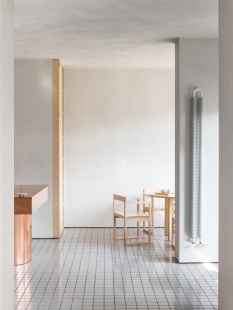
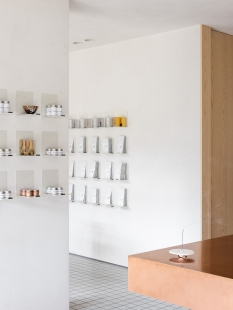
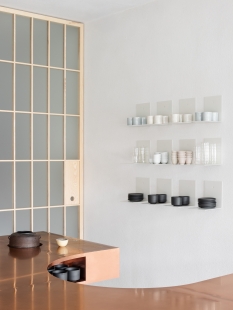
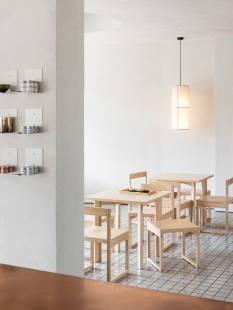
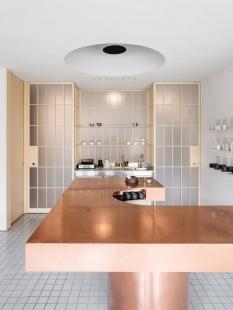
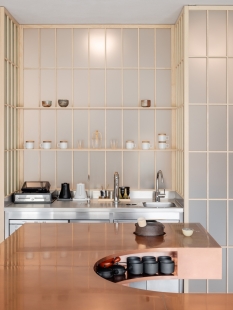
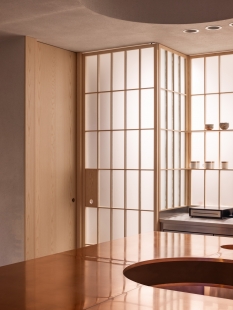
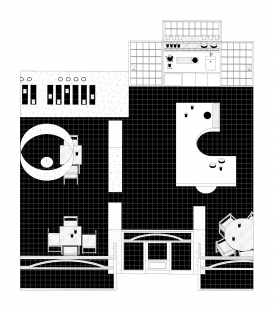
We created a simple, easily readable layout that respects the given conditions of the space (the positions of windows, light conditions...) and is based on symmetry and compositional axes. The area for customer seating faces the street, while the back room and social facilities are placed deeper into the layout. Sales areas flow to several places within the interior. The goal was not to concentrate them exclusively in one spot; on the contrary, they should be part of the experience. The form of the sales areas is either in the shape of light steel shelves or wooden shelves primarily intended for selling tea ceramics. Most elements draw from traditional Japanese craftsmanship elements, such as a semi-transparent partition wall strikingly resembling Japanese shoji. A fabric curtain - noren - hangs at the entrance door, indicating that the establishment is open.
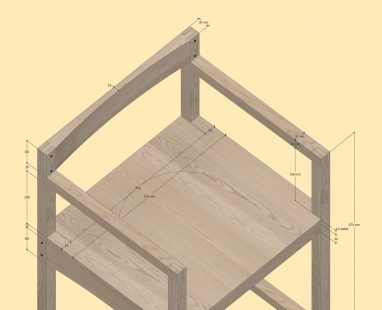
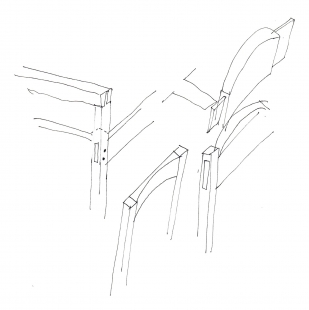
In some elements and details, our own shaping is readable, characterized by playfulness and softness of forms. From the circular openings in the ceiling to the soft shaping of the copper counter, to the small details of connecting and bending wooden elements of the furniture (connections with wooden round dowels, rounded backrests…). Since adding height to the space throughout was not possible due to technological constraints, the original height is noticeable in two circular "light wells" that partially reveal the original construction and material of the ceiling.
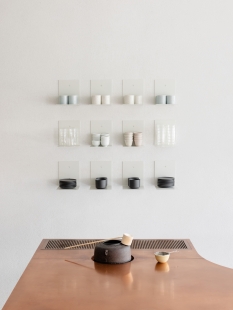
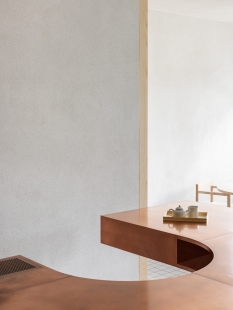
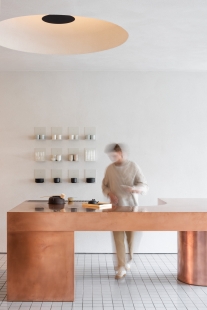
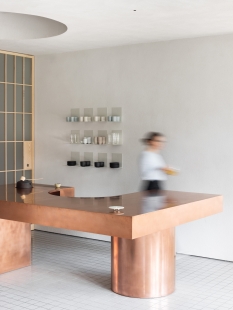
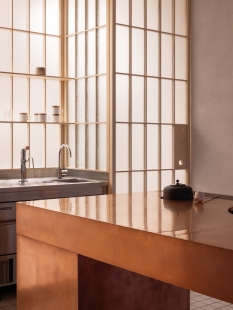
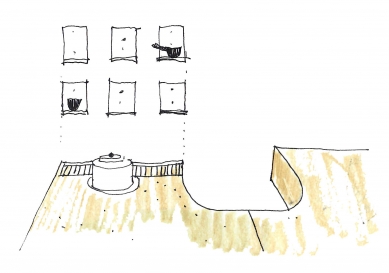
The heart of KONOMI Tea House is the copper counter, which, due to its material, shape, and position, is a dominant element of the interior. The middle section of the copper counter is cut into a semi-arch shape, allowing the tea master to serve comfortably. It also includes an integrated traditional kettle for heating water, which plays an important role in Japanese tea ceremonies.
Material Solution
Most of the materials used are directly related to personal experience and encounters on Japanese streets, traditional homes, etc. All the materials used "only" complement the copper counter and create a neutral backdrop for it. The floor features small-format terracotta tiles laid with wide joints. The flooring refers to classic Japanese street paving with small formats, enhancing the feeling of connection with the street and the exterior. The plaster on the walls has a natural character, a higher grain, and a readable craftsmanship execution. The wooden elements, with their fine structure, do not take prominence but support the softness of the interior. The dominant material is copper, characterized by its color, reflectivity, luster, and its ability to continually change over time. Copper holds an irreplaceable place in Japanese tea culture due to its antibacterial properties and resistance to corrosion. In combination with lighting, its color reflects onto the ceiling and walls, creating an extraordinary atmosphere. It is a living material whose use pays tribute to the traditional Japanese craft of working with copper.
Furniture
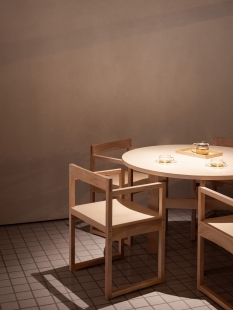
Completing the concept was also the design of furniture, which draws from Japanese minimalism and attention to detail. It was crafted with meticulous carpentry work in the village of Pravenec. Respect for traditions and craftsmanship in woodworking was also a goal in creating the interior of KONOMI Tea House.
Invisible Technologies
All technologies and technical devices have been thoroughly integrated to maintain the purity of the space. Air supply and exhaust are addressed through inconspicuous circular openings in the ceiling. A similar principle is applied to the air conditioning of the space. All gastro devices (steam lever, rinse...) are completely built into the kitchen area, or in the front bar, which serves as the support for the copper counter. Additionally, most ceiling lighting, except for the circular plates illuminating the "light wells." The primary lighting consists of a series of small-diameter spotlights that distribute light through an opening in the ceiling. All solutions, materials used, and details embody our vision of peace, harmony, and Japanese precision.
We created a simple, easily readable layout that respects the given conditions of the space (the positions of windows, light conditions...) and is based on symmetry and compositional axes. The area for customer seating faces the street, while the back room and social facilities are placed deeper into the layout. Sales areas flow to several places within the interior. The goal was not to concentrate them exclusively in one spot; on the contrary, they should be part of the experience. The form of the sales areas is either in the shape of light steel shelves or wooden shelves primarily intended for selling tea ceramics. Most elements draw from traditional Japanese craftsmanship elements, such as a semi-transparent partition wall strikingly resembling Japanese shoji. A fabric curtain - noren - hangs at the entrance door, indicating that the establishment is open.
In some elements and details, our own shaping is readable, characterized by playfulness and softness of forms. From the circular openings in the ceiling to the soft shaping of the copper counter, to the small details of connecting and bending wooden elements of the furniture (connections with wooden round dowels, rounded backrests…). Since adding height to the space throughout was not possible due to technological constraints, the original height is noticeable in two circular "light wells" that partially reveal the original construction and material of the ceiling.
The heart of KONOMI Tea House is the copper counter, which, due to its material, shape, and position, is a dominant element of the interior. The middle section of the copper counter is cut into a semi-arch shape, allowing the tea master to serve comfortably. It also includes an integrated traditional kettle for heating water, which plays an important role in Japanese tea ceremonies.
Material Solution
Most of the materials used are directly related to personal experience and encounters on Japanese streets, traditional homes, etc. All the materials used "only" complement the copper counter and create a neutral backdrop for it. The floor features small-format terracotta tiles laid with wide joints. The flooring refers to classic Japanese street paving with small formats, enhancing the feeling of connection with the street and the exterior. The plaster on the walls has a natural character, a higher grain, and a readable craftsmanship execution. The wooden elements, with their fine structure, do not take prominence but support the softness of the interior. The dominant material is copper, characterized by its color, reflectivity, luster, and its ability to continually change over time. Copper holds an irreplaceable place in Japanese tea culture due to its antibacterial properties and resistance to corrosion. In combination with lighting, its color reflects onto the ceiling and walls, creating an extraordinary atmosphere. It is a living material whose use pays tribute to the traditional Japanese craft of working with copper.
Furniture
Completing the concept was also the design of furniture, which draws from Japanese minimalism and attention to detail. It was crafted with meticulous carpentry work in the village of Pravenec. Respect for traditions and craftsmanship in woodworking was also a goal in creating the interior of KONOMI Tea House.
Invisible Technologies
All technologies and technical devices have been thoroughly integrated to maintain the purity of the space. Air supply and exhaust are addressed through inconspicuous circular openings in the ceiling. A similar principle is applied to the air conditioning of the space. All gastro devices (steam lever, rinse...) are completely built into the kitchen area, or in the front bar, which serves as the support for the copper counter. Additionally, most ceiling lighting, except for the circular plates illuminating the "light wells." The primary lighting consists of a series of small-diameter spotlights that distribute light through an opening in the ceiling. All solutions, materials used, and details embody our vision of peace, harmony, and Japanese precision.
MAPA architects
The English translation is powered by AI tool. Switch to Czech to view the original text source.

0 comments
add comment