Family House Hrabkov
Architect's house(s)

The work in which the architect is also his own client grants him unlimited creative freedom, but it also assigns him complete responsibility for the outcome. The design process is freed from the usual significant component—understanding the client and seeking a convergence of values. The work thus becomes a more intimate statement about values that are inherent to him. It inevitably becomes a tangible manifesto of the author’s ideals, but also an eternal snapshot of his current abilities. The design of his own dwelling was undoubtedly a beautiful task, but also a daunting challenge to create a structure that withstands the test of time. A work that aims to appropriately question established norms while simultaneously exceeding the necessary will not become the reason for phrases beginning with "if we were building today, then..".
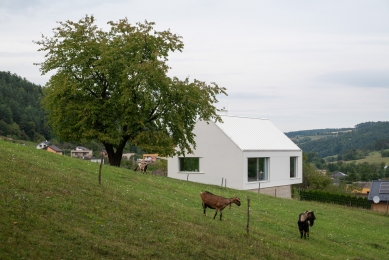
The story of the house began with an unexpected discovery of the plot, at which point everything became clear. After considerable effort, it seems we managed to transform potential into a place, into a fulfilled deep dream that we had not even fully dreamed of before. The romance of the countryside—haystacks, goats, and cows grazing on the horizons outside the windows, peace and nature within reach.
MAIN DESIGN PREMISES
Impressive location
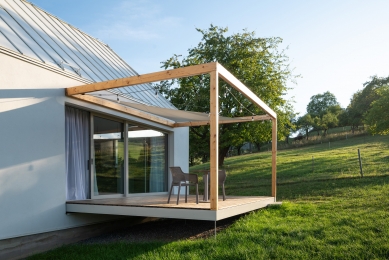
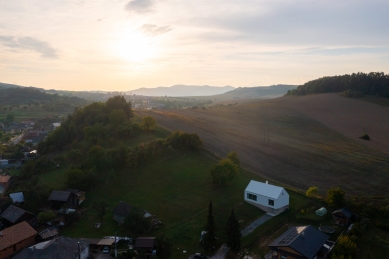
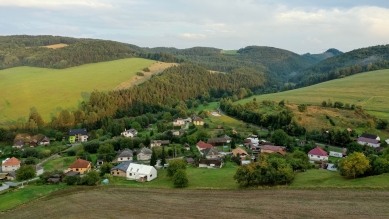
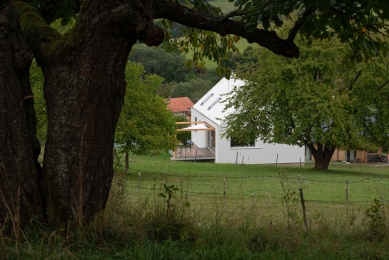
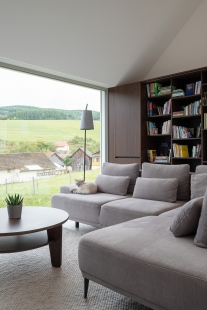
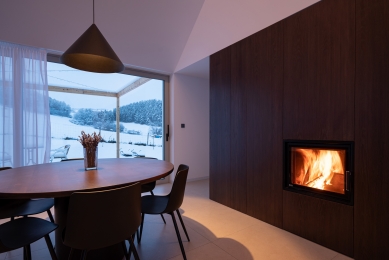
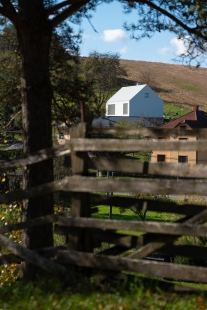
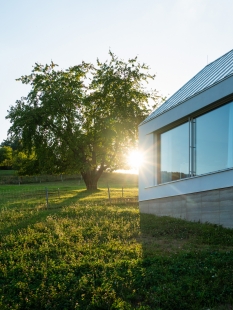
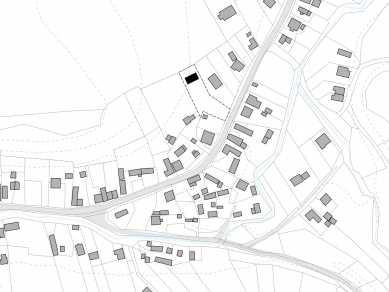
The genius loci, which can be sliced, and the unobstructed views were the main factors of the design, which did not strive to create a place but only to complement and not spoil it. The house arose according to the place and for the place. It accepts the surrounding landscape as its painting canvas, embraces the views as part of the interior space, and a constantly changing “decor”.
Natural approach to planting
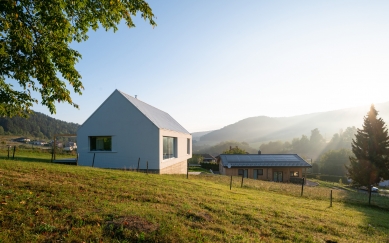
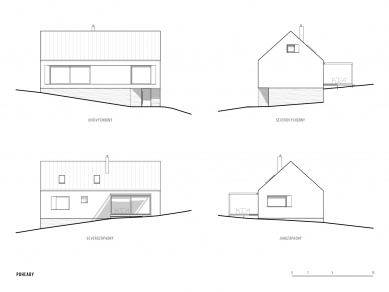
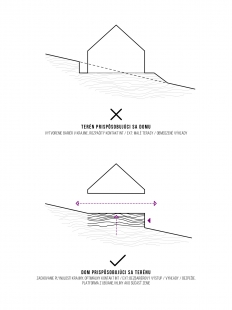
The house respects the fluid flow of the green “carpet” of the land. It willingly submits to the terrain, not the terrain violently to itself. The continuity of the land is not interrupted "behind our fence." The result is a natural integration into the landscape, rather than a segregation from it.
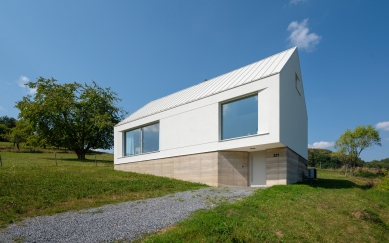
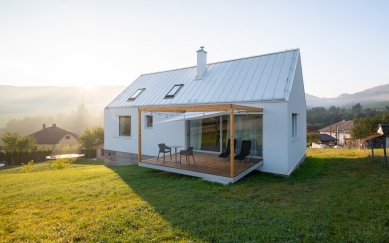
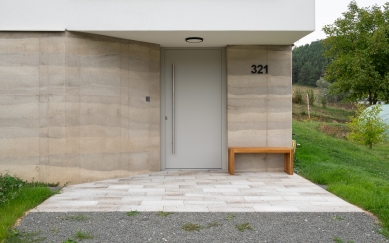
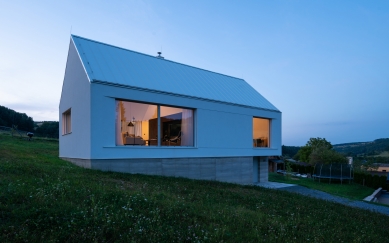
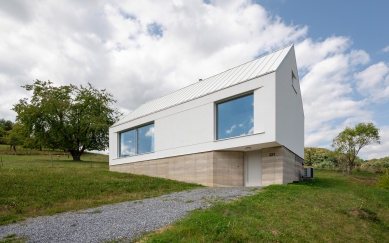
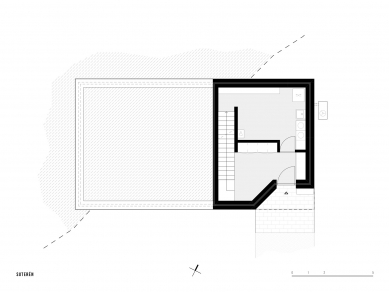
The archetypal mass of the house is positioned on an impregnable base of rammed earth in sloped terrain (CSRE). Elevated from the ground on a platform "from the earth".
Efficient layout and interior
Searching for a neat spatial configuration simultaneously with a precise interior design, which is an integral part of the house. Everything has its place; flexibility was not a priority.
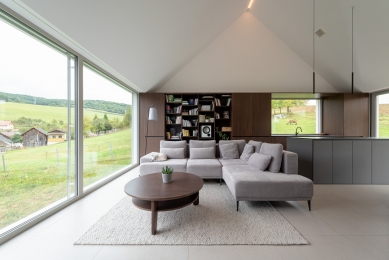
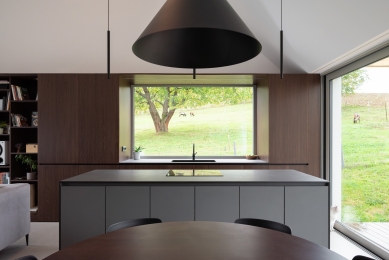
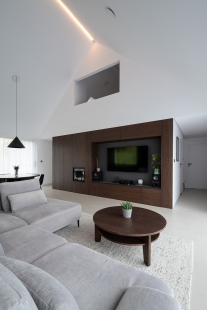
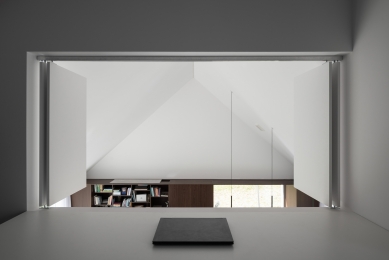
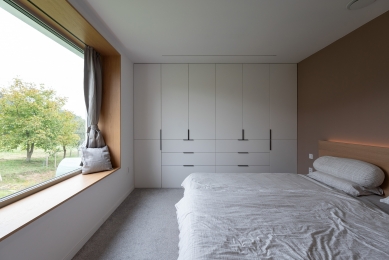
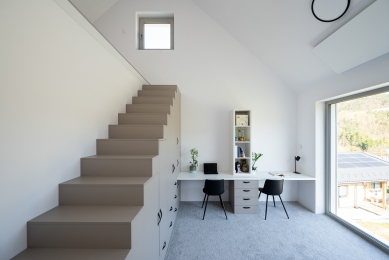
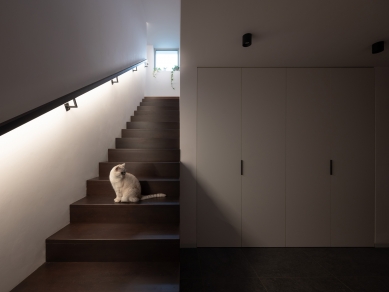
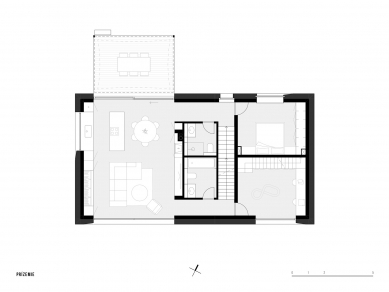
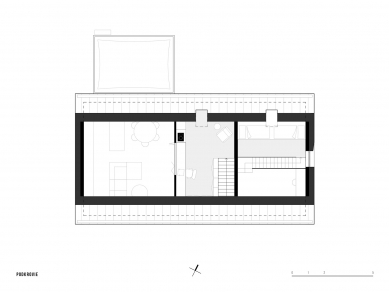
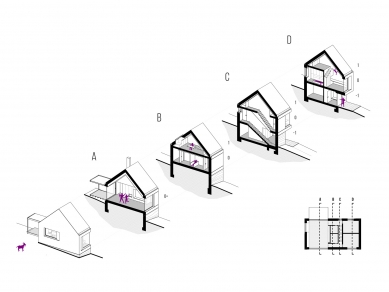
Minimalistic and functional interior design absorbed playfulness, such as a cat play structure hidden in the library and a toilet concealed under the stairs, a staircase wardrobe in the children's room, or a workspace in the attic with a view into the living room.
The goal was to maximize the use of the built volume and eliminate undefined, purposeless areas.
Spatial diversity
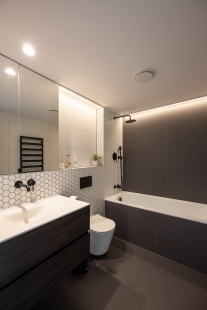
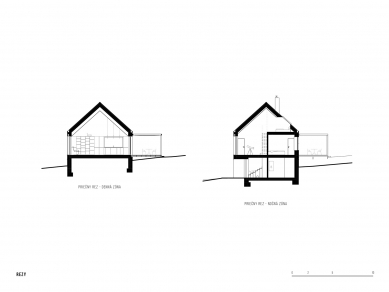
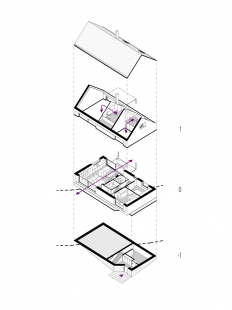
The house provides several different characters of space. It plays with different ceiling heights, levels, and targeted orientations towards views. The living zone is maximally open upwards and visually extended into the exterior, as two sides of the space are lined with glazing. It is also visually connected to the workspace in the attic. The children's room, on the other hand, is two-level, with a gallery above the parental bedroom. The hygienic block in the middle of the floor plan surrendered its height and light in favor of the others. The basement is deliberately dark, providing a sense of safety and concealment in the ground. The subsequent transition to the living area is all the more impactful due to the contrasts with what preceded. From the dark embrace upwards, towards the light, into the expansive landscape…
The language of minimalism in the service of context
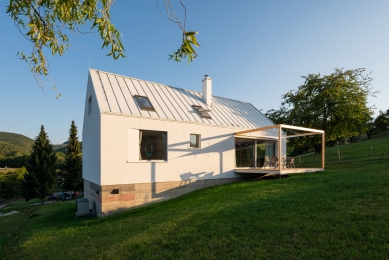
Clearly articulated mass with a balanced composition in harmony with elaborate details. The elongated floor plan of the house and the gabled roof of typical slope are features adapted from rural context, yet filtered through the lens of time. The austere architectural expression is the result of the search for balance between human intervention and natural landscape, between modern and traditionally rural. It also hopes for timelessness. The compactness, thanks to the unification of the roof and facades, becomes a uniformity. The white archetypal "little house" on a base "from the earth" stands as a sensitive sculpture in the landscape. A positive consequence of compactness is also a favorable thermal-technical aspect.
Quality and truthfulness
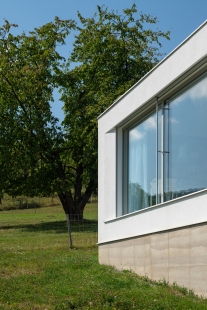
You cannot have everything, so choose what is essential and do it without compromises. The house could not be everything, at least a confrontation with financial reality reminded us of this, but it can be good at what it is. Restraint in the size of the house has benefited the quality of execution, material richness, and truthfulness. The house avoids imitations; wood is wood, earth is earth… The adventure of the honest execution of the solid base made of rammed earth (cement stabilized rammed earth) was a story in itself.
Well… and why is there that one red stripe? It is also part of the story and the creation of truthful materials… not everything turns out exactly as envisioned, but that authenticity is more than a "perfect fake." The thickness of layering and the amount of added iron oxide pigment did not quite succeed here, so it was not used in further segments.
BUILDING AND MATERIAL SOLUTION
The building is conceived as a bi-directional wall system. The load-bearing material for the external walls is sand-lime blocks, chosen for their high thermal mass. The external wall of the basement/base is a sandwich, with an outer layer made of rammed earth (CSRE). The basement ceiling is a monolithic reinforced concrete slab, while the ceilings above the ground floor are timber beam constructions. The building is founded on strip footings and covered with a wooden roof structure designed so that only small peak ties are needed, and the attic space remains maximally open. The openings are filled with aluminum doors and windows with insulating triple glass in a recessed installation. The plastered facade is insulated with graphite EPS. The sandwich wall in the basement utilizes PIR boards. The roof is insulated with mineral wool.
Technologically, the house is equipped with an air-to-water heat pump which is also used for cooling and forced ventilation with heat recovery.
The story of the house began with an unexpected discovery of the plot, at which point everything became clear. After considerable effort, it seems we managed to transform potential into a place, into a fulfilled deep dream that we had not even fully dreamed of before. The romance of the countryside—haystacks, goats, and cows grazing on the horizons outside the windows, peace and nature within reach.
MAIN DESIGN PREMISES
Impressive location
The genius loci, which can be sliced, and the unobstructed views were the main factors of the design, which did not strive to create a place but only to complement and not spoil it. The house arose according to the place and for the place. It accepts the surrounding landscape as its painting canvas, embraces the views as part of the interior space, and a constantly changing “decor”.
Natural approach to planting
The house respects the fluid flow of the green “carpet” of the land. It willingly submits to the terrain, not the terrain violently to itself. The continuity of the land is not interrupted "behind our fence." The result is a natural integration into the landscape, rather than a segregation from it.
The archetypal mass of the house is positioned on an impregnable base of rammed earth in sloped terrain (CSRE). Elevated from the ground on a platform "from the earth".
Efficient layout and interior
Searching for a neat spatial configuration simultaneously with a precise interior design, which is an integral part of the house. Everything has its place; flexibility was not a priority.
Minimalistic and functional interior design absorbed playfulness, such as a cat play structure hidden in the library and a toilet concealed under the stairs, a staircase wardrobe in the children's room, or a workspace in the attic with a view into the living room.
The goal was to maximize the use of the built volume and eliminate undefined, purposeless areas.
Spatial diversity
The house provides several different characters of space. It plays with different ceiling heights, levels, and targeted orientations towards views. The living zone is maximally open upwards and visually extended into the exterior, as two sides of the space are lined with glazing. It is also visually connected to the workspace in the attic. The children's room, on the other hand, is two-level, with a gallery above the parental bedroom. The hygienic block in the middle of the floor plan surrendered its height and light in favor of the others. The basement is deliberately dark, providing a sense of safety and concealment in the ground. The subsequent transition to the living area is all the more impactful due to the contrasts with what preceded. From the dark embrace upwards, towards the light, into the expansive landscape…
The language of minimalism in the service of context
Clearly articulated mass with a balanced composition in harmony with elaborate details. The elongated floor plan of the house and the gabled roof of typical slope are features adapted from rural context, yet filtered through the lens of time. The austere architectural expression is the result of the search for balance between human intervention and natural landscape, between modern and traditionally rural. It also hopes for timelessness. The compactness, thanks to the unification of the roof and facades, becomes a uniformity. The white archetypal "little house" on a base "from the earth" stands as a sensitive sculpture in the landscape. A positive consequence of compactness is also a favorable thermal-technical aspect.
Quality and truthfulness
You cannot have everything, so choose what is essential and do it without compromises. The house could not be everything, at least a confrontation with financial reality reminded us of this, but it can be good at what it is. Restraint in the size of the house has benefited the quality of execution, material richness, and truthfulness. The house avoids imitations; wood is wood, earth is earth… The adventure of the honest execution of the solid base made of rammed earth (cement stabilized rammed earth) was a story in itself.
Well… and why is there that one red stripe? It is also part of the story and the creation of truthful materials… not everything turns out exactly as envisioned, but that authenticity is more than a "perfect fake." The thickness of layering and the amount of added iron oxide pigment did not quite succeed here, so it was not used in further segments.
BUILDING AND MATERIAL SOLUTION
The building is conceived as a bi-directional wall system. The load-bearing material for the external walls is sand-lime blocks, chosen for their high thermal mass. The external wall of the basement/base is a sandwich, with an outer layer made of rammed earth (CSRE). The basement ceiling is a monolithic reinforced concrete slab, while the ceilings above the ground floor are timber beam constructions. The building is founded on strip footings and covered with a wooden roof structure designed so that only small peak ties are needed, and the attic space remains maximally open. The openings are filled with aluminum doors and windows with insulating triple glass in a recessed installation. The plastered facade is insulated with graphite EPS. The sandwich wall in the basement utilizes PIR boards. The roof is insulated with mineral wool.
Technologically, the house is equipped with an air-to-water heat pump which is also used for cooling and forced ventilation with heat recovery.
Lukáš Ildža
The English translation is powered by AI tool. Switch to Czech to view the original text source.






1 comment
add comment
Subject
Author
Date
Konieczny to má lepší
Lenka
29.04.26 09:36
show all comments