
Villa in Pardubičky

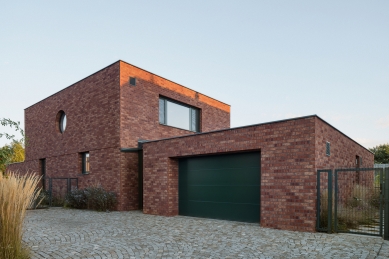
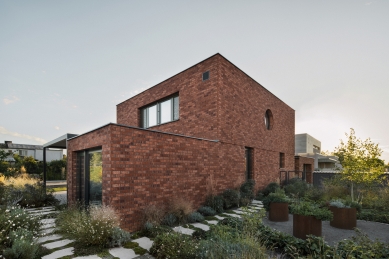
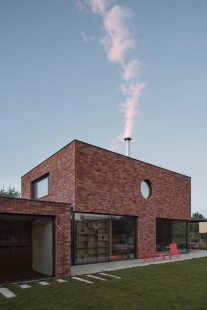
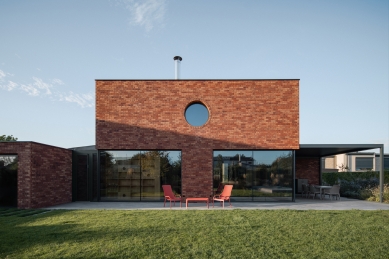
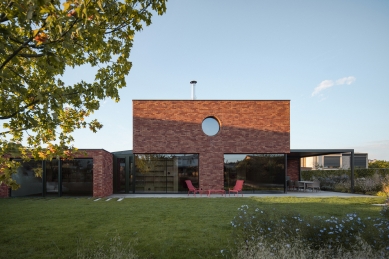
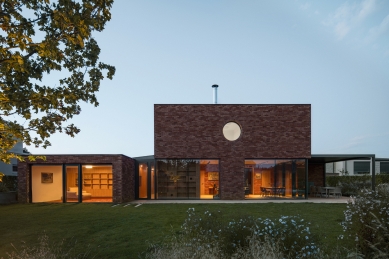
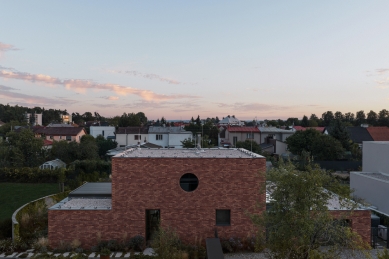
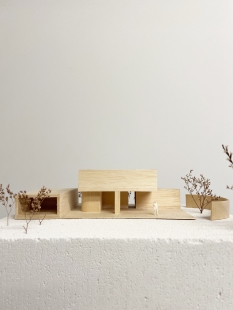
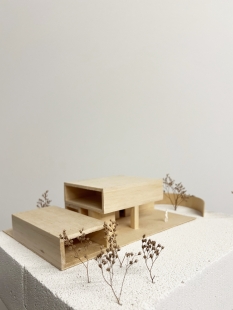
In the area of Pardubičky, which is undergoing gradual development and does not yet have a stable identity, a family house with an area of 232 m² has been created. The plot was originally part of a gardening colony, whose loose improvised structure has influenced the design: the house is a composition of several smaller volumes and interstitial spaces assembled into a single entity.
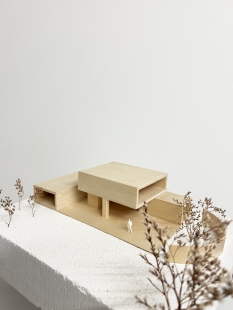
The clients approached us with a brief for a villa inspired by the Netherlands—not literally, but rather in atmosphere: a sense of coziness, compactness, and relationship to materials. We took this as a challenge. We decided to employ the motif of fragmentation: smaller masses arranged into a whole that reference the former small structure of garden buildings. A simple yet strong principle emerged: positive volumes, voids, and interspaces.
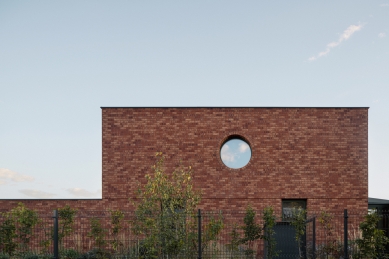
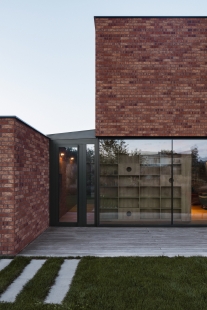
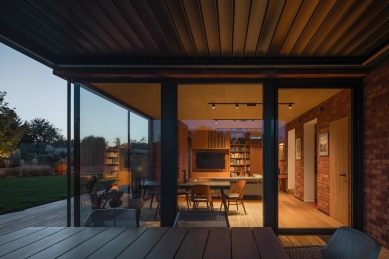
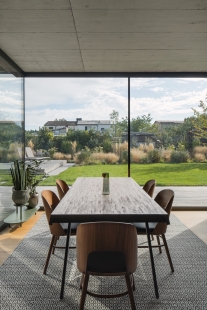
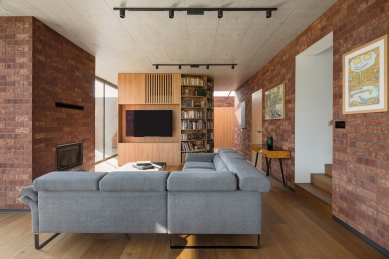
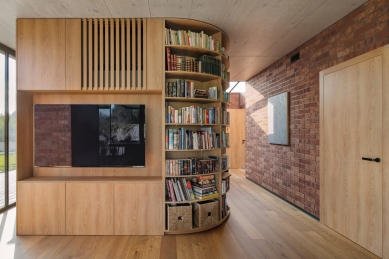
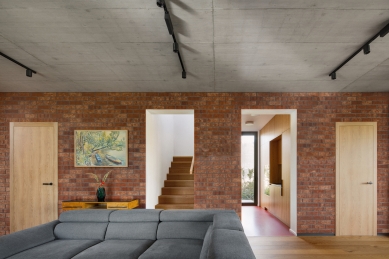
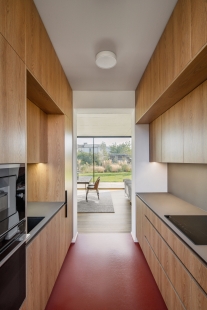
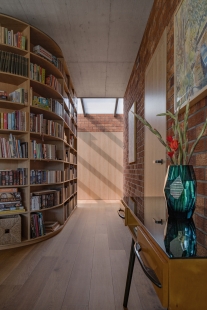
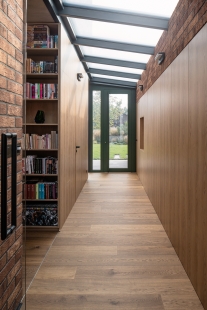
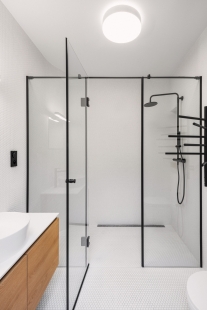
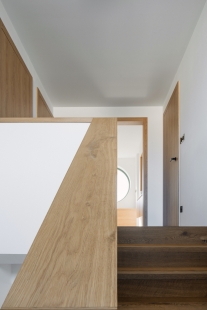
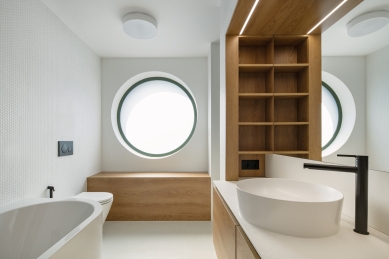
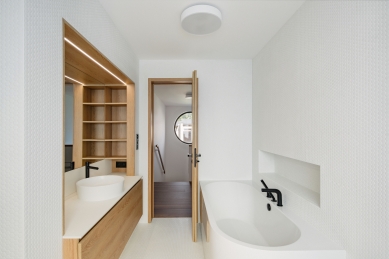
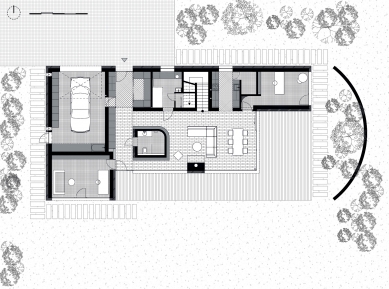
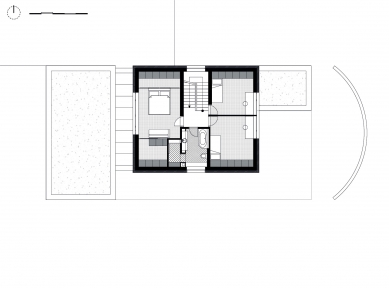
The house behaves differently towards the street and the garden. From the north, it is deliberately closed off, almost reserved, partly due to the nearby railway corridor. However, once a person passes through a narrow opening between the two masses, the house begins to open up. The first gesture is a hall with a skylight that emphasizes the space between the volumes and brings soft, changing light into the interior of the house. The living room naturally connects to the hall, formed as a "void" between the main masses of the house. A panoramic window opens the interior towards the garden and blurs the boundary between indoor and outdoor worlds. The room's centerpiece is the fireplace and the library with the television—fixed points around which everyday life revolves. The kitchen and staircase to the upper floor connect to the living area. The clients work from home. An important part of the brief was to have two studies on the ground floor, ideally with a private view of the garden. The brief also included the conscious "hiding" of the kitchen away from the main living space. Additionally, the ground floor houses a technical room and a bathroom concealed within the library wall. Upstairs, there are three bedrooms and the main bathroom.
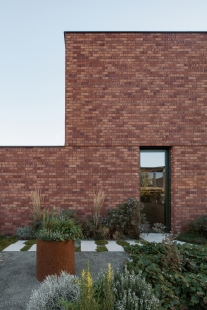
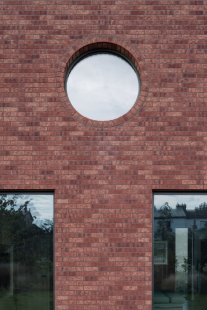
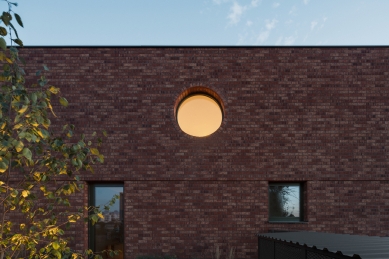
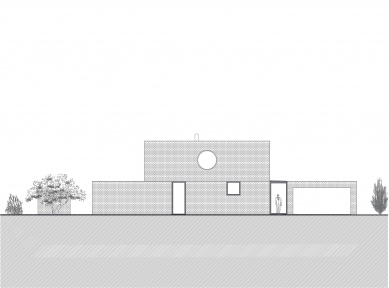
Material unity is ensured by the brick strip used on both the facades and in the interior. It allows for a seamless connection of the individual parts of the house and supports the intelligibility of the architectural concept.
An important component of the design is the work with movement and spatial arrangement: connections between rooms, sightlines, and natural guidance of the user through the house. The goal was to create a building that blends into its environment, does not stand out, and simultaneously contributes to the shaping of the identity of the emerging neighborhood.
The result is a house with a calm, comprehensible expression, based on a clear concept and spatial arrangement.
The clients approached us with a brief for a villa inspired by the Netherlands—not literally, but rather in atmosphere: a sense of coziness, compactness, and relationship to materials. We took this as a challenge. We decided to employ the motif of fragmentation: smaller masses arranged into a whole that reference the former small structure of garden buildings. A simple yet strong principle emerged: positive volumes, voids, and interspaces.
The house behaves differently towards the street and the garden. From the north, it is deliberately closed off, almost reserved, partly due to the nearby railway corridor. However, once a person passes through a narrow opening between the two masses, the house begins to open up. The first gesture is a hall with a skylight that emphasizes the space between the volumes and brings soft, changing light into the interior of the house. The living room naturally connects to the hall, formed as a "void" between the main masses of the house. A panoramic window opens the interior towards the garden and blurs the boundary between indoor and outdoor worlds. The room's centerpiece is the fireplace and the library with the television—fixed points around which everyday life revolves. The kitchen and staircase to the upper floor connect to the living area. The clients work from home. An important part of the brief was to have two studies on the ground floor, ideally with a private view of the garden. The brief also included the conscious "hiding" of the kitchen away from the main living space. Additionally, the ground floor houses a technical room and a bathroom concealed within the library wall. Upstairs, there are three bedrooms and the main bathroom.
Material unity is ensured by the brick strip used on both the facades and in the interior. It allows for a seamless connection of the individual parts of the house and supports the intelligibility of the architectural concept.
An important component of the design is the work with movement and spatial arrangement: connections between rooms, sightlines, and natural guidance of the user through the house. The goal was to create a building that blends into its environment, does not stand out, and simultaneously contributes to the shaping of the identity of the emerging neighborhood.
The result is a house with a calm, comprehensible expression, based on a clear concept and spatial arrangement.
The English translation is powered by AI tool. Switch to Czech to view the original text source.



0 comments
add comment