
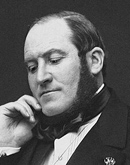
Georges-Eugène Haussmann
*27. 3. 1805 – Paris, France
†11. 1. 1891 – Paris, France
Biography
Baron Haussmann was a French urban planner responsible for the extensive rebuilding of Paris during the reign of Napoleon III. On his father's side, Haussmann was the grandson of a member of the revolutionary National Convention, and on his mother's side, the grandson of a Napoleonic general. He studied law in Paris and entered the civil service in 1831 as secretary-general of a prefecture. He gradually rose to become a subprefect (1832-48), a provincial prefect (1848-53), and finally prefect of the Seine department (1853-70). In this last position, he launched an extensive public works programme, setting a precedent for 20th-century urban planning. Haussmann cut broad, straight, tree-lined avenues through the chaotic maze of narrow streets that then made up Paris. In doing so, he linked railway stations and, for the first time, made it possible to move quickly and easily throughout the city. The purpose was partly economic—supporting industrialisation by enabling the efficient movement of goods and services; partly aesthetic—introducing a unified order and opening up space to let more light into the city; and partly military—eliminating narrow streets where insurgents could erect barricades. Haussmann also built new water supply and sewer systems, eliminating sources of unpleasant odours. Following the English model, he created urban parks in central Paris and increased the number of street lamps and pavements, giving rise to the kiosks and pavement cafés that enliven Parisian street life. His success was aided by the autocratic nature of Napoleon's regime, which allowed him to obtain enormous loans and spend them with almost no oversight. His handling of public finances drew growing criticism. After Émile Ollivier's liberal government came to power in 1870, he was dismissed from office.
Baron Haussmann was a French urban planner responsible for the extensive rebuilding of Paris during the reign of Napoleon III. On his father's side, Haussmann was the grandson of a member of the revolutionary National Convention, and on his mother's side, the grandson of a Napoleonic general. He studied law in Paris and entered the civil service in 1831 as secretary-general of a prefecture. He gradually rose to become a subprefect (1832-48), a provincial prefect (1848-53), and finally prefect of the Seine department (1853-70). In this last position, he launched an extensive public works programme, setting a precedent for 20th-century urban planning. Haussmann cut broad, straight, tree-lined avenues through the chaotic maze of narrow streets that then made up Paris. In doing so, he linked railway stations and, for the first time, made it possible to move quickly and easily throughout the city. The purpose was partly economic—supporting industrialisation by enabling the efficient movement of goods and services; partly aesthetic—introducing a unified order and opening up space to let more light into the city; and partly military—eliminating narrow streets where insurgents could erect barricades. Haussmann also built new water supply and sewer systems, eliminating sources of unpleasant odours. Following the English model, he created urban parks in central Paris and increased the number of street lamps and pavements, giving rise to the kiosks and pavement cafés that enliven Parisian street life. His success was aided by the autocratic nature of Napoleon's regime, which allowed him to obtain enormous loans and spend them with almost no oversight. His handling of public finances drew growing criticism. After Émile Ollivier's liberal government came to power in 1870, he was dismissed from office.
The English translation is powered by AI tool. Switch to Czech to view the original text source.