
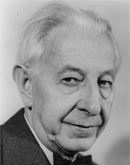
Thilo Schoder
*12. 2. 1888 – Weimar, Germany
†8. 7. 1979 – Kristiansand, Norway
Biography
Karl Wilhelm Thilo Schoder was originally a German architect who worked in Norway from 1932 (he obtained Norwegian citizenship in 1938). From 1906 to 1911, he studied under Belgian architect Henry van de Velde at the Grand Ducal Saxon School of Arts and Crafts in Weimar (now Bauhaus-Universität). During the period 1911-12, he stayed at the Vienna studio of Wiener Werkstätte Josef Hoffmann and then returned to Weimar, where he held the position of Velde's assistant. In 1914, he opened his own architectural practice in the Thuringian town of Gera. Schoder was an advocate of moderate modernism. He gained wider attention with his design of the Traugott Golde factory in Gera (1919), which was heavily influenced by Velde, and Stross's villa in Liberec (1925), where he drew inspiration from F.L. Wright. At the end of the 1920s, his smooth white forms moved closer to functionalist ideas. Schoder's reluctance to join the NSDAP and his modern approach to architecture led to financial and career problems. In 1932, he decided to relocate to Flekkefjord, from where his Norwegian wife, Bergljot Dahl, originated. After Hitler came to power in 1933, he applied for political asylum. After difficult years without a work permit, he established himself as an architect in Kristiansand in 1936, where he designed several private homes and public buildings. However, his architectural practice was interrupted by the Nazi occupation of Norway. During the occupation, he was forced to design military barracks for the occupying forces under the threat of deportation. After the war, he returned to his architectural practice, where the influence of Norwegian building traditions is evident.
Karl Wilhelm Thilo Schoder was originally a German architect who worked in Norway from 1932 (he obtained Norwegian citizenship in 1938). From 1906 to 1911, he studied under Belgian architect Henry van de Velde at the Grand Ducal Saxon School of Arts and Crafts in Weimar (now Bauhaus-Universität). During the period 1911-12, he stayed at the Vienna studio of Wiener Werkstätte Josef Hoffmann and then returned to Weimar, where he held the position of Velde's assistant. In 1914, he opened his own architectural practice in the Thuringian town of Gera. Schoder was an advocate of moderate modernism. He gained wider attention with his design of the Traugott Golde factory in Gera (1919), which was heavily influenced by Velde, and Stross's villa in Liberec (1925), where he drew inspiration from F.L. Wright. At the end of the 1920s, his smooth white forms moved closer to functionalist ideas. Schoder's reluctance to join the NSDAP and his modern approach to architecture led to financial and career problems. In 1932, he decided to relocate to Flekkefjord, from where his Norwegian wife, Bergljot Dahl, originated. After Hitler came to power in 1933, he applied for political asylum. After difficult years without a work permit, he established himself as an architect in Kristiansand in 1936, where he designed several private homes and public buildings. However, his architectural practice was interrupted by the Nazi occupation of Norway. During the occupation, he was forced to design military barracks for the occupying forces under the threat of deportation. After the war, he returned to his architectural practice, where the influence of Norwegian building traditions is evident.
The English translation is powered by AI tool. Switch to Czech to view the original text source.