
Apartment without walls

Removing almost all walls and doors from an apartment would be foolish, unacceptable, or simply absurd for most people. It would mean losing the ability to close off and cut oneself off from the surrounding world for at least a moment.
Work, sleep, food preparation, hygiene, or free time – these are the basic human activities for which separate spaces are traditionally designated in apartments. We adapt them so that these activities can take place as efficiently and comfortably as possible. Specific solutions stem from the characteristics of the human body, ergonomics, the need for light and fresh air, as well as individual personal preferences.
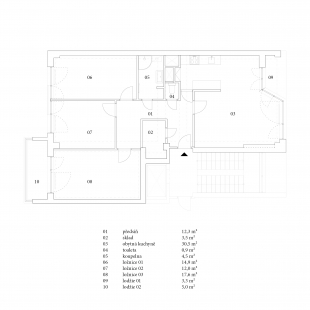
Apartments with a classic layout, where individual rooms connect to a central hallway like grapes, may not suit everyone. Fixed boundaries of spaces and clearly defined options for their use, lighting, or ventilation can be limiting for some. Such an apartment can seem cramped and unfree, regardless of the size of its floor area.
Removing some conservative rules opens up space for a new perspective on the arrangement and use of the apartment. Different levels of permeability to light, sound, or movement can be assigned to the individual solid elements of the interior. Changing these parameters allows for viewing the space from a new perspective – as an open, flexible, and free whole.
A Thin Line Between 1+kk and 4+kk
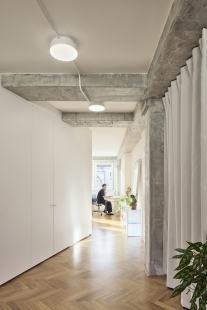
With the exception of the installation core and skylight, we have removed all solid partitions from the apartment's interior. The space has been restructured in a way that no longer requires traditional masonry walls or doors (except for the bathroom door).
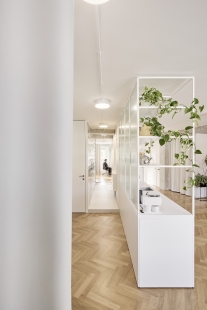
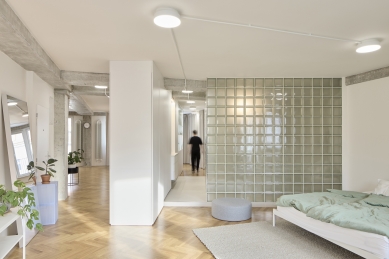
In the center of the layout, we placed a single compact furniture block. By slightly rotating it, we created individual functional zones of the apartment – as if it were a 4+kk. At the same time, a single continuous, fluid space is created – as if it were a 1+kk, which does not need rooms with clearly defined beginnings and ends for spatial hierarchy.
The basic building elements of the interior are built-in furniture, glass-concrete blocks, and curtains. Everything else consists of freely placed furnishings, accessories, and personal items. Time also plays an important role here. The apartment in this form responds to the current needs of its users, and individual solutions account for the possibility of future adjustments or changes.
Two Kitchens
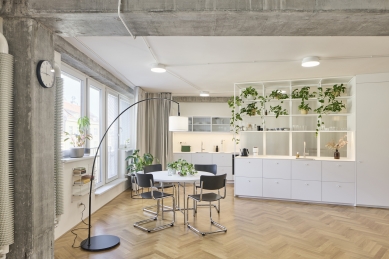
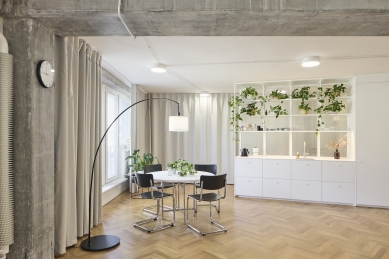
The apartment today contains two "kitchens." The first, located directly in the living space, functions more like a home café. It is not intended for cooking and can easily be adapted to another function that the apartment may need in the future.
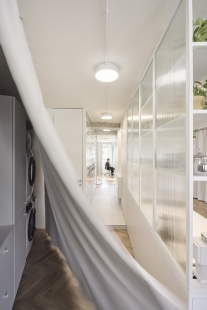
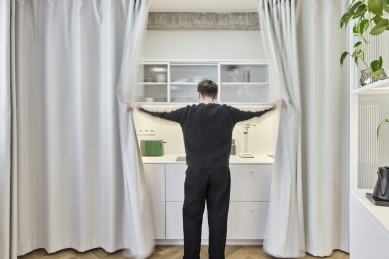
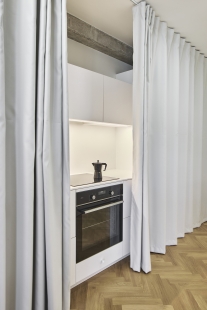
The second, fully equipped kitchen with all appliances, is located in the back part of the layout. Connecting to it is a freestanding washing machine with a dryer and a system of open shelves. This part is separated from the rest of the space by a curtain, which can be quickly moved aside, allowing it to be fully utilized according to current needs.
Hygienic Facilities
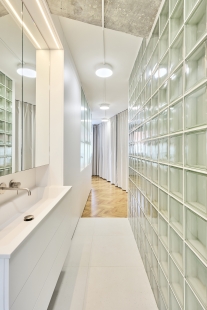
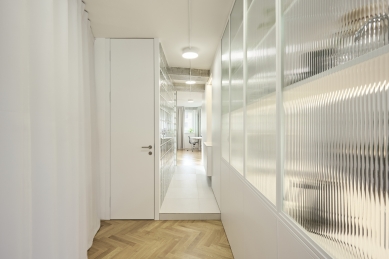
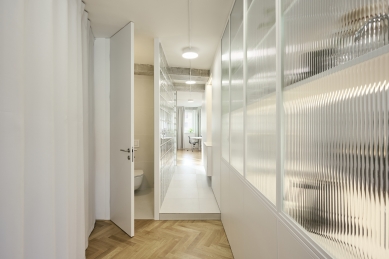
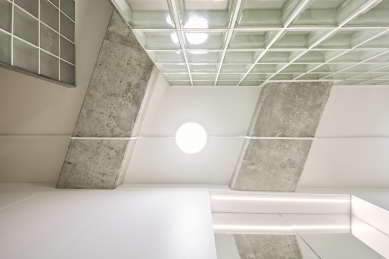
Behind the central furniture block is the hygienic background. The toilet, separated by an opaque – yet light-permeable – wall made of glass-concrete blocks, is the only room in the apartment with traditional doors.
The raised part of the floor behind the furniture assembly contains water and sewage connections for the sink and sink. Some bathroom functions are intentionally moved outside the closed shower area, allowing, for example, the sink to be used much more universally and not just for hygienic activities.
Materials and Atmosphere
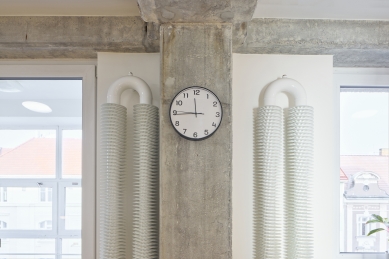
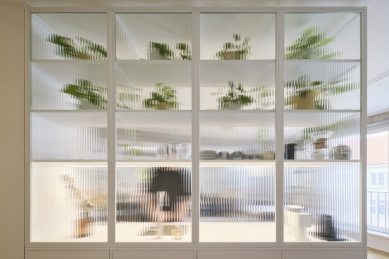
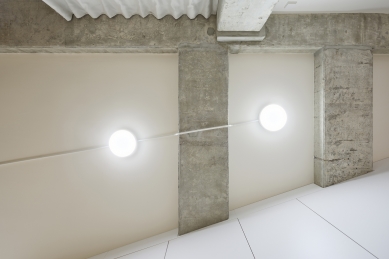
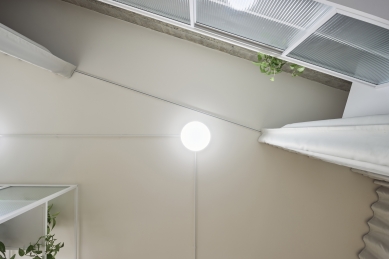
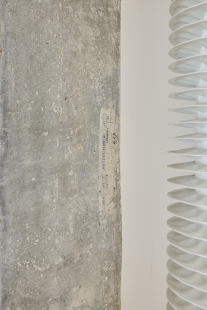
The visual character of the apartment is defined by several basic principles. First and foremost is the exposed concrete skeleton of the building, to which we have restored its natural materiality of raw concrete. Additionally, the exterior walls with plaster, flexible blackout curtains allowing for immediate light regulation and improving acoustic comfort, traditional oak parquet flooring, and light-permeable glass-concrete blocks separating the hygienic spaces.
The interior is complemented by white built-in furniture, several iconic pieces of freestanding furniture, houseplants, and personal items.
Light
The lighting installation is deliberately kept very simple. The entire apartment is connected to a single lighting circuit, with individual fixtures controlled digitally – either directly from the occupants' mobile phones or from a home tablet. Some fixtures are also paired with their own digital toggle switches located in typical places.
An Apartment in the City
The furnishings of the apartment also respond to the immediate accessibility of urban services. Grocery stores and other shops, restaurants and cafes, sports facilities, parks, cultural institutions, a large library, and a metro station with direct connections to the international airport are all within a ten-minute walking distance.
In practice, this means that the apartment only needs basic storage capacity for food and can afford to remain spatially generous and open.
Openness as a Decision
A higher degree of openness is a conscious and informed decision. However, the future may bring new priorities and needs. The layout solution therefore accommodates the possibility of easily realizable adjustments – exchanging some furnishing elements or adding further dividing elements if they prove necessary in the future.
Work, sleep, food preparation, hygiene, or free time – these are the basic human activities for which separate spaces are traditionally designated in apartments. We adapt them so that these activities can take place as efficiently and comfortably as possible. Specific solutions stem from the characteristics of the human body, ergonomics, the need for light and fresh air, as well as individual personal preferences.
Apartments with a classic layout, where individual rooms connect to a central hallway like grapes, may not suit everyone. Fixed boundaries of spaces and clearly defined options for their use, lighting, or ventilation can be limiting for some. Such an apartment can seem cramped and unfree, regardless of the size of its floor area.
Removing some conservative rules opens up space for a new perspective on the arrangement and use of the apartment. Different levels of permeability to light, sound, or movement can be assigned to the individual solid elements of the interior. Changing these parameters allows for viewing the space from a new perspective – as an open, flexible, and free whole.
A Thin Line Between 1+kk and 4+kk
With the exception of the installation core and skylight, we have removed all solid partitions from the apartment's interior. The space has been restructured in a way that no longer requires traditional masonry walls or doors (except for the bathroom door).
In the center of the layout, we placed a single compact furniture block. By slightly rotating it, we created individual functional zones of the apartment – as if it were a 4+kk. At the same time, a single continuous, fluid space is created – as if it were a 1+kk, which does not need rooms with clearly defined beginnings and ends for spatial hierarchy.
The basic building elements of the interior are built-in furniture, glass-concrete blocks, and curtains. Everything else consists of freely placed furnishings, accessories, and personal items. Time also plays an important role here. The apartment in this form responds to the current needs of its users, and individual solutions account for the possibility of future adjustments or changes.
Two Kitchens
The apartment today contains two "kitchens." The first, located directly in the living space, functions more like a home café. It is not intended for cooking and can easily be adapted to another function that the apartment may need in the future.
The second, fully equipped kitchen with all appliances, is located in the back part of the layout. Connecting to it is a freestanding washing machine with a dryer and a system of open shelves. This part is separated from the rest of the space by a curtain, which can be quickly moved aside, allowing it to be fully utilized according to current needs.
Hygienic Facilities
Behind the central furniture block is the hygienic background. The toilet, separated by an opaque – yet light-permeable – wall made of glass-concrete blocks, is the only room in the apartment with traditional doors.
The raised part of the floor behind the furniture assembly contains water and sewage connections for the sink and sink. Some bathroom functions are intentionally moved outside the closed shower area, allowing, for example, the sink to be used much more universally and not just for hygienic activities.
Materials and Atmosphere
The visual character of the apartment is defined by several basic principles. First and foremost is the exposed concrete skeleton of the building, to which we have restored its natural materiality of raw concrete. Additionally, the exterior walls with plaster, flexible blackout curtains allowing for immediate light regulation and improving acoustic comfort, traditional oak parquet flooring, and light-permeable glass-concrete blocks separating the hygienic spaces.
The interior is complemented by white built-in furniture, several iconic pieces of freestanding furniture, houseplants, and personal items.
Light
The lighting installation is deliberately kept very simple. The entire apartment is connected to a single lighting circuit, with individual fixtures controlled digitally – either directly from the occupants' mobile phones or from a home tablet. Some fixtures are also paired with their own digital toggle switches located in typical places.
An Apartment in the City
The furnishings of the apartment also respond to the immediate accessibility of urban services. Grocery stores and other shops, restaurants and cafes, sports facilities, parks, cultural institutions, a large library, and a metro station with direct connections to the international airport are all within a ten-minute walking distance.
In practice, this means that the apartment only needs basic storage capacity for food and can afford to remain spatially generous and open.
Openness as a Decision
A higher degree of openness is a conscious and informed decision. However, the future may bring new priorities and needs. The layout solution therefore accommodates the possibility of easily realizable adjustments – exchanging some furnishing elements or adding further dividing elements if they prove necessary in the future.
The English translation is powered by AI tool. Switch to Czech to view the original text source.





0 comments
add comment