
Senior home in Nový Bydžov

Sad and brick wall near the cemetery with a church, a historic town with a beautiful town hall. Tall trees. And then old age as a phenomenon – calm, silence, bricks as the archetype of home. The proximity of a hospital and a cemetery may invite bitter associations. Here, however, it is quality, an image of silence, concentration, a quiet edge of the city. The castle-like, symmetrical, almost neoclassical arrangement brings the home atriums, gardens, views, and plenty of light inside.
Across the street lies the cemetery with the church, beautiful brick buildings, the first objects seen when one arrives in the town. The silence and symbolic predestination of the place is slightly disturbed only by the road, which, however, brings the stirrings of life – not only cars but mothers with strollers, people walking dogs, and pedestrians hurrying to their duties. The cemetery and church are striking, symbolic, with huge trees and a magical atmosphere. The brick walls are long and low, while the church tower rises upward. The size of the land allowed for a ground-level, large footprint building, which is also accessible and negotiable. One might say with a bit of imagination – yes, this is where I would expect a home for the elderly.
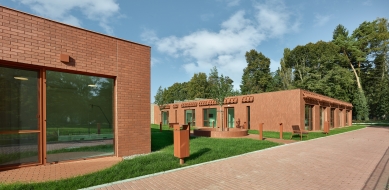
The surrounding landscape is flat, with forests and fields, between which long roads flow. It is visually beautiful, typical "Central Bohemian" with horizons crowned by silhouettes of villages. In this environment, we place a ground-level house, a sort of five-leaf clover made up of four households connected by a central core. A symbol of the four elements and also of the four cardinal directions, as the building is positioned orthogonally to these directions.
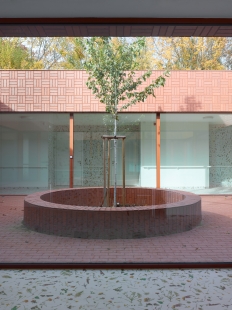
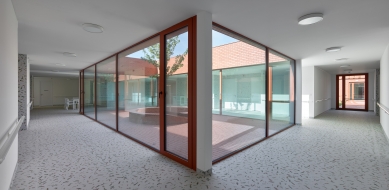
The concept of internal atriums allows for generous lighting of the corridors and creates pleasant internal spaces.
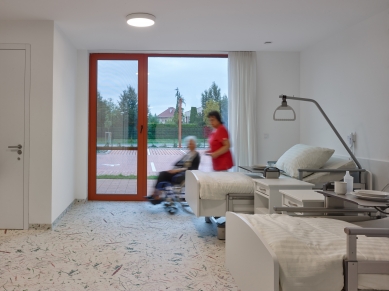
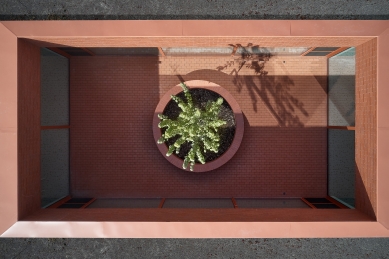
Each room has a small terrace with direct access. The individual households have their own covered internal courtyard and also an exit to a larger shared garden, connecting two households at a time.
All four households are connected by a central core. The rooms here are combined into one composition according to the same principle – they are placed around the perimeter of the central atrium. The internal atriums play an important role in the spatial concept – the spaces are visually connected to the gardens, interiors are airy, full of light and contact with nature.
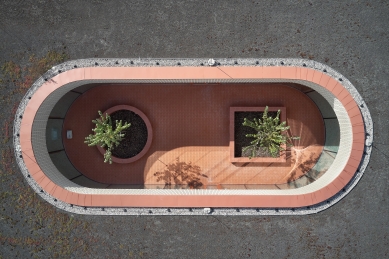
Entering through the central entrance to the building on the southern side, visitors enter a spacious hall from which they can see the main atrium of oval shape. Here is the reception from which visitors disperse into each of the four households. Around the reception is also a waiting area, directly connected to the central atrium. The house is single-story; one walks through it, a stroll is the intention, one goes through a light-filled interior.
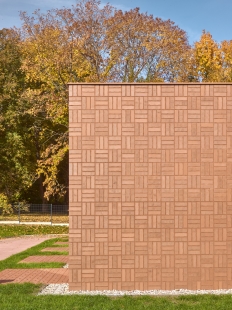
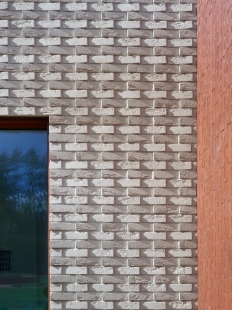
The brick facade also has four different patterns that also translate into the interior – in the secondary reception areas and the joint cut in the bathrooms. This principle also creates the uniqueness of each "home," or household.
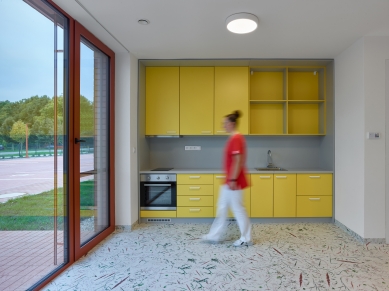
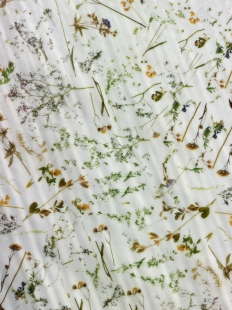
The interior consists of bricks, features a lot of white, which brightens it even further. Characteristic are the floors created to order – photos of local flowers and grasses were scanned and transferred to the flooring. This is also a guiding principle of the fairly extensive building. There are thus the households: Grass, Blackcurrant, Chamomile, and Dandelion. At the entrances to the rooms, the floor coverings rise up, and the natural floral patterns thus create pictures.
"The house is the result of the above-standard approach of the investor – the town of Nový Bydžov, its trust in the architects' effort to create an exceptional object for the Home for the Elderly. It was about mutual cooperation and a constructive exchange of views where both sides listened and were willing to change (some things were realized differently than they were designed). The designers were also professional and patient partners throughout the process. The house in this quality ultimately arose thanks to unusual meticulousness, experience, and understanding from the contractor." (DK)
The ceiling above the first above-ground floor consists mainly of reinforced concrete ceiling panels 250 mm thick, supplemented with monolithic parts of the same thickness, with the structure bordered by a monolithic reinforced concrete parapet 150 mm thick. The ceiling structure above the central atrium and adjacent areas is primarily designed as monolithic reinforced concrete 250 mm thick due to its complex shape and is supported on ceramic masonry with localized support from steel columns.
The object is covered with flat roofs, which are designed to be occasionally walkable for maintenance purposes. The main waterproofing layer consists of PVC foil 1.5 mm thick with a reinforcing insert, under which a separating geotextile is laid. In selected parts of the roof, an extensive green roof is proposed with a drainage layer of dimpled foil, an accumulation layer of basalt hydrofilous wool, and a vegetation layer of substrate for xerophytic plants. The thermal insulation of the roofs is supplemented by sloping wedges that ensure the necessary slope of the roof covering.
The outer shell of the building is solved as a sandwich construction of brick masonry, thermal insulation, and a visible facade, with the insulation done using a contact thermal insulation system ETICS with a brick cladding. The internal doors are designed as frame wooden structures clad with HDF boards with a laminate surface, in full and glazed versions, fitted into trim frames in a unified material and design solution.
The building is heated by its own gas heat source in the boiler room, which also provides central heating of hot water. The heating of individual spaces is solved through underfloor heating. To ensure a quality indoor environment, the building is equipped with an air conditioning system, and outdoor openings are supplemented with outdoor shading blinds that contribute to limiting summer overheating.
Old Age
Old age is a contemporary European theme. How do we view old age, what do we do for elderly people, how do we perceive them, what do we offer them, but also what do we ask of them? What is it like to be an elderly person in the Czech Republic in 2026? At the beginning of our brainstorming, we asked the question – what kind of old age would we like to live? How to materialize the phenomenon of home? Old age does not have to be a burden and suffering; it can be active, fulfilling, still in a certain sense vital. It can mean calmness (finally) or liberation. An elderly person can glimpse the meaning of life, has time to think, can take stock. If they are religious, closeness to death can also be a release. A wise society does not regard elderly people as helpless pieces of flesh to be lamented over, to be cleaned up, and to be cared for. Old age in such a society can bring wisdom, calmness, liberation from the unnecessary, it can impart experiences and demonstrate a distance from the hustle and bustle of everyday life. Old age also brings tenderness (grandchildren) and, in a good sense, slows things down – our rushing society needs to calm down. An elderly person should feel useful or have something to offer. We can perceive old age as our mirror or as a return to the beginning of our earthly journey. There are many similarities between children and elderly people.The Red Line in That Endless Green
The task set by the town of Nový Bydžov was to design a Home for the Elderly on the site of a former orchard adjacent to the hospital.Across the street lies the cemetery with the church, beautiful brick buildings, the first objects seen when one arrives in the town. The silence and symbolic predestination of the place is slightly disturbed only by the road, which, however, brings the stirrings of life – not only cars but mothers with strollers, people walking dogs, and pedestrians hurrying to their duties. The cemetery and church are striking, symbolic, with huge trees and a magical atmosphere. The brick walls are long and low, while the church tower rises upward. The size of the land allowed for a ground-level, large footprint building, which is also accessible and negotiable. One might say with a bit of imagination – yes, this is where I would expect a home for the elderly.
The surrounding landscape is flat, with forests and fields, between which long roads flow. It is visually beautiful, typical "Central Bohemian" with horizons crowned by silhouettes of villages. In this environment, we place a ground-level house, a sort of five-leaf clover made up of four households connected by a central core. A symbol of the four elements and also of the four cardinal directions, as the building is positioned orthogonally to these directions.
The Concept of Households with Internal Atriums
The spatial solution is based on dividing the entire volume of the building into four self-sufficient groups – households for approximately sixty clients. Each of them accommodates fifteen clients and the required staff and ensures completely independent operations. The households are designed so that the arrangement of rooms does not lead to long linear corridors. On the contrary, by placing them around a common atrium, the rooms create a compact composition and the common corridors of the atrium loop around. Each household has technical and storage rooms, staff facilities and a communal space with direct access to the internal garden. The concept of internal atriums allows for generous lighting of the corridors and creates pleasant internal spaces.
Each room has a small terrace with direct access. The individual households have their own covered internal courtyard and also an exit to a larger shared garden, connecting two households at a time.
All four households are connected by a central core. The rooms here are combined into one composition according to the same principle – they are placed around the perimeter of the central atrium. The internal atriums play an important role in the spatial concept – the spaces are visually connected to the gardens, interiors are airy, full of light and contact with nature.
Entering through the central entrance to the building on the southern side, visitors enter a spacious hall from which they can see the main atrium of oval shape. Here is the reception from which visitors disperse into each of the four households. Around the reception is also a waiting area, directly connected to the central atrium. The house is single-story; one walks through it, a stroll is the intention, one goes through a light-filled interior.
Bricks, Flowers and Light
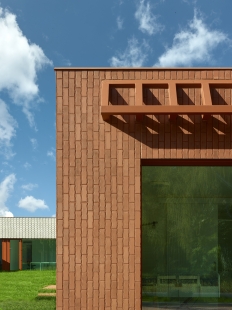
The brick facades are an analogy to the walls of the cemetery, their geometry emphasized by a simple rhythm of French windows that provide clients with direct access to the terrace. The windows are symbolic openings in this wall. The differing shading of the windows supports the individual character of each household. For example, the southwestern household has rectangular steel structures at the level of the cornice, while the northeastern has slanted ones, symbolizing eaves. The northwest part is not exposed to direct sunlight; here the exterior is designed without an overhang or shading.The brick facade also has four different patterns that also translate into the interior – in the secondary reception areas and the joint cut in the bathrooms. This principle also creates the uniqueness of each "home," or household.
The interior consists of bricks, features a lot of white, which brightens it even further. Characteristic are the floors created to order – photos of local flowers and grasses were scanned and transferred to the flooring. This is also a guiding principle of the fairly extensive building. There are thus the households: Grass, Blackcurrant, Chamomile, and Dandelion. At the entrances to the rooms, the floor coverings rise up, and the natural floral patterns thus create pictures.
"The house is the result of the above-standard approach of the investor – the town of Nový Bydžov, its trust in the architects' effort to create an exceptional object for the Home for the Elderly. It was about mutual cooperation and a constructive exchange of views where both sides listened and were willing to change (some things were realized differently than they were designed). The designers were also professional and patient partners throughout the process. The house in this quality ultimately arose thanks to unusual meticulousness, experience, and understanding from the contractor." (DK)
Construction and Technology
The foundation of the Home for the Elderly is designed as a surface system of two-step concrete foundation strips, on which a monolithic reinforced concrete floor slab of 150 mm thick is constructed. The vertical load-bearing structures of the above-ground floors are solved using THERM-type brick blocks 300 mm thick, internal load-bearing walls are made of ceramic blocks 240 mm thick and internal partitions are planned as masonry. The building employs local steel columns, particularly in the area of the central atrium, at ceiling openings of smaller atriums, at the main entrance to the building, and in the window portal of the meeting room, where they support the ceiling structures and the edges of the slabs with the parapet.The ceiling above the first above-ground floor consists mainly of reinforced concrete ceiling panels 250 mm thick, supplemented with monolithic parts of the same thickness, with the structure bordered by a monolithic reinforced concrete parapet 150 mm thick. The ceiling structure above the central atrium and adjacent areas is primarily designed as monolithic reinforced concrete 250 mm thick due to its complex shape and is supported on ceramic masonry with localized support from steel columns.
The object is covered with flat roofs, which are designed to be occasionally walkable for maintenance purposes. The main waterproofing layer consists of PVC foil 1.5 mm thick with a reinforcing insert, under which a separating geotextile is laid. In selected parts of the roof, an extensive green roof is proposed with a drainage layer of dimpled foil, an accumulation layer of basalt hydrofilous wool, and a vegetation layer of substrate for xerophytic plants. The thermal insulation of the roofs is supplemented by sloping wedges that ensure the necessary slope of the roof covering.
The outer shell of the building is solved as a sandwich construction of brick masonry, thermal insulation, and a visible facade, with the insulation done using a contact thermal insulation system ETICS with a brick cladding. The internal doors are designed as frame wooden structures clad with HDF boards with a laminate surface, in full and glazed versions, fitted into trim frames in a unified material and design solution.
The building is heated by its own gas heat source in the boiler room, which also provides central heating of hot water. The heating of individual spaces is solved through underfloor heating. To ensure a quality indoor environment, the building is equipped with an air conditioning system, and outdoor openings are supplemented with outdoor shading blinds that contribute to limiting summer overheating.
The English translation is powered by AI tool. Switch to Czech to view the original text source.











0 comments
add comment