
House on the Edge of the Plain

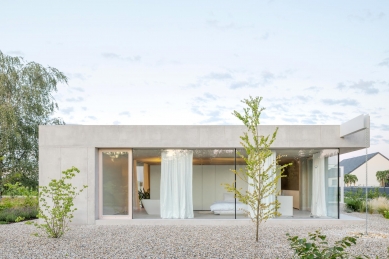
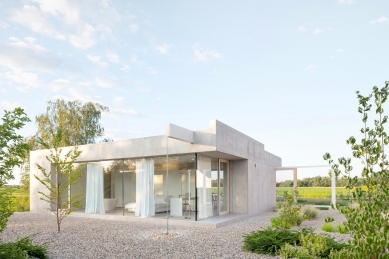
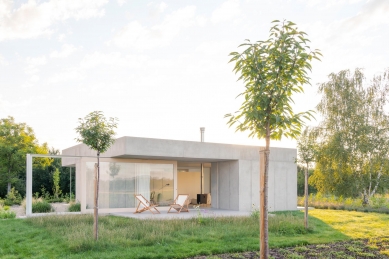
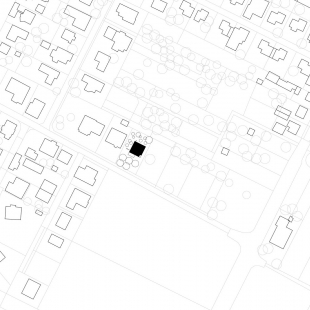
A modest house on the edge of the Murska Sobota plain reinterprets the idea of a pavilion in greenery as a contemporary space for everyday living. Rather than seeking visual impact or formal expression, the project focuses on clarity, openness and a close relationship with landscape.
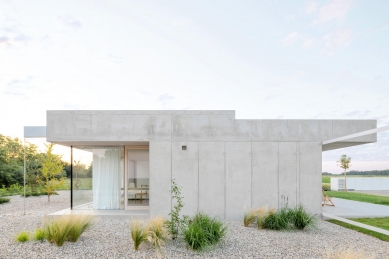
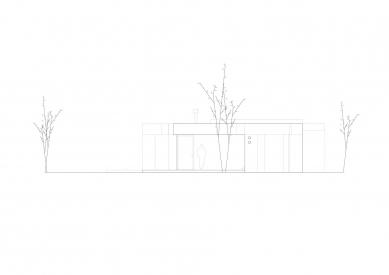
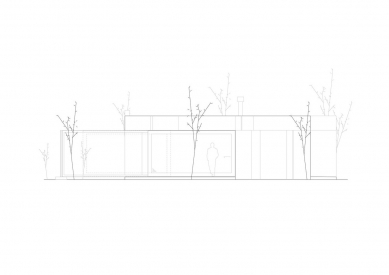
Although the house complies with strict urban planning requirements in terms of siting, dimensions and height, it deliberately resists suburban conventions. Life is organised around the garden, light and seasonal change, continuing a local tradition of low-lying dwellings characterised by generous glazing, deep overhangs and fluid transitions between interior and exterior. This approach echoes the modernist legacy of Murska Sobota, while translating it into a contemporary spatial language.
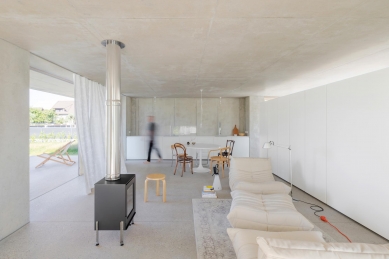
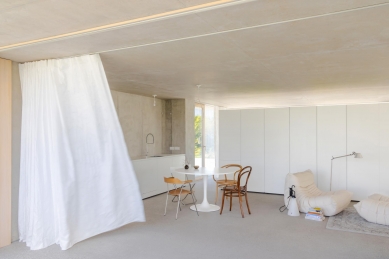
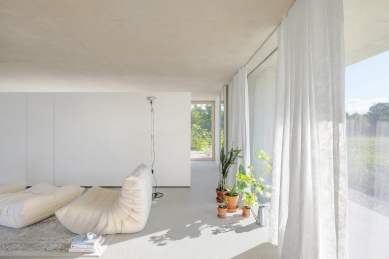
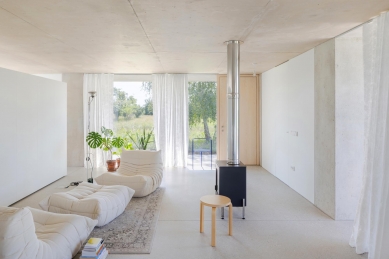
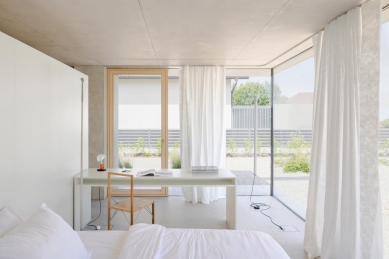
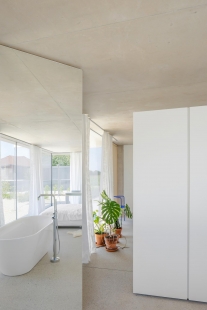
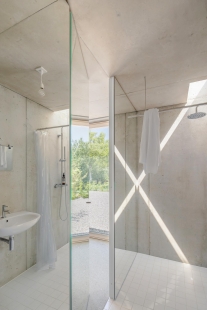
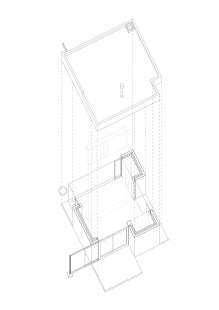
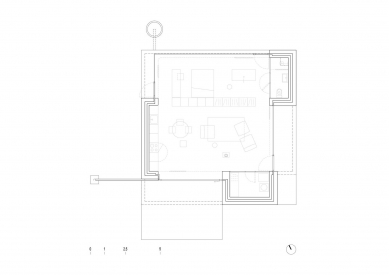
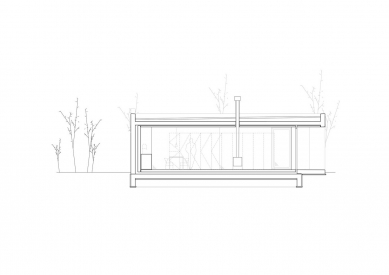
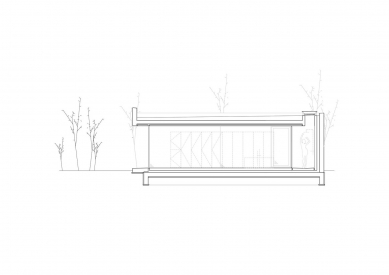
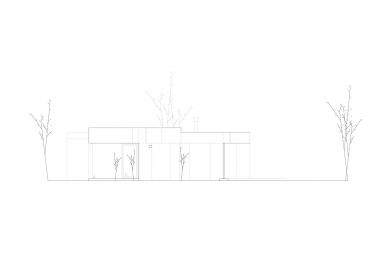
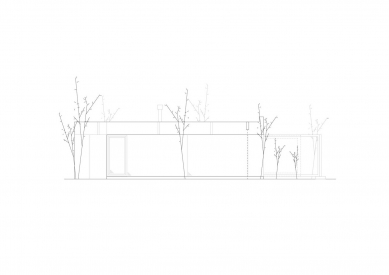
The house is organised around three reinforced-concrete cores that function as both structure and technical infrastructure, housing the bathroom, utility spaces and kitchen. These cores support a flat concrete slab, allowing the remaining space to be completely open and flexible. Living and dining areas open towards the south-west garden and terrace, while sleeping and working spaces face a more intimate north-east garden. A long, double-sided storage wall both separates and connects these zones without breaking the spatial continuity.
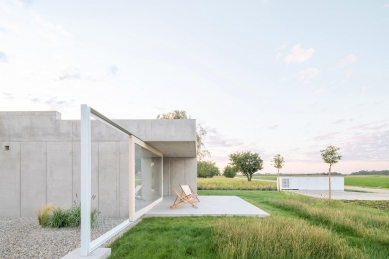
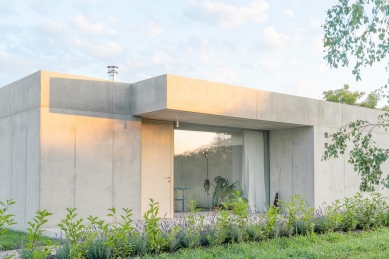
At the north-west corner, a subtle structural fold in the roof creates a fully glazed, load-free corner that dissolves the boundary between inside and outside. A large timber sliding panorama window on the south-west façade further strengthens this connection, disappearing entirely into a recessed steel frame and allowing the living space to merge with the garden during warmer months.
Exposed concrete is used throughout the exterior and interior, cast with local Mura river gravel to give the surfaces a soft, mineral character. The concrete retains traces of reused formwork, leaving textures, irregularities and patina that introduce a sense of time and imperfection. Rather than acting as a neutral backdrop, the material becomes an active part of the architectural expression.
The restrained approach continues inside, with polished concrete floors, built-in furniture made from veneered chipboard, reused chairs and simple, ready-made lighting elements. A compact cast-iron stove anchors the living space in winter, reinforcing the domestic atmosphere.
Rather than presenting itself as an architectural object, the house is conceived as a spatial framework for everyday rituals, light and seasonal change. With its emphasis on construction, material honesty and lived experience, the project offers a quiet alternative to image-driven residential architecture – one that balances rational structure with a sensitive, poetic relationship to place.
Although the house complies with strict urban planning requirements in terms of siting, dimensions and height, it deliberately resists suburban conventions. Life is organised around the garden, light and seasonal change, continuing a local tradition of low-lying dwellings characterised by generous glazing, deep overhangs and fluid transitions between interior and exterior. This approach echoes the modernist legacy of Murska Sobota, while translating it into a contemporary spatial language.
The house is organised around three reinforced-concrete cores that function as both structure and technical infrastructure, housing the bathroom, utility spaces and kitchen. These cores support a flat concrete slab, allowing the remaining space to be completely open and flexible. Living and dining areas open towards the south-west garden and terrace, while sleeping and working spaces face a more intimate north-east garden. A long, double-sided storage wall both separates and connects these zones without breaking the spatial continuity.
At the north-west corner, a subtle structural fold in the roof creates a fully glazed, load-free corner that dissolves the boundary between inside and outside. A large timber sliding panorama window on the south-west façade further strengthens this connection, disappearing entirely into a recessed steel frame and allowing the living space to merge with the garden during warmer months.
Exposed concrete is used throughout the exterior and interior, cast with local Mura river gravel to give the surfaces a soft, mineral character. The concrete retains traces of reused formwork, leaving textures, irregularities and patina that introduce a sense of time and imperfection. Rather than acting as a neutral backdrop, the material becomes an active part of the architectural expression.
The restrained approach continues inside, with polished concrete floors, built-in furniture made from veneered chipboard, reused chairs and simple, ready-made lighting elements. A compact cast-iron stove anchors the living space in winter, reinforcing the domestic atmosphere.
Rather than presenting itself as an architectural object, the house is conceived as a spatial framework for everyday rituals, light and seasonal change. With its emphasis on construction, material honesty and lived experience, the project offers a quiet alternative to image-driven residential architecture – one that balances rational structure with a sensitive, poetic relationship to place.
Skupaj arhitekti


3 comments
add comment
Subject
Author
Date
Portál
Lukáš
26.01.26 11:13
Posuvné okno
Tomaž Ebenšpanger
31.01.26 10:18
Posuvné okno
Tomaž Ebenšpanger
31.01.26 10:52
show all comments