
Reconstruction of the School Campus of Primary School with Kindergarten K. Mahra Trnava

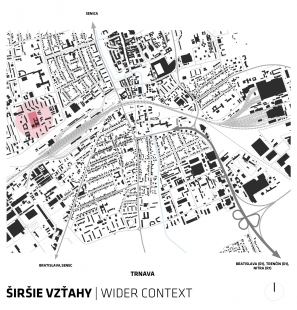
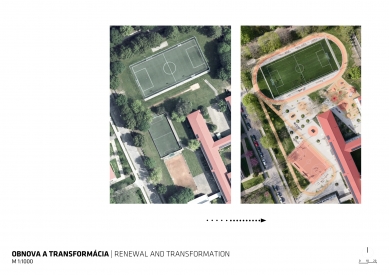
The site is located in the cadastral area of Trnava on plot no. 5671/92, owned by the City of Trnava. It is a built-up area and courtyard within the urban zone, with a total area of approximately 13,555 m², forming a primary school campus including part of a gymnasium. Prior to the design, the site contained outdated sports facilities, various paved surfaces, and urban furniture. The terrain is mostly flat, and several utility networks run through the area. The original sports surfaces, pavements, and furniture were removed, with only the artificial turf football field retained.
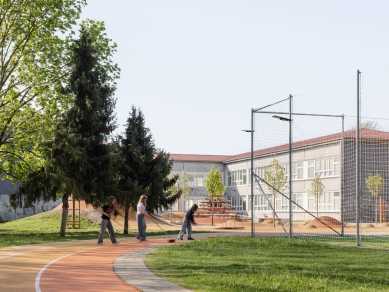
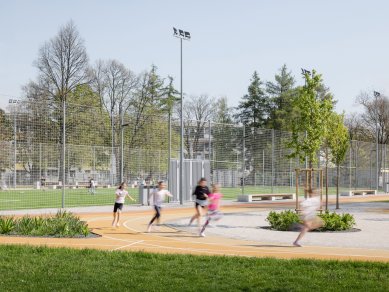
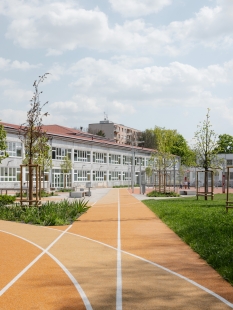
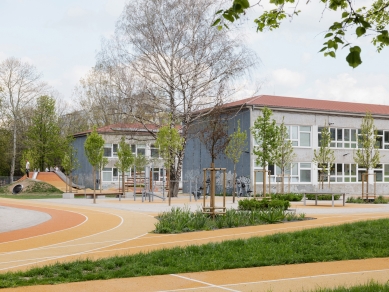
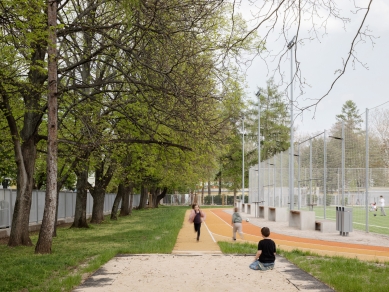
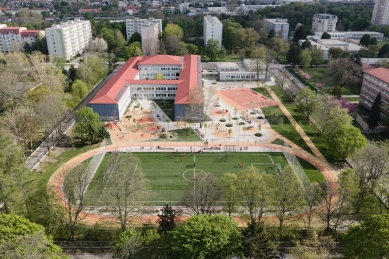
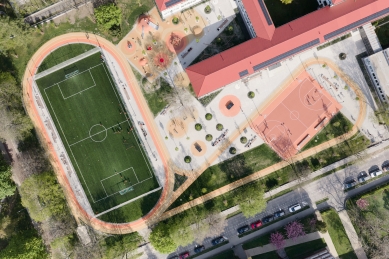
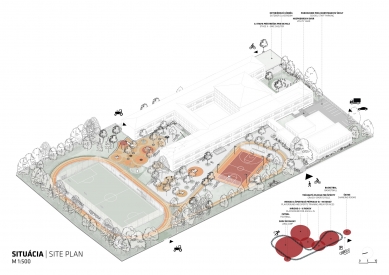
The proposal addresses a comprehensive renewal of the campus, with an emphasis on clear zoning, logical connections, and a structured arrangement of sports, recreational, and leisure areas. The aim is to create a legible space that supports movement, relaxation, and social interaction, while also being accessible to the public. The concept is based on a linear arrangement of functions, where elements form a logical sequence enabling intuitive movement. The key feature is a running track designed as a continuous “ribbon” that connects and unifies the different zones. The area is organized according to age groups and types of activities. Dynamic sports areas are complemented by calmer leisure spaces, creating a balanced environment. The composition respects the irregular shape of the plot and its relationship to the school building.
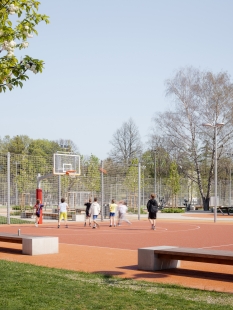
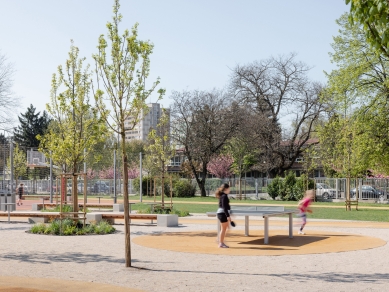
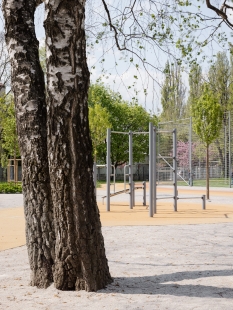
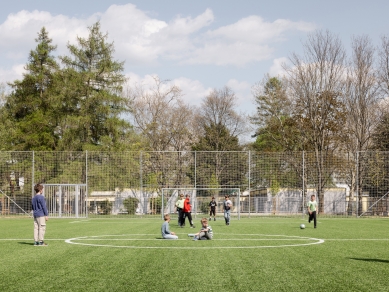
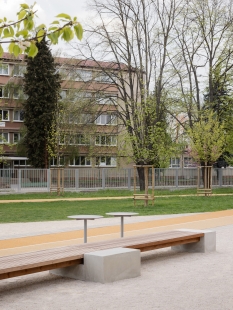
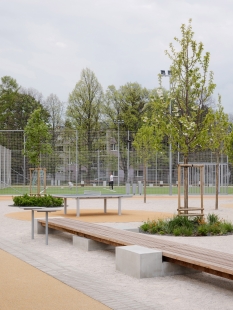
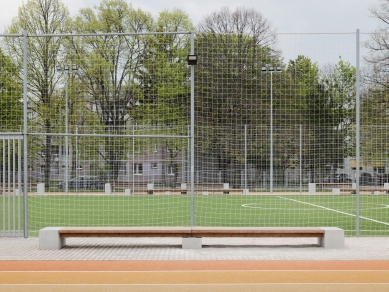
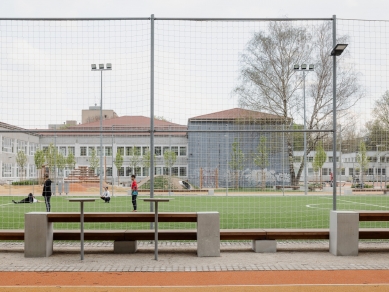
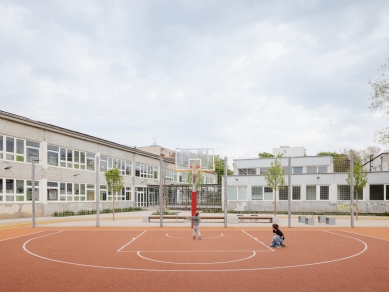
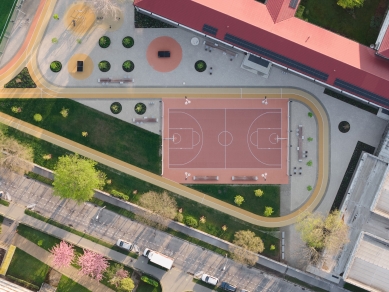
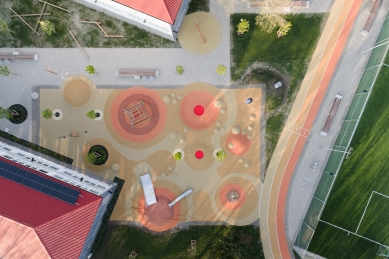
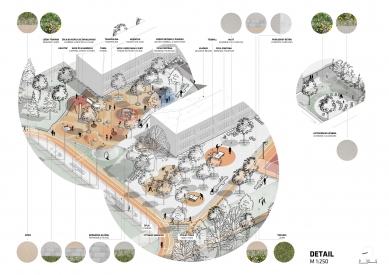
The sports infrastructure has been modernized. The football field underwent surface renewal, fencing adjustments, and the addition of a two-tier stand. Additional facilities include a basketball court, a sprint track, and a long jump pit. Smaller recreational zones with EPDM surfaces for activities such as workout, teqball, and table tennis are located between them. The forecourt of the school was opened by removing barriers, replacing asphalt with paving, and adding greenery. The color scheme works with a gradient from gravel surfaces through vegetation to EPDM areas, strengthening orientation and visual continuity.
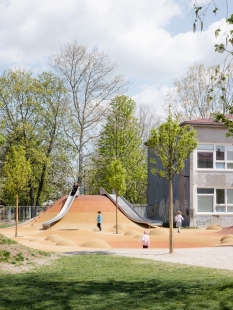
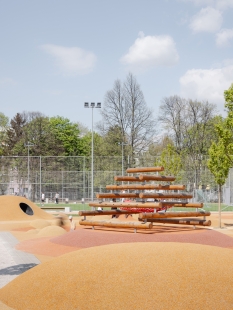
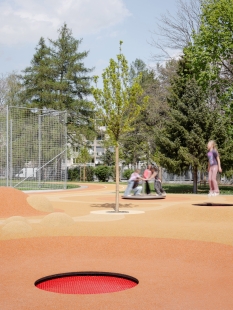
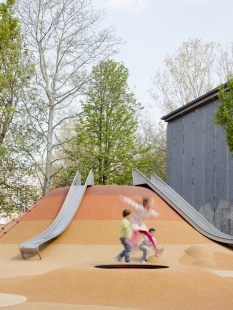
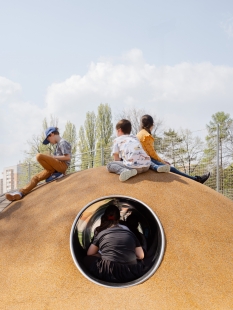
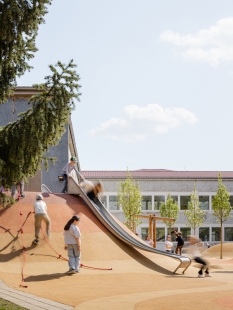
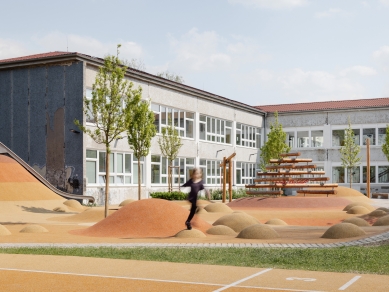
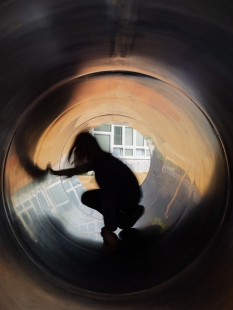
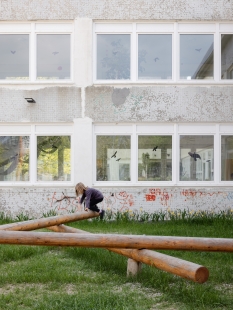
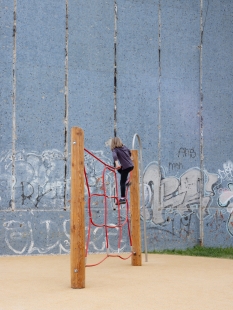
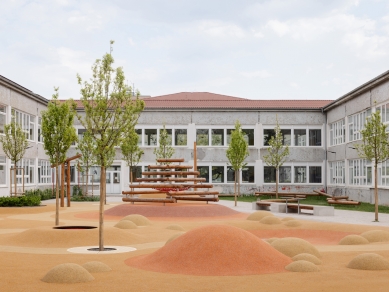
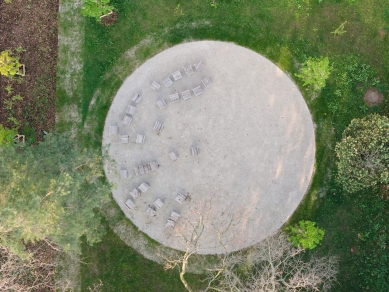
Along the school building, a main leisure area with a gravel surface and flexible furniture is located. In the southern part, there is an outdoor classroom with a circular layout supporting flexible teaching. The patio is designed for the youngest children, featuring terrain modeling, play elements, and safe surfaces, with a playground as its dominant feature.
The proposal also includes the renovation of the gym facilities – the changing rooms were converted into two separate units with sanitary facilities, including accessible features. The design accommodates use by both the school and the public and ensures barrier-free access. Staff parking and a waste management solution were also added. The existing fencing was largely preserved and locally repaired. Vegetation design builds on the existing greenery and is complemented with new plantings to improve the microclimate.
The overall concept emphasizes functionality, sustainability, clarity, and everyday use by both the school and the public. Blue-green infrastructure and closed-loop water management system
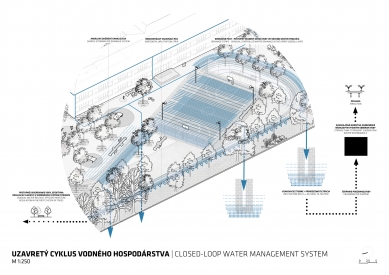
The proposal includes an integrated blue-green infrastructure system based on nature-based stormwater management principles. The system effectively integrates retention, filtration, infiltration, and the reuse of rainwater directly at the point of precipitation, thereby reducing the load on the public sewer system while simultaneously enhancing the local microclimate of the site.
Due to unfavorable geological conditions and the low permeability of the surface soil layers in parts of the site, rainwater from building roofs and main paved sports surfaces is directed into deeper geological strata. Infiltration wells serve as primary points for rainwater infiltration through impermeable surface horizons and ensure its transport into deeper subsurface layers. The water subsequently undergoes a slow geomorphological filtration process through the underlying strata until it reaches the groundwater aquifer.
The accumulated and prefiltered groundwater is then returned to the surface water cycle via an existing on-site well, from which it is used for irrigation and landscape maintenance. A balancing storage tank prevents peak loads on the well and excessive groundwater abstraction (formation of a drawdown cone). The tank capacity is designed to be at least 1.5 times the daily irrigation demand of the entire sports and park area, ensuring stable operation even during dry periods.
In areas with fine surface textures, such as running tracks and crushed aggregate surfaces, a decentralized water management approach is applied directly within the surface and subsurface soil layers. An infiltration strip located along the running track captures part of the rainfall and allows its gradual infiltration into the upper soil layers, reducing the need for active irrigation and stabilizing the natural moisture regime of the vegetation. Drainage strips simultaneously ensure controlled runoff from paved surfaces toward adjacent vegetated areas, where water is gradually infiltrated or naturally evaporated, contributing to high load-bearing capacity, stability, and long-term durability of the sports surfaces.
The entire blue-green infrastructure system is fully integrated into the overall site concept and forms the foundation of its environmental strategy. It supports rainwater retention, reduces operational load, stabilizes microclimatic conditions, and contributes to the long-term sustainability of the area in line with nature-based design principles.
The landscape architectural design is based on principles of nature-based design and sustainable green space management. The tree layer builds on existing vegetation along the perimeter of the site and is systematically supplemented with new plantings, strengthening the spatial structure and improving microclimatic conditions. The species composition reflects site conditions and prioritizes native and well-adapted species.
Shrub plantings are applied selectively, with an emphasis on maintaining visibility, safety, and spatial orientation. The herbaceous layer consists of a combination of perennial beds, ornamental grasses, and bulb plants, applying principles of plant sociability and self-regulation. This approach enables the creation of visually valuable yet low-maintenance vegetation elements.
Lawn areas are differentiated according to intensity of use into recreational lawns, extensive meadow lawns, and gravel lawns, optimizing maintenance requirements while supporting ecological stability.
The overall design integrates principles of blue-green infrastructure, particularly in terms of stormwater retention, microclimate improvement, and biodiversity support. The proposal thus creates a high-quality, functional, and environmentally sustainable environment for everyday use by both the school and the wider public.
The proposal addresses a comprehensive renewal of the campus, with an emphasis on clear zoning, logical connections, and a structured arrangement of sports, recreational, and leisure areas. The aim is to create a legible space that supports movement, relaxation, and social interaction, while also being accessible to the public. The concept is based on a linear arrangement of functions, where elements form a logical sequence enabling intuitive movement. The key feature is a running track designed as a continuous “ribbon” that connects and unifies the different zones. The area is organized according to age groups and types of activities. Dynamic sports areas are complemented by calmer leisure spaces, creating a balanced environment. The composition respects the irregular shape of the plot and its relationship to the school building.
The sports infrastructure has been modernized. The football field underwent surface renewal, fencing adjustments, and the addition of a two-tier stand. Additional facilities include a basketball court, a sprint track, and a long jump pit. Smaller recreational zones with EPDM surfaces for activities such as workout, teqball, and table tennis are located between them. The forecourt of the school was opened by removing barriers, replacing asphalt with paving, and adding greenery. The color scheme works with a gradient from gravel surfaces through vegetation to EPDM areas, strengthening orientation and visual continuity.
Along the school building, a main leisure area with a gravel surface and flexible furniture is located. In the southern part, there is an outdoor classroom with a circular layout supporting flexible teaching. The patio is designed for the youngest children, featuring terrain modeling, play elements, and safe surfaces, with a playground as its dominant feature.
The proposal also includes the renovation of the gym facilities – the changing rooms were converted into two separate units with sanitary facilities, including accessible features. The design accommodates use by both the school and the public and ensures barrier-free access. Staff parking and a waste management solution were also added. The existing fencing was largely preserved and locally repaired. Vegetation design builds on the existing greenery and is complemented with new plantings to improve the microclimate.
The overall concept emphasizes functionality, sustainability, clarity, and everyday use by both the school and the public. Blue-green infrastructure and closed-loop water management system
The proposal includes an integrated blue-green infrastructure system based on nature-based stormwater management principles. The system effectively integrates retention, filtration, infiltration, and the reuse of rainwater directly at the point of precipitation, thereby reducing the load on the public sewer system while simultaneously enhancing the local microclimate of the site.
Due to unfavorable geological conditions and the low permeability of the surface soil layers in parts of the site, rainwater from building roofs and main paved sports surfaces is directed into deeper geological strata. Infiltration wells serve as primary points for rainwater infiltration through impermeable surface horizons and ensure its transport into deeper subsurface layers. The water subsequently undergoes a slow geomorphological filtration process through the underlying strata until it reaches the groundwater aquifer.
The accumulated and prefiltered groundwater is then returned to the surface water cycle via an existing on-site well, from which it is used for irrigation and landscape maintenance. A balancing storage tank prevents peak loads on the well and excessive groundwater abstraction (formation of a drawdown cone). The tank capacity is designed to be at least 1.5 times the daily irrigation demand of the entire sports and park area, ensuring stable operation even during dry periods.
In areas with fine surface textures, such as running tracks and crushed aggregate surfaces, a decentralized water management approach is applied directly within the surface and subsurface soil layers. An infiltration strip located along the running track captures part of the rainfall and allows its gradual infiltration into the upper soil layers, reducing the need for active irrigation and stabilizing the natural moisture regime of the vegetation. Drainage strips simultaneously ensure controlled runoff from paved surfaces toward adjacent vegetated areas, where water is gradually infiltrated or naturally evaporated, contributing to high load-bearing capacity, stability, and long-term durability of the sports surfaces.
The entire blue-green infrastructure system is fully integrated into the overall site concept and forms the foundation of its environmental strategy. It supports rainwater retention, reduces operational load, stabilizes microclimatic conditions, and contributes to the long-term sustainability of the area in line with nature-based design principles.
The landscape architectural design is based on principles of nature-based design and sustainable green space management. The tree layer builds on existing vegetation along the perimeter of the site and is systematically supplemented with new plantings, strengthening the spatial structure and improving microclimatic conditions. The species composition reflects site conditions and prioritizes native and well-adapted species.
Shrub plantings are applied selectively, with an emphasis on maintaining visibility, safety, and spatial orientation. The herbaceous layer consists of a combination of perennial beds, ornamental grasses, and bulb plants, applying principles of plant sociability and self-regulation. This approach enables the creation of visually valuable yet low-maintenance vegetation elements.
Lawn areas are differentiated according to intensity of use into recreational lawns, extensive meadow lawns, and gravel lawns, optimizing maintenance requirements while supporting ecological stability.
The overall design integrates principles of blue-green infrastructure, particularly in terms of stormwater retention, microclimate improvement, and biodiversity support. The proposal thus creates a high-quality, functional, and environmentally sustainable environment for everyday use by both the school and the wider public.
Šercel Švec architekti
0 comments
add comment