
Revitalization of Templářské Sklepy

Nine Centuries of Wine Beneath Čejkovice
The caravan slowly climbs to the hilltop into the oldest part of the village of Čejkovice. It passes the castle and the historical granaries of the winery, behind which the road ends. On a grassy plateau with a homey backdrop adorned with roses, a panoramic view of the summer landscape unfolds. The heated air ripples above the red roofs, which alternate with strips of green embroidered with rows of vines. The vine had pressed itself into this landscape even before the name Čejkovice entered history.
The vineyards here were established by the Knights Templar at the beginning of the 13th century. During their tenure, they also built the oldest and most extensive medieval wine cellars in Moravia near the Čejkovice fortress. Their cool corridors still preserve not only the wine but also the memory of nine long centuries of local winemaking tradition, which has passed through church, noble, and state management, but primarily has been inherited as both a craft and an art from family to family.
A large portion of the grapes from the local vineyard plots is now processed by the Templářské sklepy Čejkovice winery cooperative. This voluntary association of several dozen winemakers and grape growers was established in 1936 and, after its revival in 1992, now unites approximately 340 members who together ensure the processing of the harvest and the sale of wine.
The revitalization of the oldest part of the winery is another step in the joint effort of local winemakers caring for their own traditions. The subterranean premises are intertwined like ancient roots with the winding corridors of the medieval cellars. Along their walls run wine pipes—arteries distributing wine to the various parts of the winery, whose brand draws its identity from the Templar cellars.
Today, 400 out of approximately 650 meters of corridors are accessible to the public, with their previous extent presumed to be much larger.
Living History of the Underground
The greatest value of the historical cellars lies in their material and spatial authenticity. The revitalization primarily focused on removing modern inappropriate alterations and decorative superfluities. It allows the simple beauty of the historical underground to shine.The overall concept was created by designer Petr Novague. He brings a contemporary, clearly readable layer to the cleaned space, which supports the unique character of the cellars. Besides the exhibition and furnishings, he also designed a new form of bottles, whose silhouette references the shape of the Templar cross.
The generous space vaulted from stone and brick is complemented by ambient lighting. A soft musical background accompanies visitors from Gothic motifs through the Jesuit period to the present day. The quiet atmosphere evokes the continuity of the place and the legacy of the people who have utilized the cellars for generations to store wine.
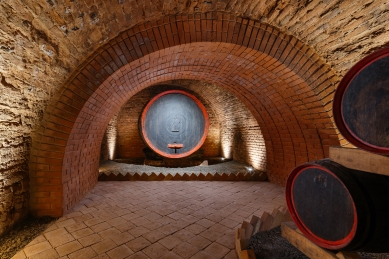
The walls of the corridors are lined with dozens of oak barrels with a capacity of approximately 2,000 to 5,000 liters, as well as exhibitions of commemorative barrels. While smaller barrels could be transported to the cellar whole, the largest ones are brought disassembled, and coopers traditionally assemble them on-site using a nail-free technique. The designs on their fronts reflect different periods in the history of the winery cooperative.
The most precious ones include the largest barrel previously used in the Czech Republic, with a capacity of 20,250 liters, and the commemorative barrel from the first decade since the establishment of the cooperative in 1946. On the carved lid featuring Saint Wenceslas, the patron saint of the Czech lands, the individuals associated with the founding of the cooperative are remembered. Many of their families are still connected to winemaking today. The barrel was made by Eduard Pecka, one of the founders of the original cooperative and an ancestor of today’s cooper Eduard Bařina, the fifth master cooper in the family line, who in 2026 will create the cooperative's third commemorative barrel in his professional career.
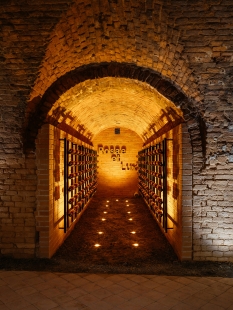
In addition to the historical archive of wines, safeguarded by a statue of Saint Urban, an exhibition titled Rosae et Lux dedicated to rosé wines has also emerged. It introduces a more delicate, symbolically female element to the cellars. The exhibition also includes photographs, archival documents, and original labels from the time of the winery cooperative's founding and from the decades of its functioning after nationalization. Due to high humidity, the underground requires continuous maintenance. Sensitive exhibits are stored in custom-designed display cases, and air quality is ensured by ozone generators.
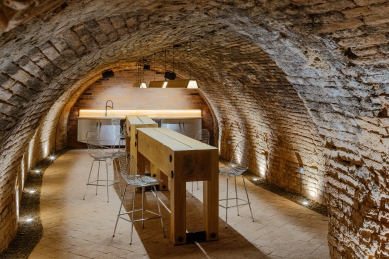
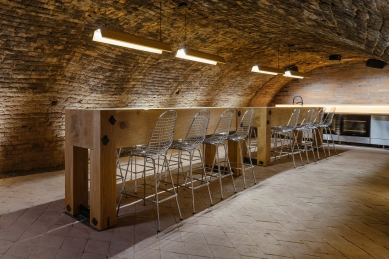
New elements are conceived modestly and with respect for the character of the space. The raw material environment of the cellars is complemented by furnishings made of wood, metal, and sandstone. Traditional craft techniques meet contemporary technologies, robust details with expressive minimalism. Glossy steel surfaces contrast with massive wood and blacksmith details on the oak tasting tables. Bar stools woven from delicate, gleaming steel evoke the texture of knightly chainmail.
The centerpiece of the final tasting space is a sandstone monolith slightly bent into the shape of the Templar cross. The cross motif is repeated in a large rotating logo, a prominent directional element that delineates the intersecting corridors and the tour's direction.
The underground environment is not an exhibition of the past but part of the organism of the winery, where craft traditions meet contemporary design to serve the art of living.
The English translation is powered by AI tool. Switch to Czech to view the original text source.









0 comments
add comment