
The Cloud One
hotel with a shopping arcade

Annotation:
The aim of the proposal was to return inaccessible brownfield land between the railway tracks and the highway back to the natural organism of the city center.
The form of the project on Hybernská went through many stages of development. From the idea of an administrative center, we gradually shifted to the concept of a hotel city block with an internal courtyard and public passages. This allowed us to integrate the connection with the concurrently developing project of the roof over Masaryk Station. The archaeological survey revealed a number of hidden historical layers that we preserved and surrounded with new constructions. The idea of completing Hybernská in the form of an urban boulevard with colonnades, tree lines, and bike paths required significant effort and investment associated with redesigning the traffic solution for the busiest intersection in the Czech Republic.
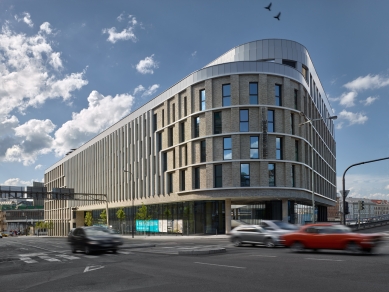
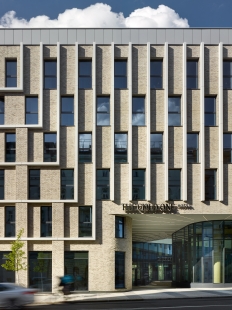
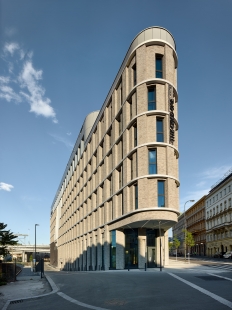
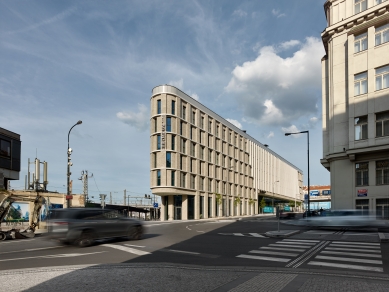
The energy of the surrounding traffic and movement of people inspired us to create a rounded silhouette for the block with a subtle corner towards the Powder Gate. The facade cladding made of natural fired bricks with a deep profile aligns with the scale of the historical context.
We hope that our work will contribute to the connection of urban life and the cultivation of public space.
Urbanism:
The project enhances the undeveloped space at the busy intersection "U Bulhara". Originally, the triangular plot was used as a parking lot surrounded by elevated structures of the Prague highway (Wilsonova Street), Hybernská Street, and to the north by the railway yard of Masaryk Station.
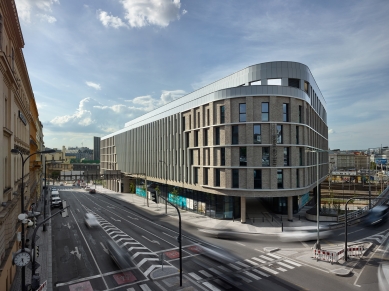
The design is based on the principle of an urban block, which from the southern side along Hybernská creates an extended street profile with a new line of trees, while on the eastern side, parallel to the opposite facade of the NTM railway museum, the building line connects to the corner property of the King David hotel on U Bulhara Street. On the western side, the block's construction respects the street profile at the intersection with Opletalova Street, allowing direct access to Na Florenci Street via a planned pedestrian connection over the Masaryk Station yard. To the north, the block recedes from the Masaryk Station yard, thereby defining a new communication route towards the NTM.
An important visual axis from the Powder Gate culminates at the intersection of Hybernská/Opletalova with a subtle corner, (precedent example: the "iron" building at the intersection of Broadway and 5th Avenue in New York) which urbanistically accentuates the division of two visual dominants – the Žižkov panorama with the television tower and the monument at Vítkov. The height arrangement of the block corresponds with the cornices and roof ridges of the opposite buildings on Hybernská. Given the slope of the street, the main cornice is at an average height of 21.9 m, and the ridge, or the recessed floor, is at a height of 28.5 m. The northeast corner of the building creates a height dominant not only for the block but for the entire block development connected to it.
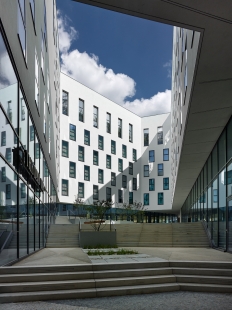
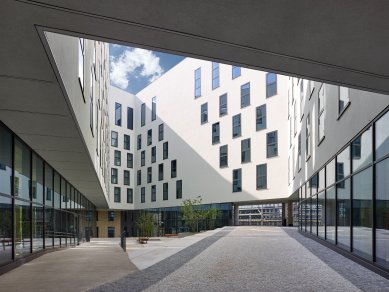
From the southeast corner of the block, a public pedestrian passage is designed through the building, which allows barrier-free and direct connection from the new roofing of Masaryk Station to U Bulhara Street, thus providing the shortest way to transfer to the Main Station. The main entrance is located in the inner block accessible from Hybernská Street and from the newly created pedestrian passage. The inner courtyard creates a forecourt for the entrance to the hotel and the ground floor commercial spaces. Its cascading height arrangement leading to the passage, complemented by trees, forms a quiet place in the midst of one of the busiest traffic hubs in Prague.
The proposed urban block is served by traffic from the intersection of Hybernská and Opletalova streets.
A new connection of a calmed residential communication along the northern edge is designed with an entrance to the underground garages, which further leads to the parking area under the highway and to the Railway Museum.
Architecture:
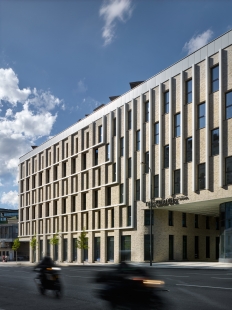
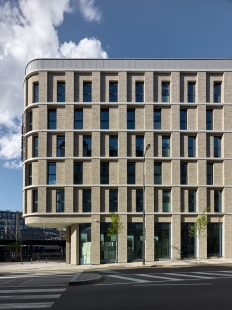
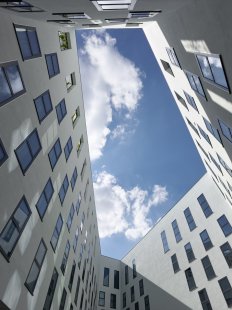
The architectural solution of the block supports the urban concept through a unified facade form, which is rounded at the corners so that the object appears as a calm island with hidden corners inside, surrounded by the transportation corridors of railway, vehicle, and pedestrian traffic. The rounding of the facade is visually supported by thin light lines of horizontal profiles, which reflect the dynamics of the traffic hub. In Hybernská Street, traffic is calmed and the horizontal profiles gradually change to vertical. The long street facade thus gains vertical segmentation that mirrors the divisions of apartment buildings in a classic Prague block. Between the horizontal profiles, regular facade columns are placed, alternating with irregular facade openings with a vertical proportion, thus creating a profiled massive wall with a natural brick cladding. A similar principle is applied to the top floor, whose facade with high windows recedes from the main cornice in Hybernská and partially towards Masaryk Station, providing views of the Old Town panorama from the roof terraces.
While the northern facade firmly emerges from the ground, defining the mass of the block from the corridor of railway transport, the eastern and western facades recede from the building line, forming a colonnade that gradually transforms into glass storefronts of the commercial spaces on the east. At the southeastern corner, the facade recedes even deeper, creating a covered entrance space to the passage, lined by a rounded glass facade of the commercial spaces, as well as defining the entrance passage of the hotel. The interior block is sharply carved within the mass, contrasting the external rounded shape. The white facades bring light into the confined space.
This architecturally subtracted form of the block softens the silhouette and adapts the scale to the surrounding urban structure, and its irregularity reflects the dynamic character of the genius loci.
Function:
The building is vertically divided into seven above-ground and one underground floor. The mass is placed on the plot such that the level of the adjoining communication of the southern edge is in the 1st floor, and the northern edge in the basement.
On the eastern and western sides, the terrain is leveled by a slope. The height level of the inner block is at level 1st floor on the west and rises to level 2nd floor towards the east using stairs and ramps.
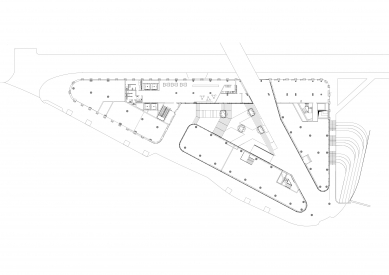
The main functional purpose of the block is short-term accommodation – a hotel. The main entrance to the hotel is located on the ground floor from the northwest corner of the inner block, thus leading to the central part of the northern mass, followed by a vast lobby with a reception and operational facilities to the east, and with the main vertical communication and guest facilities to the west. The remaining parts of the ground floor consist of commercial spaces with entrances from Hybernská street and back entrances from the inner block. The commercial spaces rise to the level of the 2nd floor ceiling slab. The basement of the building serves as garages and storage for the hotel as well as technical facilities and storage for the operation of the entire building. The basement is divided into two separate parts due to the preservation of remnants of city walls found about 30 cm below the surface. Both parts are connected by a "passage" at the southeast stairs.
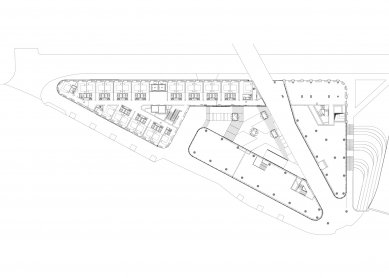
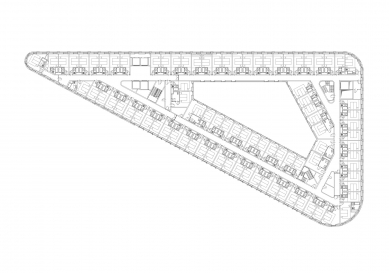
The garages have an entrance from the northern edge; opposite the entrance is a space for the security of the building. There is also access to technical facilities and from the east a back entrance to the hotel and waste disposal. On the second above-ground floor, commercial spaces are located on the east, accessible from the passage. The western part consists of hotel rooms with the necessary facilities. The third to sixth floors contain hotel rooms across the entire footprint.
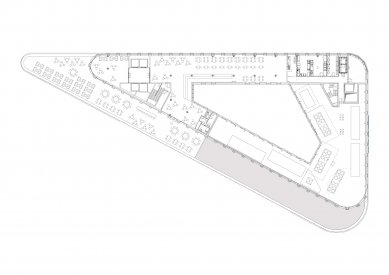
The seventh floor is set back and is only present in the northern part, which includes a breakfast room and lounge bar for the hotel with the necessary facilities. This mass is complemented by a terrace for hotel guests on the western part and a hidden technological terrace on the eastern part.
The aim of the proposal was to return inaccessible brownfield land between the railway tracks and the highway back to the natural organism of the city center.
The form of the project on Hybernská went through many stages of development. From the idea of an administrative center, we gradually shifted to the concept of a hotel city block with an internal courtyard and public passages. This allowed us to integrate the connection with the concurrently developing project of the roof over Masaryk Station. The archaeological survey revealed a number of hidden historical layers that we preserved and surrounded with new constructions. The idea of completing Hybernská in the form of an urban boulevard with colonnades, tree lines, and bike paths required significant effort and investment associated with redesigning the traffic solution for the busiest intersection in the Czech Republic.
The energy of the surrounding traffic and movement of people inspired us to create a rounded silhouette for the block with a subtle corner towards the Powder Gate. The facade cladding made of natural fired bricks with a deep profile aligns with the scale of the historical context.
We hope that our work will contribute to the connection of urban life and the cultivation of public space.
Urbanism:
The project enhances the undeveloped space at the busy intersection "U Bulhara". Originally, the triangular plot was used as a parking lot surrounded by elevated structures of the Prague highway (Wilsonova Street), Hybernská Street, and to the north by the railway yard of Masaryk Station.
The design is based on the principle of an urban block, which from the southern side along Hybernská creates an extended street profile with a new line of trees, while on the eastern side, parallel to the opposite facade of the NTM railway museum, the building line connects to the corner property of the King David hotel on U Bulhara Street. On the western side, the block's construction respects the street profile at the intersection with Opletalova Street, allowing direct access to Na Florenci Street via a planned pedestrian connection over the Masaryk Station yard. To the north, the block recedes from the Masaryk Station yard, thereby defining a new communication route towards the NTM.
An important visual axis from the Powder Gate culminates at the intersection of Hybernská/Opletalova with a subtle corner, (precedent example: the "iron" building at the intersection of Broadway and 5th Avenue in New York) which urbanistically accentuates the division of two visual dominants – the Žižkov panorama with the television tower and the monument at Vítkov. The height arrangement of the block corresponds with the cornices and roof ridges of the opposite buildings on Hybernská. Given the slope of the street, the main cornice is at an average height of 21.9 m, and the ridge, or the recessed floor, is at a height of 28.5 m. The northeast corner of the building creates a height dominant not only for the block but for the entire block development connected to it.
From the southeast corner of the block, a public pedestrian passage is designed through the building, which allows barrier-free and direct connection from the new roofing of Masaryk Station to U Bulhara Street, thus providing the shortest way to transfer to the Main Station. The main entrance is located in the inner block accessible from Hybernská Street and from the newly created pedestrian passage. The inner courtyard creates a forecourt for the entrance to the hotel and the ground floor commercial spaces. Its cascading height arrangement leading to the passage, complemented by trees, forms a quiet place in the midst of one of the busiest traffic hubs in Prague.
The proposed urban block is served by traffic from the intersection of Hybernská and Opletalova streets.
A new connection of a calmed residential communication along the northern edge is designed with an entrance to the underground garages, which further leads to the parking area under the highway and to the Railway Museum.
Architecture:
The architectural solution of the block supports the urban concept through a unified facade form, which is rounded at the corners so that the object appears as a calm island with hidden corners inside, surrounded by the transportation corridors of railway, vehicle, and pedestrian traffic. The rounding of the facade is visually supported by thin light lines of horizontal profiles, which reflect the dynamics of the traffic hub. In Hybernská Street, traffic is calmed and the horizontal profiles gradually change to vertical. The long street facade thus gains vertical segmentation that mirrors the divisions of apartment buildings in a classic Prague block. Between the horizontal profiles, regular facade columns are placed, alternating with irregular facade openings with a vertical proportion, thus creating a profiled massive wall with a natural brick cladding. A similar principle is applied to the top floor, whose facade with high windows recedes from the main cornice in Hybernská and partially towards Masaryk Station, providing views of the Old Town panorama from the roof terraces.
While the northern facade firmly emerges from the ground, defining the mass of the block from the corridor of railway transport, the eastern and western facades recede from the building line, forming a colonnade that gradually transforms into glass storefronts of the commercial spaces on the east. At the southeastern corner, the facade recedes even deeper, creating a covered entrance space to the passage, lined by a rounded glass facade of the commercial spaces, as well as defining the entrance passage of the hotel. The interior block is sharply carved within the mass, contrasting the external rounded shape. The white facades bring light into the confined space.
This architecturally subtracted form of the block softens the silhouette and adapts the scale to the surrounding urban structure, and its irregularity reflects the dynamic character of the genius loci.
Function:
The building is vertically divided into seven above-ground and one underground floor. The mass is placed on the plot such that the level of the adjoining communication of the southern edge is in the 1st floor, and the northern edge in the basement.
On the eastern and western sides, the terrain is leveled by a slope. The height level of the inner block is at level 1st floor on the west and rises to level 2nd floor towards the east using stairs and ramps.
The main functional purpose of the block is short-term accommodation – a hotel. The main entrance to the hotel is located on the ground floor from the northwest corner of the inner block, thus leading to the central part of the northern mass, followed by a vast lobby with a reception and operational facilities to the east, and with the main vertical communication and guest facilities to the west. The remaining parts of the ground floor consist of commercial spaces with entrances from Hybernská street and back entrances from the inner block. The commercial spaces rise to the level of the 2nd floor ceiling slab. The basement of the building serves as garages and storage for the hotel as well as technical facilities and storage for the operation of the entire building. The basement is divided into two separate parts due to the preservation of remnants of city walls found about 30 cm below the surface. Both parts are connected by a "passage" at the southeast stairs.
The garages have an entrance from the northern edge; opposite the entrance is a space for the security of the building. There is also access to technical facilities and from the east a back entrance to the hotel and waste disposal. On the second above-ground floor, commercial spaces are located on the east, accessible from the passage. The western part consists of hotel rooms with the necessary facilities. The third to sixth floors contain hotel rooms across the entire footprint.
The seventh floor is set back and is only present in the northern part, which includes a breakfast room and lounge bar for the hotel with the necessary facilities. This mass is complemented by a terrace for hotel guests on the western part and a hidden technological terrace on the eastern part.
Jan Schindler
SCHINDLER SEKO ARCHITEKTI s.r.o.
The English translation is powered by AI tool. Switch to Czech to view the original text source.




0 comments
add comment