
Planter box house

The "Truhlík House" is a prime example of improvisation and compromise.
It stands as an unintended counterpoint to current trends, where every detail of the construction process is strictly predetermined.
Reality sometimes surprises us and forces us to make quick decisions.
The clients decided to build a small cabin where they could “get a feel for” the lot and assess its qualities.
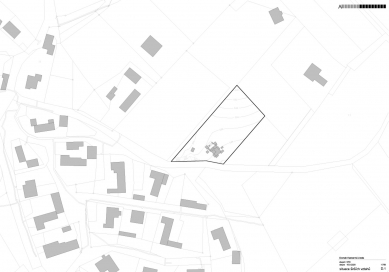
The authorities forced a change in the building’s location. This had consequences.
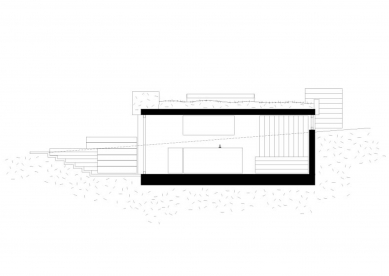
A rock discovered 1.8 meters below ground level forced the clients to rethink their plan and convert the space originally intended for the cottage’s basement into a living area at this level.
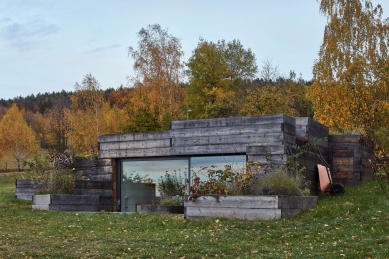
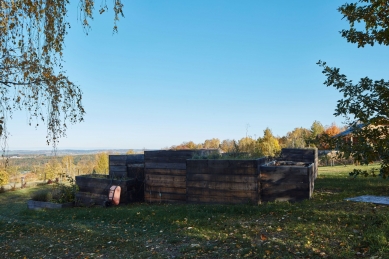
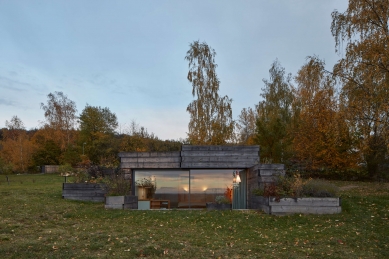
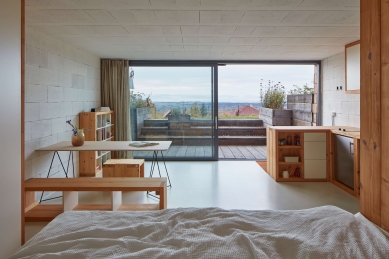
Although the building’s volume is partially buried in the ground, it allows for ample sunlight and unobstructed views of the landscape.
It is precisely this embedding in the ground that influenced the building’s style and character.
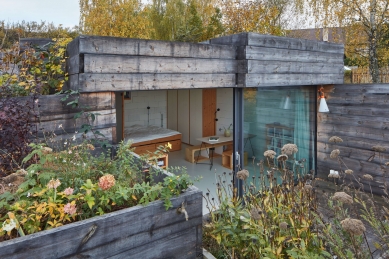
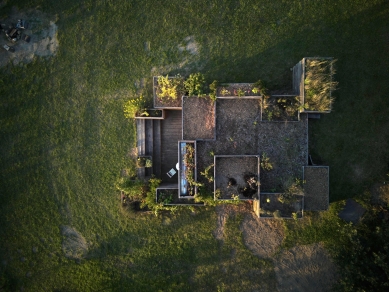
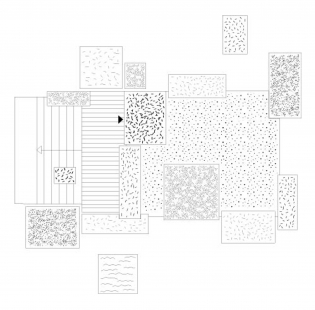
The house’s silhouette is not immediately apparent; it dissolves into the composition of the planting boxes.
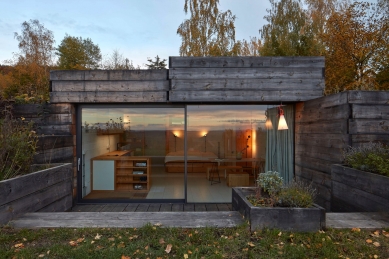
The wooden planter is the fundamental compositional element; it shapes the space, alters the nature of its use, forms the interior, and becomes furniture.
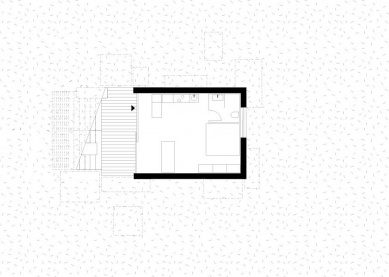
The connection to the garden is achieved through generous sliding doors. The living area stairs extend the living space to include a summer seating area.
Structurally, it is a concrete structure measuring 6.9 x 5.6 m, built using permanent formwork with ceramic interlocking ceilings. The roof is a vibrant green. The window and door frames are aluminum. The planters are made of spruce planks.
Heating is provided by electric underfloor heating.
The building was constructed through self-help, utilizing local resources and trades to the greatest extent possible.
It stands as an unintended counterpoint to current trends, where every detail of the construction process is strictly predetermined.
Reality sometimes surprises us and forces us to make quick decisions.
The clients decided to build a small cabin where they could “get a feel for” the lot and assess its qualities.
The authorities forced a change in the building’s location. This had consequences.
A rock discovered 1.8 meters below ground level forced the clients to rethink their plan and convert the space originally intended for the cottage’s basement into a living area at this level.
Although the building’s volume is partially buried in the ground, it allows for ample sunlight and unobstructed views of the landscape.
It is precisely this embedding in the ground that influenced the building’s style and character.
The house’s silhouette is not immediately apparent; it dissolves into the composition of the planting boxes.
The wooden planter is the fundamental compositional element; it shapes the space, alters the nature of its use, forms the interior, and becomes furniture.
The connection to the garden is achieved through generous sliding doors. The living area stairs extend the living space to include a summer seating area.
Structurally, it is a concrete structure measuring 6.9 x 5.6 m, built using permanent formwork with ceramic interlocking ceilings. The roof is a vibrant green. The window and door frames are aluminum. The planters are made of spruce planks.
Heating is provided by electric underfloor heating.
The building was constructed through self-help, utilizing local resources and trades to the greatest extent possible.
A69 - architekti

1 comment
add comment
Subject
Author
Date
A69
DH
23.06.26 03:52
show all comments