
UNI Space

Project UNI Space in the rectorate building of Silesian University in Opava
The project addresses the issue of inadequate infrastructural facilities at the Silesian University in Opava (SU) for ensuring quality education, enhancing openness, strengthening international cooperation, and increasing interest in studying at the university. The aim of the project was to create a high-quality environment at Silesian University through the improvement of interior, audiovisual, and other equipment, and to enhance the openness and attractiveness of studying at SU. The project supports the development of international cooperation and strengthens the attractiveness of studying at Silesian University. Thanks to the project, the perception of SU as a modern and progressive family-type university providing internationally competitive education has been significantly supported.
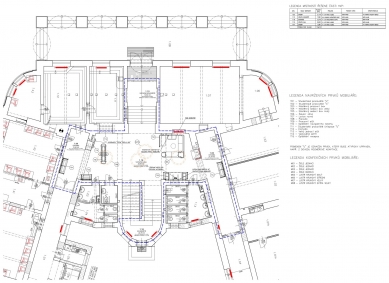
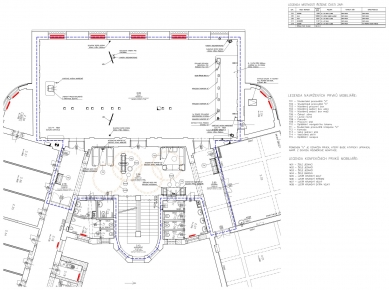
The subject of our delivery was the design and development of a project for atypical furniture elements and their incorporation into the existing spaces of the rectorate building without the need for major construction interventions into the building. The rectorate building is located in the center of Opava, at the corner of Na rybníčku and Olbrichova streets, with its main facade facing the Republic Square. The building consists of 5 above-ground floors including the original attic (5NP), and 1 underground floor. The interior modifications focused on selected common parts of the building, corridor spaces, and the entrance foyer (1NP-3NP), as well as a large closed training room on the 3rd floor and a multipurpose classroom in the basement. The project also included the technological modernization of the representative hall of the auditorium.
The impressive classicizing building originally served as a military command with a representative ballroom in the first quarter of the last century and has been serving the university since 2003.
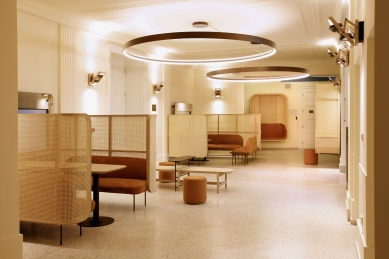
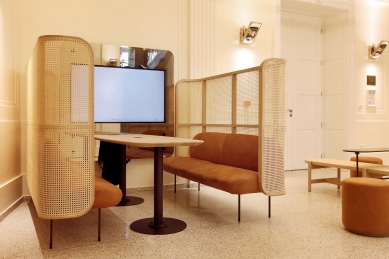
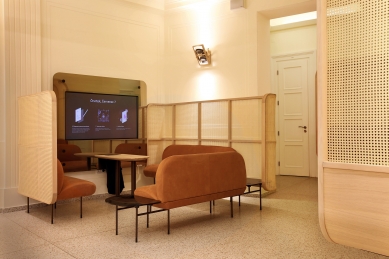
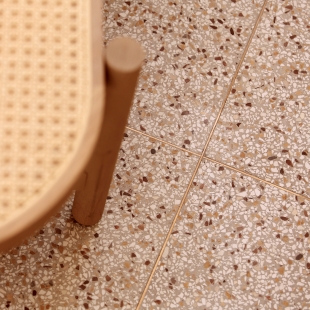
The material and shape solution of the proposed interior sensitively references the representative character of the historical building and supports its neoclassical appearance. To the richly stucco-decorated walls and ceilings, we introduced a lightweight type of furniture created from a slender ash structure with a cane weave. Given the smaller spatial rooms, this type of furniture provides sufficient privacy for all users in busy communication nodes. It seemed appropriate to use this historic furniture-making technology as a connection between two worlds: the world of modern technology and the historic environment of the building. As part of the modifications, we replaced the modern ceramic tiles of format 40x40 cm with a historically closer surface made of cast terrazzo. The surfaces of the walls and ceilings were coordinated with a creamy color that matched the pinkish shade of the cast terrazzo and with the whitened tone of the uniquely designed wooden furniture. An important aspect was also the new quality lighting of the dealt interior parts.
The project is interesting not only because it draws on architecture from the early 20th century and references names such as Michael Thonet and Leopold Bauer, but above all because it views the furnishing of public buildings, schools, universities, and office workplaces somewhat differently than usual. It involves a design for a modular office furniture system that has a wide range of applications. It is flexible and can be assembled into various configurations. It also offers the user a variety of functions (individual and shared workplaces, or waiting and relaxation zones). Therefore, the proposed furniture is suitable for public buildings, hotel lobbies, or office spaces.
The project addresses the issue of inadequate infrastructural facilities at the Silesian University in Opava (SU) for ensuring quality education, enhancing openness, strengthening international cooperation, and increasing interest in studying at the university. The aim of the project was to create a high-quality environment at Silesian University through the improvement of interior, audiovisual, and other equipment, and to enhance the openness and attractiveness of studying at SU. The project supports the development of international cooperation and strengthens the attractiveness of studying at Silesian University. Thanks to the project, the perception of SU as a modern and progressive family-type university providing internationally competitive education has been significantly supported.
The subject of our delivery was the design and development of a project for atypical furniture elements and their incorporation into the existing spaces of the rectorate building without the need for major construction interventions into the building. The rectorate building is located in the center of Opava, at the corner of Na rybníčku and Olbrichova streets, with its main facade facing the Republic Square. The building consists of 5 above-ground floors including the original attic (5NP), and 1 underground floor. The interior modifications focused on selected common parts of the building, corridor spaces, and the entrance foyer (1NP-3NP), as well as a large closed training room on the 3rd floor and a multipurpose classroom in the basement. The project also included the technological modernization of the representative hall of the auditorium.
The impressive classicizing building originally served as a military command with a representative ballroom in the first quarter of the last century and has been serving the university since 2003.
The material and shape solution of the proposed interior sensitively references the representative character of the historical building and supports its neoclassical appearance. To the richly stucco-decorated walls and ceilings, we introduced a lightweight type of furniture created from a slender ash structure with a cane weave. Given the smaller spatial rooms, this type of furniture provides sufficient privacy for all users in busy communication nodes. It seemed appropriate to use this historic furniture-making technology as a connection between two worlds: the world of modern technology and the historic environment of the building. As part of the modifications, we replaced the modern ceramic tiles of format 40x40 cm with a historically closer surface made of cast terrazzo. The surfaces of the walls and ceilings were coordinated with a creamy color that matched the pinkish shade of the cast terrazzo and with the whitened tone of the uniquely designed wooden furniture. An important aspect was also the new quality lighting of the dealt interior parts.
The project is interesting not only because it draws on architecture from the early 20th century and references names such as Michael Thonet and Leopold Bauer, but above all because it views the furnishing of public buildings, schools, universities, and office workplaces somewhat differently than usual. It involves a design for a modular office furniture system that has a wide range of applications. It is flexible and can be assembled into various configurations. It also offers the user a variety of functions (individual and shared workplaces, or waiting and relaxation zones). Therefore, the proposed furniture is suitable for public buildings, hotel lobbies, or office spaces.
IO Studio
The English translation is powered by AI tool. Switch to Czech to view the original text source.






0 comments
add comment