
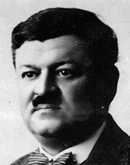
Čeněk Musil
*5. 3. 1889 – Kolín, Czech Republic
†1. 11. 1947 – Jičín, Czech Republic
Biography
Čeněk Musil was a Czech architect and urban planner, who predominantly worked in Jičín and significantly influenced the town's appearance during the First Republic. His work features elements of neoclassicism, functionalism, and constructivism, and he was also inspired by Jan Kotěra. In his work, he always paid careful attention to the sensitive integration of proposed objects into the surrounding space; he applied this approach as the author of the regulatory plan for Jičín (1930-35).
He came from Kolín, attended high school in Jičín, and after graduating in 1908, continued his studies at the Civil Engineering School of CVUT (1908–13), concurrently studying architecture at the Academy of Fine Arts. After World War I, he settled in Jičín, where he opened a design office in 1923. Although he was not the only architect in Jičín, over time he gained a prominent position, winning public competitions and directly obtaining many commissions. His first significant realization was the project for the Jičín district hospital complex (1923–30), after which he designed numerous public buildings (schools, financial institutions) and private houses. Among his most significant works is the functionalist building of the Masaryk Business Academy on 17. listopadu Street under the castle garden. His regulatory plan for Jičín was one of the very first regulatory plans in Bohemia (1930–1935). He was concurrently working on the regulatory plan for Lázně Bělohrad (1929–1931). He tried to establish himself in Prague, which he did not succeed in, but at the turn of the 1920s and 1930s, he began to make a name for himself throughout the Jičín district. In several municipalities and towns, sports halls and schools were built according to his designs, and he created a new landmark for the square in Nová Paka with the building of the City Savings Bank (1930–1934). During World War II, he had to limit his activities; after 1945, he co-authored a treatise on the post-war reconstruction of Jičín with his colleague Václav Šťastný and co-founded the East Bohemian Stavoprojekt (1947). He did not manage to realize his other plans, as his design office was closed after his sudden death in 1947.
In addition to his profession as an architect, he also excelled as a scenographer and artist; moreover, he actively participated in public life in Jičín and was a member of several associations, serving as the city engineer of Jičín as well.
The English translation is powered by AI tool. Switch to Czech to view the original text source.