
The Office for Non Precarious Future
18. Venice Biennale of Architecture

INTRODUCTION
The national presentation of the Czech Republic at the 18th Venice Biennale of Architecture addresses the conditions under which architecture is created. The theme of work resonates particularly among younger generations within the framework of international discourse; however, it ultimately represents a critical reflection on the discipline as a whole. The project "The Office for a Non Precarious Future" poses a key question in the context of the architectural profession: "How can we design a better future for all when we cannot ensure a dignified present even for ourselves?"
CONCEPT
The main goal is to give the audience a glimpse beneath the polished surface of architecture, a prestigious field with the ambition to change the world, whose internal problems are not immediately apparent. The moment of understanding is a crucial point of the dramaturgy. The exhibition is based on a systematic approach, with the specific theme of working conditions situated within a broader social context. The basic structure of the content consists of a triad: WHAT (the problem posed) – WHY (the causes of this problem) – HOW (its possible solutions). This logic is reflected in the spatial solution, where all parts take different forms but hold equal significance: realizing the very existence of the problem and understanding its causes is as important as its potential solutions.
ARCHITECTURE
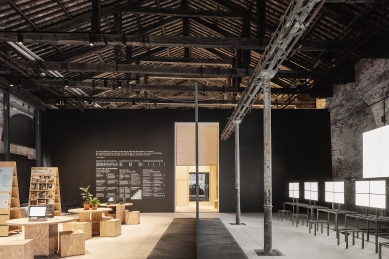
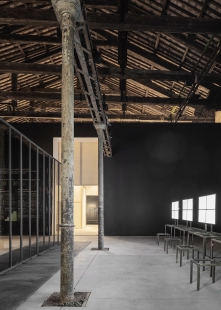
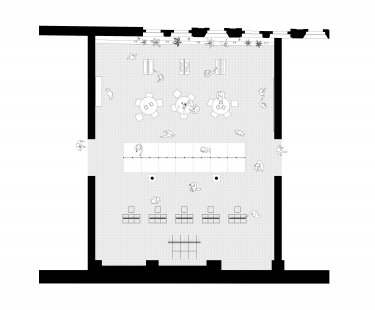
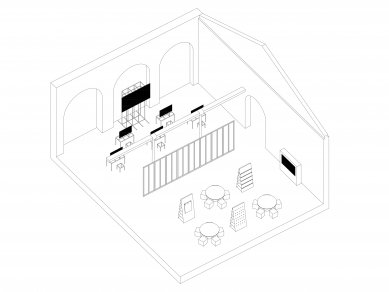
The complex approach is also expressed through the architecture of the exhibition, which offers visitors diverse spaces and ways to interact and immerse themselves in the complicated topic. The main spatial concept is divided into a Factory section and a Laboratory section. The Factory symbolizes negative stereotypes and the status quo of the field. The clearly hierarchical space embodies the individualistic following of the cult of architecture as a mission. The strict steel grid, empty screens, and unusable furniture can be understood as a self-ironic commentary.
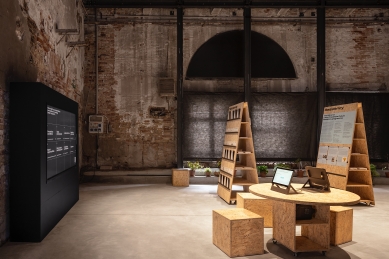
The inclusive Laboratory functions on the opposite principle: information is readable, and the furniture allows for seating and collaboration. Materials, accessories, and light create a welcoming environment for personal activity and shaping the future. The dividing element between both worlds is a monumental partition that also allows a glimpse beneath the shiny reality of contemporary architecture. The sole and rather derided architectural element of the exhibition thus serves as a certain form of self-reflection.
DRAMATURGY
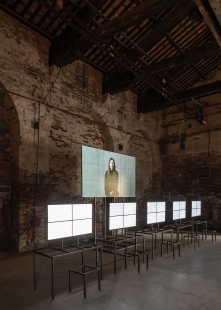
The exhibition deliberately places certain demands on the audience: just like in the real world, understanding requires at least minimal effort. Upon first encountering the installation, the audience perceives a series of empty office monitors emanating white light. Above them towers a large-format screen, resembling an altar, posing urgent questions without answers. A part of the oppressive atmosphere is also the sound layer, composed of unsettling noises and a rhythm drawing attention to the passing time – something is not right. Answers are revealed only when peering through the partition equipped with a polarizing filter, which allows one to see the content on the previously empty white screens. The image is inverted by the filter and displayed on a dark background. This principle symbolizes the fact that the issue of working conditions may not be immediately evident.
CONTENT
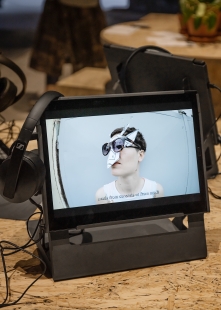
The current state of the architectural profession, which exhibits many signs of precarization, is presented in the Factory. This occurs first on a personal level through the testimonies of young architects and architectresses, and secondly on an objective level, presenting data from Czech and European research on this topic. In the Laboratory space, the causes of this state are articulated in the form of essential questions related to working in architecture. How can we contribute to the creation of a better future if:
...we work in precarious conditions?
...we consider a toxic environment to be normal?
...we learn to work out of love for architecture?
...opportunities in architecture are not equal?
...people do not need architecture?
...we strive for authorship?
...the profession as a whole is fragmented?
The Laboratory also offers potential solutions, including examples of good practice. Tools for addressing these issues are divided into individual, collective, and systemic, as the problems of working conditions manifest themselves differently at each of these levels. As Rob Hopkins writes: if we wait for the government, it will be too late. If we act individually, it will not be enough. Only if we act together can it be sufficient and timely.
An essential aspect of the exhibition is its multi-layeredness and participation. Thanks to the various levels of information, the exhibition can communicate with the broadest audience in just a few seconds while also offering the possibility of deep, expert immersion for those interested. This is accompanied by a wide range of activities for visitors, who can watch videos, study data on interactive screens, participate in surveys, use tools to improve their own situation, share their experiences, or simply sit down and relax.
CONCLUSION
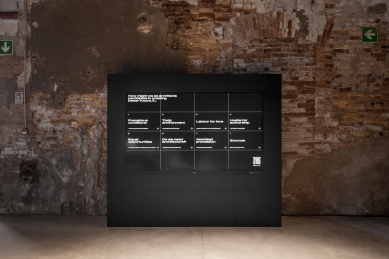
The core element of the installation and, consequently, the entire visual style is the recycled monitor screen. The standard screen size of 16:9, together with the grid principle and black-and-white contrast, defines the graphic identity of the entire project.
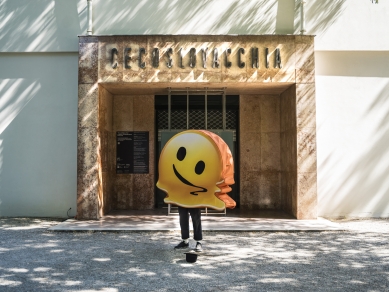
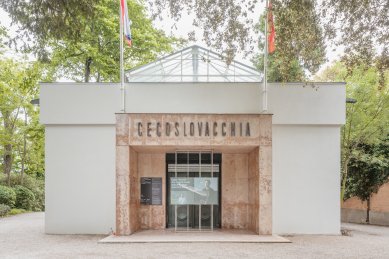
Due to the long-term reconstruction of the Czech-Slovak pavilion, the core of the exhibition was unusually located in a rented space in the Arsenale, while a digital totem was placed in front of the closed pavilion in Giardini. The exhibition was meant to be presented at the Veletržní Palace after the conclusion of the Venice Biennale, but the National Gallery ultimately abandoned this plan.
The national presentation of the Czech Republic at the 18th Venice Biennale of Architecture addresses the conditions under which architecture is created. The theme of work resonates particularly among younger generations within the framework of international discourse; however, it ultimately represents a critical reflection on the discipline as a whole. The project "The Office for a Non Precarious Future" poses a key question in the context of the architectural profession: "How can we design a better future for all when we cannot ensure a dignified present even for ourselves?"
CONCEPT
The main goal is to give the audience a glimpse beneath the polished surface of architecture, a prestigious field with the ambition to change the world, whose internal problems are not immediately apparent. The moment of understanding is a crucial point of the dramaturgy. The exhibition is based on a systematic approach, with the specific theme of working conditions situated within a broader social context. The basic structure of the content consists of a triad: WHAT (the problem posed) – WHY (the causes of this problem) – HOW (its possible solutions). This logic is reflected in the spatial solution, where all parts take different forms but hold equal significance: realizing the very existence of the problem and understanding its causes is as important as its potential solutions.
ARCHITECTURE
The complex approach is also expressed through the architecture of the exhibition, which offers visitors diverse spaces and ways to interact and immerse themselves in the complicated topic. The main spatial concept is divided into a Factory section and a Laboratory section. The Factory symbolizes negative stereotypes and the status quo of the field. The clearly hierarchical space embodies the individualistic following of the cult of architecture as a mission. The strict steel grid, empty screens, and unusable furniture can be understood as a self-ironic commentary.
The inclusive Laboratory functions on the opposite principle: information is readable, and the furniture allows for seating and collaboration. Materials, accessories, and light create a welcoming environment for personal activity and shaping the future. The dividing element between both worlds is a monumental partition that also allows a glimpse beneath the shiny reality of contemporary architecture. The sole and rather derided architectural element of the exhibition thus serves as a certain form of self-reflection.
DRAMATURGY
The exhibition deliberately places certain demands on the audience: just like in the real world, understanding requires at least minimal effort. Upon first encountering the installation, the audience perceives a series of empty office monitors emanating white light. Above them towers a large-format screen, resembling an altar, posing urgent questions without answers. A part of the oppressive atmosphere is also the sound layer, composed of unsettling noises and a rhythm drawing attention to the passing time – something is not right. Answers are revealed only when peering through the partition equipped with a polarizing filter, which allows one to see the content on the previously empty white screens. The image is inverted by the filter and displayed on a dark background. This principle symbolizes the fact that the issue of working conditions may not be immediately evident.
CONTENT
The current state of the architectural profession, which exhibits many signs of precarization, is presented in the Factory. This occurs first on a personal level through the testimonies of young architects and architectresses, and secondly on an objective level, presenting data from Czech and European research on this topic. In the Laboratory space, the causes of this state are articulated in the form of essential questions related to working in architecture. How can we contribute to the creation of a better future if:
...we work in precarious conditions?
...we consider a toxic environment to be normal?
...we learn to work out of love for architecture?
...opportunities in architecture are not equal?
...people do not need architecture?
...we strive for authorship?
...the profession as a whole is fragmented?
The Laboratory also offers potential solutions, including examples of good practice. Tools for addressing these issues are divided into individual, collective, and systemic, as the problems of working conditions manifest themselves differently at each of these levels. As Rob Hopkins writes: if we wait for the government, it will be too late. If we act individually, it will not be enough. Only if we act together can it be sufficient and timely.
An essential aspect of the exhibition is its multi-layeredness and participation. Thanks to the various levels of information, the exhibition can communicate with the broadest audience in just a few seconds while also offering the possibility of deep, expert immersion for those interested. This is accompanied by a wide range of activities for visitors, who can watch videos, study data on interactive screens, participate in surveys, use tools to improve their own situation, share their experiences, or simply sit down and relax.
CONCLUSION
The core element of the installation and, consequently, the entire visual style is the recycled monitor screen. The standard screen size of 16:9, together with the grid principle and black-and-white contrast, defines the graphic identity of the entire project.
Due to the long-term reconstruction of the Czech-Slovak pavilion, the core of the exhibition was unusually located in a rented space in the Arsenale, while a digital totem was placed in front of the closed pavilion in Giardini. The exhibition was meant to be presented at the Veletržní Palace after the conclusion of the Venice Biennale, but the National Gallery ultimately abandoned this plan.
The English translation is powered by AI tool. Switch to Czech to view the original text source.

0 comments
add comment