
Landscape festival Hradec Králové 2026
Urban acupuncture in the Republic Salon
The Landscape Festival transforms Hradec Králové into a temporary laboratory of public space
From the beginning of June until the end of September, the Landscape Festival enters the streets, parks, inner blocks, waterfronts, and overlooked places of Hradec Králové. Temporary architectural and artistic interventions here are not merely objects to observe. They function as questions posed to the city: how do we use public space today, for whom do we create it, and which layers of it have we yet to learn to perceive?
Hradec Králové has, for decades, leaned on the epithet "Salon of the Republic." However, it didn't gain this title solely due to notable buildings by Jan Kotěra, Josef Gočár and other significant architects. Its modern form has primarily been shaped by the city's ability to work with a long-term vision and consistently translate it into urban structure, architecture, and public spaces. An important role was played by mayor František Ulrich, who managed to connect political responsibility with expertise and the courage to transform the city.
However, historical reputation alone does not guarantee the quality of the current urban environment. Even Hradec Králové is now seeking answers to questions that most European cities are addressing: how to deal with brownfields near the center, how to reintegrate the neglected remnants of the former fortress into urban life, how to revitalize public spaces in housing estates and peripheries, or how to better utilize the potential of rivers, parks, and transport infrastructures. Equally important is the need to enhance the presence of contemporary art in public space and involve residents in discussions about its future form.
This year's Landscape Festival opens precisely these topics. An international project that has been connecting landscape architecture, architecture, visual arts, design, and environmental issues for thirteen years, becomes a temporary laboratory of the city in Hradec Králové. The department of the chief architect provides expert collaboration for the festival, and the statutory city financially supports its organization.
Temporality as a method
The festival interventions do not bring ready-made answers or definitive solutions. They enter specific locations in the scale of light installations, benches, tables, pavilions, play elements, or temporary viewpoints. They draw attention to the hidden potential of locations and allow us to test how they could be utilized differently.
Temporality here is not an excuse for being provisional, but a working method. It offers space for experimentation, allows monitoring user reactions, and opens public discussions before a definitive assignment or costly investment is made. Some interventions may disappear after the festival ends; others may be relocated or materially reused. Above all, however, they should leave a new experience of the place.
Therefore, the festival map does not only lead through well-known representative spaces. It connects the main train station, Ulrich Square, and the waterfront with Hostivítova Street, housing estates, spaces under transport infrastructures, former military sites, and places that have thus far remained outside public interest.
The everyday city in a new light
(The numbering of images corresponds to the numbering of installations and exhibits on the festival map, which can be downloaded from landscape-festival.cz, or collected at the Gallery of Modern Art, the buildings of the East Bohemia Museum, RecyUpcy, the Tourist and Information Centre, or the city hall)
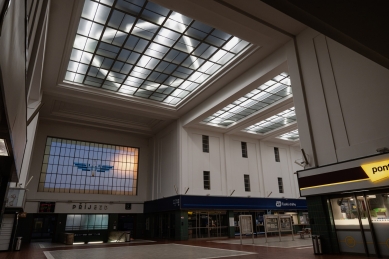
One of the first places that a visitor to Hradec encounters is the main train station. The light installation In-pulse (image 01) by Pavla Korbička works with nine skylights in the monumental check-in hall. Gradually illuminating lines connect its sturdy architectural grid and convey the rhythm of moving travelers. The artistic intervention does not compete with interwar architecture but develops its own geometric and dynamic qualities.
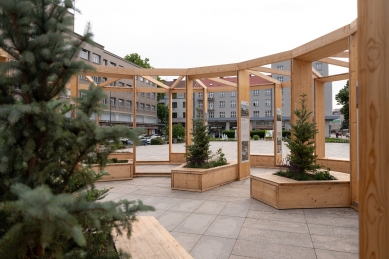
At Ulrich Square, Wooden Oasis (image 08) created by the Prodesi/Domesi studio with plantings by Petra Součková offers a place for sitting, shade, and greenery. The construction made of CLT panels was previously used at the Timber Buildings Salon in Prague. In Hradec, it thus demonstrates both the possibilities of contemporary wooden building and the value of reusing structures and the beauty of a material that gradually records time.
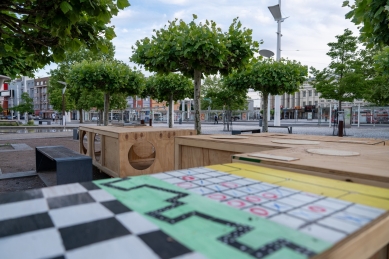
Under the trees in front of the Černigov Hotel, a Common Table (image 02) designed by students from the Department of Fine Arts and Textile Creation at the University of Hradec Králové has been created. Eight mobile modules can be arranged into different configurations and used for work, dining, playing, and simple gatherings. This seemingly simple intervention reminds us that the quality of public space is not determined only by large urban planning decisions, but also by the possibility to comfortably stay somewhere and be with others.
A similar experiment is HRA(D)HAD (image 16) by the Rehwaldt Landscape Architects studio on Hostivítova Street. The colorful arrangement of relaxation platforms and tables for ping-pong primarily responds to the needs of students. It tests various ways of sitting, lying down, meeting, and playing, while also examining whether a street can be not only a route that people pass through but also a place where they want to stay.
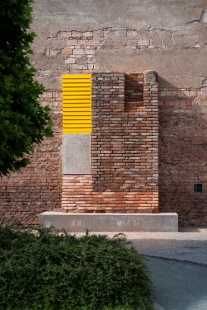
The brick relief GRDC (image 06) by Pavel Dušek connects an artistic work with everyday use. The glazed masonry and sandstone refer to the building culture of modern Hradec and the history of the city’s fortifications; however, the object also serves as a bench. The boundary between art, architecture, and urban furniture intentionally blurs here.
The city’s memory is not a closed chapter: military brownfields
A significant layer of the festival involves working with historical memory. Hradec Králové emerged on the footprint of a former baroque fortress, the remnants of which today simultaneously represent cultural heritage, natural enclaves, and difficult-to-utilize military brownfields.
In the Brewery Flošna, Martin Kocourek and Kurt Gebauer enter the Fortress Dialogue (image 24) through sculptures and objects placed behind the preserved spaces' bars. The military past connects here with natural succession and the experience of the contemporary world, where armed conflicts are again an immediate part of public space and everyday media.
In the Pajkrová Flošna area, ARN studio has created An Outlook Without a View (image 25). The structure works with the principle of a viewpoint, at the end of which, however, the visitor is not greeted by an open panorama, but a textual reminder of the Battle of Hradec Králové in 1866. The historical event is viewed here not as a military image of great history but through the experience of a specific individual.
The memory of the city is also echoed in the exhibition pavilion Homage to MUDr. Ladislav Vančura (image 18) on the piazza in front of the regional court building. The wooden structure resembling a garden pergola and a young apple tree refer to the private world of a prison doctor and resistance fighter who helped the imprisoned during the occupation. The regular rhythm of the pavilion also responds to the monumentality of the court building; however, it translates it into a human scale of stopping, reading, and quiet personal memories. The pavilion, designed by Šárka Dlouhá, serves as a temporary exhibition space where passersby can view the competition proposals for a memorial plaque dedicated to MUDr. Ladislav Vančura.
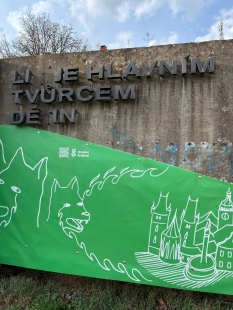
A different way of working with problematic heritage is represented by the project Dog with Fiery Eyes (image 03) by the collcoll studio and its co-authors. It responds to the concrete monument of the former Gallery of Heroes and Pioneers of Socialist Work between U Koruny Street and Sukovy Sady. Instead of removing this inconvenient layer of the past, it seeks a way to reinterpret it through contemporary artistic intervention.
Space for children, seniors, and those who want to swim
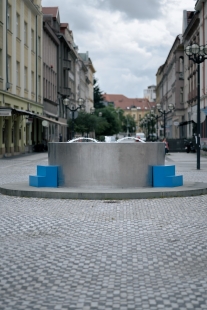
The festival also highlights that public space is not equally accessible and understandable to everyone. The Compensatory Furniture (image 09) by Pavlína Jindrová responds to the scale of a young visitor for whom the interior of Michal Gabriel's fountain remains hidden. Small steps allow children to climb higher and become equal observers of the work. The acupuncture intervention reveals barriers that adults often overlook.
The intervention Metuje – Lightening Playground (image 30) by the collective Hra_na addresses the opposite age group. In collaboration with the Arreta home, an outdoor space is created for seniors and persons with reduced self-sufficiency, supplemented with play elements, mini-golf, a stair trainer, and furniture supporting movement and fine motor skills. Playfulness is thus not a privilege of children but a natural part of life at every age.
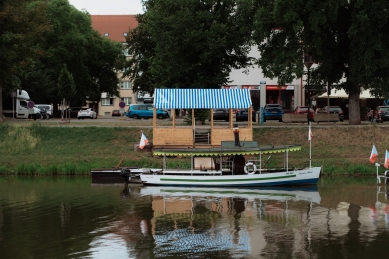
Other interventions draw attention to the rivers of Hradec. The Jetty (image 10) by Ehl & Koumar Architects adds a small shelter for waiting, conversing, and observing life on the water to the Elbe waterfront. The project Beach (image 12) by the collective Hra_na recalls the former informal use of Eliška's waterfront and provocatively opens the question of why a city surrounded by water only utilizes its recreational potential to a limited extent.
From Venice to Hradec
The international dimension of the festival is represented, among other things, by the project In-Between (image 23) by the Japanese studio SUNAKI, authored by Toshikatsu Kiuchi and Taichi Sunayama. The installation in Hradec is a recomposition of a work presented in the Japanese pavilion at the 19th Architecture Biennale in Venice. The ellipse defined by 3D-printed clay elements, copper tape, gravel, and steel opens questions about the relationship between natural, artificial, and collective environments.
Renowned creators and the perspective of the youngest generation
Beneath established Czech and foreign authors, students and emerging creators receive a prominent space. The University of Hradec Králové, the Secondary School of Applied Arts in Sculpture and Stonework in Hořice, and students from architectural and art schools in Brno, Prague, and Ostrava participate in the program. Thus, the festival creates not only a showcase of finished works but also an environment for intergenerational collaboration, workshops, and the implementation of designs directly in the field.
From the center to the region: Červený Kostelec and Vlkov
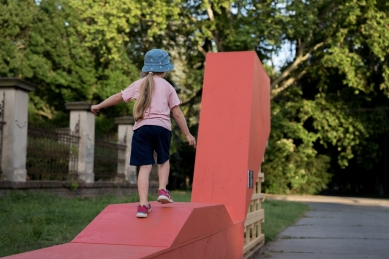
Moreover, the program does not end at the borders of the regional city. In Červený Kostelec, a portable wooden Pavilion - A Place for Play (image 32) designed by Archwerk studio appears in A. B. Svojsík Park. In Vlkov, Med Arkitekt works with the history of the village's name through the installation Vlkov Wolves (image 33) while also presenting the transformation of the originally technical water reservoir into a living space with a jetty, footbridge, and a littoral zone supporting biodiversity. The regional overreach shows that issues of habitation, identity, and climate-sensitive planning do not only concern large cities.
From the festival intervention to long-term transformation
The effort to transcend the framework of a one-off cultural event is most evident in Bidlův Park. The area at the intersection of residential buildings, schools, Gočár's circuit, and the space under the viaduct has long been perceived as incomplete and difficult to read public space. Nonetheless, it has the potential to become an important urban park for students, residents of surrounding streets, families with children, and seniors.
Instead of a simple festival installation, the city has initiated a broader participatory and analytical process led by City Upgrade studio. This includes field mapping, surveys, interviews, meetings with residents, and workshops with students from local schools. The aim is to discover how people actually use the park, what they consider valuable in it, where they don’t feel safe, and what activities or facilities they are missing.
How to find the ideal solution?
The result should not only be a list of wishes but a basis for a future conceptual study and gradual park restoration. The acquired inputs can lead to the first physical interventions, for example, in the space under the bridge, where the atmosphere could be transformed by working with light, art, or temporary architectural structures. The festival acts as a catalyst for a long-term process: it helps to make the place visible, opens communication between the city, schools, and residents, and allows first changes to be collaboratively tested.
The city as a joint work: public space is not a backdrop but part of our everyday life
The Landscape Festival in Hradec Králové is not only a summer showcase of architecture and art. Through installations, exhibitions, guided walks, workshops, and debates, it creates a temporary public institution spread throughout the city. It reminds us that public space is not merely a backdrop between buildings, but a shared infrastructure of everyday life.
Individual interventions may be small and time-limited. However, their strength lies in the ability to disrupt established views, draw attention to overlooked places, or make spaces accessible to people who were forgotten in their design. Just as acupuncture points can also small interventions influence the way we perceive and use the city.
Hradec Králové was historically shaped by a long-term vision and courage to realize its ideas. This year's Landscape Festival poses the question of how similar urban visions can emerge today – in dialogue with architects, artists, local authorities, institutions, and primarily the people who live in the city.
Landscape Festival Hradec Králové 2026
June–September 2026
Hradec Králové, Červený Kostelec, and Vlkov
www.landscape-festival.cz
The Landscape Festival transforms Hradec Králové into a temporary laboratory of public space
From the beginning of June until the end of September, the Landscape Festival enters the streets, parks, inner blocks, waterfronts, and overlooked places of Hradec Králové. Temporary architectural and artistic interventions here are not merely objects to observe. They function as questions posed to the city: how do we use public space today, for whom do we create it, and which layers of it have we yet to learn to perceive?
Hradec Králové has, for decades, leaned on the epithet "Salon of the Republic." However, it didn't gain this title solely due to notable buildings by Jan Kotěra, Josef Gočár and other significant architects. Its modern form has primarily been shaped by the city's ability to work with a long-term vision and consistently translate it into urban structure, architecture, and public spaces. An important role was played by mayor František Ulrich, who managed to connect political responsibility with expertise and the courage to transform the city.
However, historical reputation alone does not guarantee the quality of the current urban environment. Even Hradec Králové is now seeking answers to questions that most European cities are addressing: how to deal with brownfields near the center, how to reintegrate the neglected remnants of the former fortress into urban life, how to revitalize public spaces in housing estates and peripheries, or how to better utilize the potential of rivers, parks, and transport infrastructures. Equally important is the need to enhance the presence of contemporary art in public space and involve residents in discussions about its future form.
This year's Landscape Festival opens precisely these topics. An international project that has been connecting landscape architecture, architecture, visual arts, design, and environmental issues for thirteen years, becomes a temporary laboratory of the city in Hradec Králové. The department of the chief architect provides expert collaboration for the festival, and the statutory city financially supports its organization.
Temporality as a method
The festival interventions do not bring ready-made answers or definitive solutions. They enter specific locations in the scale of light installations, benches, tables, pavilions, play elements, or temporary viewpoints. They draw attention to the hidden potential of locations and allow us to test how they could be utilized differently.
Temporality here is not an excuse for being provisional, but a working method. It offers space for experimentation, allows monitoring user reactions, and opens public discussions before a definitive assignment or costly investment is made. Some interventions may disappear after the festival ends; others may be relocated or materially reused. Above all, however, they should leave a new experience of the place.
Therefore, the festival map does not only lead through well-known representative spaces. It connects the main train station, Ulrich Square, and the waterfront with Hostivítova Street, housing estates, spaces under transport infrastructures, former military sites, and places that have thus far remained outside public interest.
The everyday city in a new light
(The numbering of images corresponds to the numbering of installations and exhibits on the festival map, which can be downloaded from landscape-festival.cz, or collected at the Gallery of Modern Art, the buildings of the East Bohemia Museum, RecyUpcy, the Tourist and Information Centre, or the city hall)
One of the first places that a visitor to Hradec encounters is the main train station. The light installation In-pulse (image 01) by Pavla Korbička works with nine skylights in the monumental check-in hall. Gradually illuminating lines connect its sturdy architectural grid and convey the rhythm of moving travelers. The artistic intervention does not compete with interwar architecture but develops its own geometric and dynamic qualities.
At Ulrich Square, Wooden Oasis (image 08) created by the Prodesi/Domesi studio with plantings by Petra Součková offers a place for sitting, shade, and greenery. The construction made of CLT panels was previously used at the Timber Buildings Salon in Prague. In Hradec, it thus demonstrates both the possibilities of contemporary wooden building and the value of reusing structures and the beauty of a material that gradually records time.
Under the trees in front of the Černigov Hotel, a Common Table (image 02) designed by students from the Department of Fine Arts and Textile Creation at the University of Hradec Králové has been created. Eight mobile modules can be arranged into different configurations and used for work, dining, playing, and simple gatherings. This seemingly simple intervention reminds us that the quality of public space is not determined only by large urban planning decisions, but also by the possibility to comfortably stay somewhere and be with others.
A similar experiment is HRA(D)HAD (image 16) by the Rehwaldt Landscape Architects studio on Hostivítova Street. The colorful arrangement of relaxation platforms and tables for ping-pong primarily responds to the needs of students. It tests various ways of sitting, lying down, meeting, and playing, while also examining whether a street can be not only a route that people pass through but also a place where they want to stay.
The brick relief GRDC (image 06) by Pavel Dušek connects an artistic work with everyday use. The glazed masonry and sandstone refer to the building culture of modern Hradec and the history of the city’s fortifications; however, the object also serves as a bench. The boundary between art, architecture, and urban furniture intentionally blurs here.
The city’s memory is not a closed chapter: military brownfields
A significant layer of the festival involves working with historical memory. Hradec Králové emerged on the footprint of a former baroque fortress, the remnants of which today simultaneously represent cultural heritage, natural enclaves, and difficult-to-utilize military brownfields.
In the Brewery Flošna, Martin Kocourek and Kurt Gebauer enter the Fortress Dialogue (image 24) through sculptures and objects placed behind the preserved spaces' bars. The military past connects here with natural succession and the experience of the contemporary world, where armed conflicts are again an immediate part of public space and everyday media.
In the Pajkrová Flošna area, ARN studio has created An Outlook Without a View (image 25). The structure works with the principle of a viewpoint, at the end of which, however, the visitor is not greeted by an open panorama, but a textual reminder of the Battle of Hradec Králové in 1866. The historical event is viewed here not as a military image of great history but through the experience of a specific individual.
The memory of the city is also echoed in the exhibition pavilion Homage to MUDr. Ladislav Vančura (image 18) on the piazza in front of the regional court building. The wooden structure resembling a garden pergola and a young apple tree refer to the private world of a prison doctor and resistance fighter who helped the imprisoned during the occupation. The regular rhythm of the pavilion also responds to the monumentality of the court building; however, it translates it into a human scale of stopping, reading, and quiet personal memories. The pavilion, designed by Šárka Dlouhá, serves as a temporary exhibition space where passersby can view the competition proposals for a memorial plaque dedicated to MUDr. Ladislav Vančura.
A different way of working with problematic heritage is represented by the project Dog with Fiery Eyes (image 03) by the collcoll studio and its co-authors. It responds to the concrete monument of the former Gallery of Heroes and Pioneers of Socialist Work between U Koruny Street and Sukovy Sady. Instead of removing this inconvenient layer of the past, it seeks a way to reinterpret it through contemporary artistic intervention.
Space for children, seniors, and those who want to swim
The festival also highlights that public space is not equally accessible and understandable to everyone. The Compensatory Furniture (image 09) by Pavlína Jindrová responds to the scale of a young visitor for whom the interior of Michal Gabriel's fountain remains hidden. Small steps allow children to climb higher and become equal observers of the work. The acupuncture intervention reveals barriers that adults often overlook.
The intervention Metuje – Lightening Playground (image 30) by the collective Hra_na addresses the opposite age group. In collaboration with the Arreta home, an outdoor space is created for seniors and persons with reduced self-sufficiency, supplemented with play elements, mini-golf, a stair trainer, and furniture supporting movement and fine motor skills. Playfulness is thus not a privilege of children but a natural part of life at every age.
Other interventions draw attention to the rivers of Hradec. The Jetty (image 10) by Ehl & Koumar Architects adds a small shelter for waiting, conversing, and observing life on the water to the Elbe waterfront. The project Beach (image 12) by the collective Hra_na recalls the former informal use of Eliška's waterfront and provocatively opens the question of why a city surrounded by water only utilizes its recreational potential to a limited extent.
From Venice to Hradec
The international dimension of the festival is represented, among other things, by the project In-Between (image 23) by the Japanese studio SUNAKI, authored by Toshikatsu Kiuchi and Taichi Sunayama. The installation in Hradec is a recomposition of a work presented in the Japanese pavilion at the 19th Architecture Biennale in Venice. The ellipse defined by 3D-printed clay elements, copper tape, gravel, and steel opens questions about the relationship between natural, artificial, and collective environments.
Renowned creators and the perspective of the youngest generation
Beneath established Czech and foreign authors, students and emerging creators receive a prominent space. The University of Hradec Králové, the Secondary School of Applied Arts in Sculpture and Stonework in Hořice, and students from architectural and art schools in Brno, Prague, and Ostrava participate in the program. Thus, the festival creates not only a showcase of finished works but also an environment for intergenerational collaboration, workshops, and the implementation of designs directly in the field.
From the center to the region: Červený Kostelec and Vlkov
Moreover, the program does not end at the borders of the regional city. In Červený Kostelec, a portable wooden Pavilion - A Place for Play (image 32) designed by Archwerk studio appears in A. B. Svojsík Park. In Vlkov, Med Arkitekt works with the history of the village's name through the installation Vlkov Wolves (image 33) while also presenting the transformation of the originally technical water reservoir into a living space with a jetty, footbridge, and a littoral zone supporting biodiversity. The regional overreach shows that issues of habitation, identity, and climate-sensitive planning do not only concern large cities.
From the festival intervention to long-term transformation
The effort to transcend the framework of a one-off cultural event is most evident in Bidlův Park. The area at the intersection of residential buildings, schools, Gočár's circuit, and the space under the viaduct has long been perceived as incomplete and difficult to read public space. Nonetheless, it has the potential to become an important urban park for students, residents of surrounding streets, families with children, and seniors.
Instead of a simple festival installation, the city has initiated a broader participatory and analytical process led by City Upgrade studio. This includes field mapping, surveys, interviews, meetings with residents, and workshops with students from local schools. The aim is to discover how people actually use the park, what they consider valuable in it, where they don’t feel safe, and what activities or facilities they are missing.
How to find the ideal solution?
The result should not only be a list of wishes but a basis for a future conceptual study and gradual park restoration. The acquired inputs can lead to the first physical interventions, for example, in the space under the bridge, where the atmosphere could be transformed by working with light, art, or temporary architectural structures. The festival acts as a catalyst for a long-term process: it helps to make the place visible, opens communication between the city, schools, and residents, and allows first changes to be collaboratively tested.
The city as a joint work: public space is not a backdrop but part of our everyday life
The Landscape Festival in Hradec Králové is not only a summer showcase of architecture and art. Through installations, exhibitions, guided walks, workshops, and debates, it creates a temporary public institution spread throughout the city. It reminds us that public space is not merely a backdrop between buildings, but a shared infrastructure of everyday life.
Individual interventions may be small and time-limited. However, their strength lies in the ability to disrupt established views, draw attention to overlooked places, or make spaces accessible to people who were forgotten in their design. Just as acupuncture points can also small interventions influence the way we perceive and use the city.
Hradec Králové was historically shaped by a long-term vision and courage to realize its ideas. This year's Landscape Festival poses the question of how similar urban visions can emerge today – in dialogue with architects, artists, local authorities, institutions, and primarily the people who live in the city.
Landscape Festival Hradec Králové 2026
June–September 2026
Hradec Králové, Červený Kostelec, and Vlkov
www.landscape-festival.cz
The English translation is powered by AI tool. Switch to Czech to view the original text source.
0 comments
add comment