
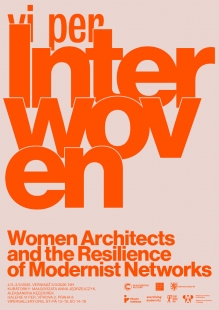
Interwoven: Women Architects and the Resilience of Modernist Networks
The exhibition explores the resilience and vulnerability of architectural networks in turbulent times. It revisits the history of the International Congresses of Modern Architecture (Congrès Internationaux d’Architecture Moderne, CIAM), viewed from the perspective of their female protagonists in Central Europe, such as Helena Syrkus, Barbara Brukalska, Margarete Schütte-Lihotzky, and Ise Gropius. It reflects on the ways women contributed to building communities, exchanging ideas, and establishing international connections that later shaped the architectural discourse of modernity.
Women operated as architects and designers, but also as secretaries, translators, and editors, entering into new – and yet largely invisible – realms of architectural practice. Within this “performing” of gender, they played a key role in creating and maintaining networks of collaboration, facilitating the transfer of ideas, and globally disseminating architectural concepts. These connections were deeply disrupted (though not entirely severed) by pivotal events starting with World War II, the emergence of the Eastern Bloc and the Iron Curtain, and the rise of the communists to power. The exhibition thus not only narrates the history of architecture but also a broader experience of Central and Eastern Europe, shaped by geopolitical upheavals, shifts in borders, and changes in political systems.
The project offers space for reflection on the status of women in architecture and presents them through the practice of design and the role they played in pushing the boundaries of the entire field. Often invisible and marginalized forms of work disrupt the linear narrative of “iconic” projects, challenge biases in architectural historiography, and expand our understanding of architectural practice itself.
This project serves as a prelude to the exhibition Interwoven: Barbara Brukalska, Helena Syrkus, and the Networks of Modernism (Museum of Architecture in Wrocław, June 25 – October 4, 2026).
Curators: Małgorzata Jędrzejczyk, Aleksandra Kędziorek
Exhibition design: Marko Čambor
Co-organized by: Pilecki Institute Berlin, Exercising Modernity
Support: Museum of Architecture in Wrocław, Polish Institute in Prague
Women operated as architects and designers, but also as secretaries, translators, and editors, entering into new – and yet largely invisible – realms of architectural practice. Within this “performing” of gender, they played a key role in creating and maintaining networks of collaboration, facilitating the transfer of ideas, and globally disseminating architectural concepts. These connections were deeply disrupted (though not entirely severed) by pivotal events starting with World War II, the emergence of the Eastern Bloc and the Iron Curtain, and the rise of the communists to power. The exhibition thus not only narrates the history of architecture but also a broader experience of Central and Eastern Europe, shaped by geopolitical upheavals, shifts in borders, and changes in political systems.
The project offers space for reflection on the status of women in architecture and presents them through the practice of design and the role they played in pushing the boundaries of the entire field. Often invisible and marginalized forms of work disrupt the linear narrative of “iconic” projects, challenge biases in architectural historiography, and expand our understanding of architectural practice itself.
This project serves as a prelude to the exhibition Interwoven: Barbara Brukalska, Helena Syrkus, and the Networks of Modernism (Museum of Architecture in Wrocław, June 25 – October 4, 2026).
Curators: Małgorzata Jędrzejczyk, Aleksandra Kędziorek
Exhibition design: Marko Čambor
Co-organized by: Pilecki Institute Berlin, Exercising Modernity
Support: Museum of Architecture in Wrocław, Polish Institute in Prague
The English translation is powered by AI tool. Switch to Czech to view the original text source.

0 comments
add comment