
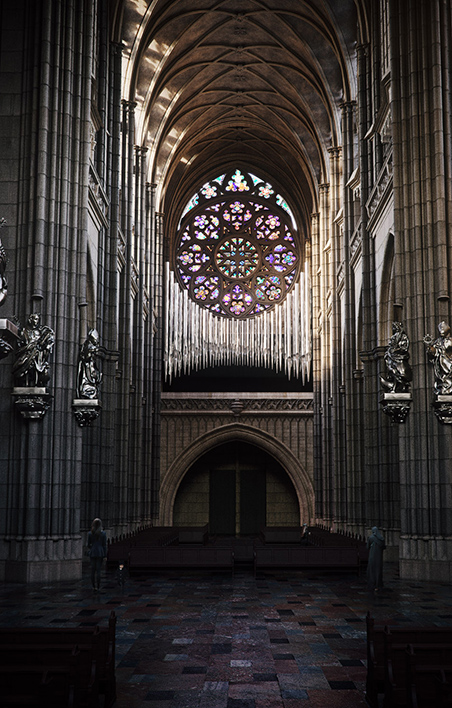
The St. Vitus Cathedral is a symbol of Czech statehood, the organ symbolically completes its construction
 |
- St. Vitus Cathedral, named after St. Vitus, Wenceslaus, and Adalbert, as the church at Prague Castle has been officially called since 1997, is more than just a religious site and the seat of the Archbishop of Prague. Even during its completion in the second half of the 19th century, it seemed to mark the culmination of Czech national emancipation, and its opening in its present form in 1929 was directly associated with Czech and Czechoslovak statehood. The cathedral is also the resting place for the relics of saints, patron saints, monarchs, nobles, and archbishops.
- The consecration and new concert will symbolically conclude the construction of the cathedral nearly seven centuries after the laying of its cornerstone on November 21, 1344, in the presence of King John of Luxembourg and his son, the later King of Bohemia and Holy Roman Emperor Charles IV. The instrument, which according to leading Czech organist and professor at Prague’s HAMU, Jaroslav Tůma, finally fills the entire space of the cathedral with its sound, ranks among the most magnificent cathedral organs in the world. Its creation took a long time, and its purchase was supported by a public collection.
- The organ from the Spanish workshop of organ builder Gerhard Grenzing is not the first instrument to echo in the cathedral. The first mentions of the St. Vitus organs date back to the mid-13th century, when they were played in the predecessor of the Gothic church; however, it is possible that an instrument existed there as early as the previous century. When services began in the incomplete church at the end of the 60s of the 14th century, they were already accompanied by the sound of an organ. These St. Vitus organs apparently even survived the Hussite era when many other instruments were lost, with the mention of them being played dating back to 1436.
- After the year 1500, the church – then having only one tower; the typical pair of slender towers on the western facade were added during the Neo-Gothic completion at the turn of the 19th and 20th centuries – received a new instrument thanks in part to King Vladislav Jagellon’s contribution. However, this organ was destroyed in a fire in 1541, and a similar fate awaited the subsequent so-called Ferdinand's organ, which succumbed to fire during the Prussian bombardment of Prague in 1757. The Tachov organ builder Antonín Gartner then built Baroque organs, which served until the last completion of the church.
- In 1923, during work on the cathedral, the instrument was dismantled, intending to be reassembled after construction. "...most of its parts were literally stolen. In 1929, only their prospect section was assembled on the second level of the gallery, which still serves as a backdrop," states the website of the cathedral. The replacement was completed by the Kutná Hora organ builder Josef Mölzer in 1930. However, it was not sufficient for the temple space, as experts noted that they were only clearly audible in the cross aisle, while the volume dramatically dropped in the main aisle.
- There had long been discussions about the need for a new organ at St. Vitus Cathedral. At the turn of the century, at least the instrument from Mölzer’s workshop was renovated – the first since 1972. A nationwide collection for the acquisition of dignified organs began in 2015, and two years later, Gerhard Grenzing won an international competition. It was initially discussed that the instrument would be completed in 2019, but the deadline was repeatedly postponed due to the COVID-19 pandemic. The installation of the organ began last April, it was completed in August, and then tuning followed.
- The current cathedral is the third church of the same dedication at the same location. Around 925, Prince Wenceslaus I founded a Romanesque rotunda here, where his relics were later interred. The rotunda was rebuilt into a three-nave basilica with two towers after 1060, which was replaced by the Gothic church. Charles IV significantly contributed to its construction, calling the architect Matthäus of Arras from France. After his death in 1352, Petr Parléř continued his work, emerging as an audacious reformer of the Gothic style.
- Parléř was ahead of his time in many ways by using elements typical of late Gothic architecture (suspended keystones, net and star vaults, numerous external buttresses and pillars, and more). During his lifetime (he died in 1399), the sanctuary with a wreath of rectangular chapels, the northern sacristy, the southern vestibule, the Chapel of St. Wenceslaus, and partially the southern tower were completed. In 1419, construction was interrupted for more than 400 years; in June 1421, it was plundered by Hussites, and later the church burned down twice (in 1541 and 1757).
- Only in 1844, at the initiative of patriot Václav Michal Pešina of Čechorod, was the Unity for the Completion of St. Vitus Cathedral established. The completion was entrusted to architect Josef Mocker, who gave it its current Neo-Gothic appearance with two towers in the facade. In the first phase from 1861 to 1873, the original church was thoroughly restored, and in 1873 the cornerstone for its new part was laid. After Mocker's death in 1899, Kamil Hilbert took over the leadership. The western part of the nave and the facade with two towers were created between 1873 and 1929.
- In 1925, the original Gothic part of the cathedral was connected with the Neo-Gothic part into a single organic whole; the church interior was furnished with Baroque and Renaissance inventories, complemented by modern artistic works with a sensitive regard to the Gothic style. The ceremonial opening of the not entirely completed church took place on September 28, 1929, on the occasion of the Millennial celebration of St. Wenceslaus. The main completion was finished in September 1938, while the finishing work on the interior was interrupted by the German occupation. After the war, reconstruction continued.
- In 1954, the Unity for the Completion of St. Vitus Cathedral was dissolved, and the management of the cathedral was transferred by government decree to the presidential office. After November 1989, a dispute between the church and the state regarding ownership of the cathedral erupted, which became one of the important social issues of the 1990s. A significant role was played by writer and screenwriter Zdeněk Mahler, who in 1994 presented his view on the history of St. Vitus Cathedral in a television series and later in a book. Mahler opposed the return of the cathedral to the church.
- During the years-long dispute that began on December 30, 1992, courts of various levels gradually awarded the cathedral to both the church and the state. The last final ruling from April 2008 rejected the church's claim, but ultimately, in May 2010, then-Archbishop Dominik Duka and President Václav Klaus signed an agreement under which both the state and the church would care for the cathedral together. The law on property settlement between the state and churches, passed in 2012, explicitly states that this restitution norm does not apply to St. Vitus Cathedral.
The English translation is powered by AI tool. Switch to Czech to view the original text source.

0 comments
add comment
Related articles
0
15.06.2026 | In St. Vitus Cathedral, the blessing of new organs will take place today
0
09.05.2019 | It will be 90 years since the consecration of the cathedral at Prague Castle.
0
25.04.2017 | New organs for St. Vitus Cathedral will be built by a company from Barcelona
0
20.04.2011 | The St. Vitus Cathedral will receive new bells and possibly also an organ