
House in Dolná Lehota

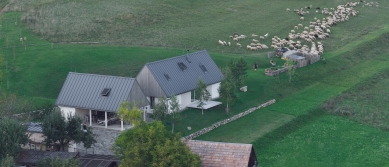
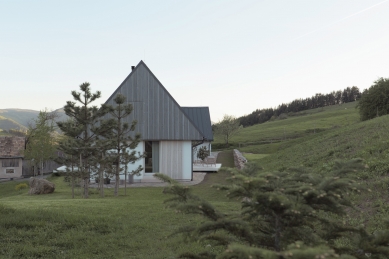
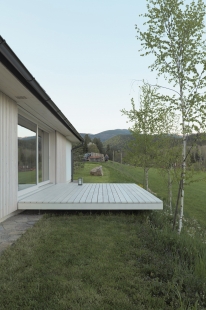
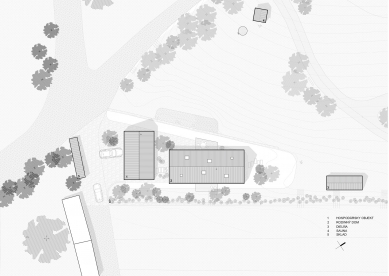
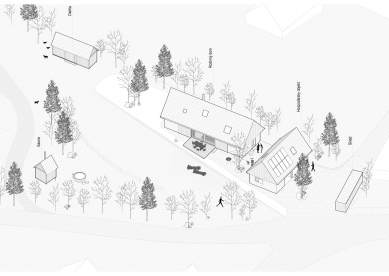
The shape of the family house situated at the foothills of the Low Tatras in a historically traditional Slovak village has been defined from the very beginning by the surrounding environment and the circumstances of its construction. The spacious plot is located at the very end of the village and spatially encloses a group of houses, whose owners and family relatives have inhabited this place for generations. Strong ties to the values of this mountainous environment, combined with the memory of the original wooden houses, have influenced the architecture of the building not only in the form of an archetypal mass with a gabled roof but also in the structural solution and urban composition.
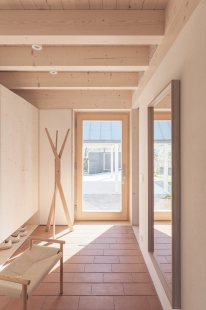
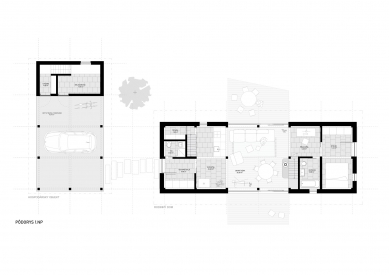
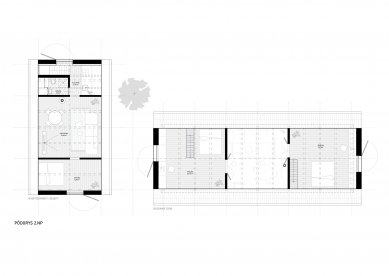
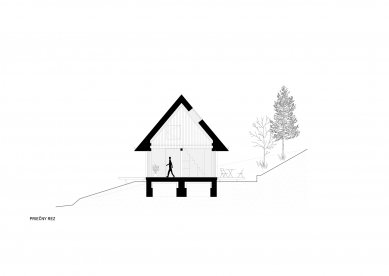
The architectural and construction principle of the two main buildings is based on a wooden skeleton structure, arranged in a uniform modular system of 2.5x2.5 m. This solution was chosen for several reasons. In the case of the family house itself, its internal space allows it to be divided into three equal sections depending on their function. Just as in the original rural wooden houses, one entered into the central hall / vestibule, which was followed by a room on one side and a pantry on the other, in this case, the sections of the house are similarly defined as a central living area, a bedroom with a bathroom, and a utility part in the form of a kitchen, pantry, and entrance hall. The same construction system in the form of two modules was also used in the smaller structure of the parking shelter with a workshop. However, another equally important factor was the possibility of self-building such a structure. Referring to traditional folk construction in this case is not merely a formal gesture in the form of the material range used or the architectural mass, but also a return to manual labor, the communal way of rural life, and the technical skills of the owners. After designing and preparing the individual parts of the basic construction system, almost all the work was carried out over the following six years by individual family members, relatives, and friends. This approach also allowed the authors, in addition to significantly reducing financial costs, to test and adapt the individually tailored details during the construction process.
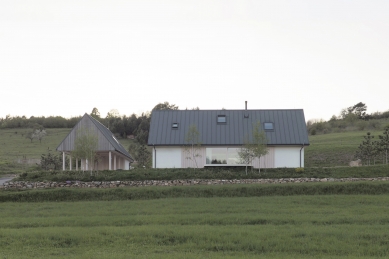
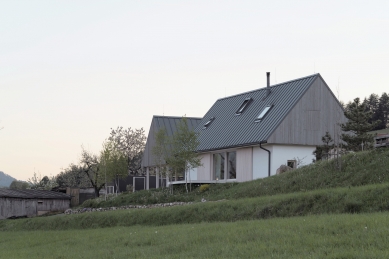
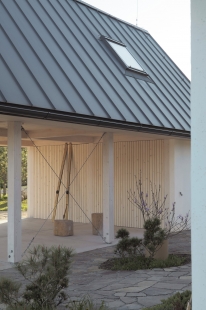
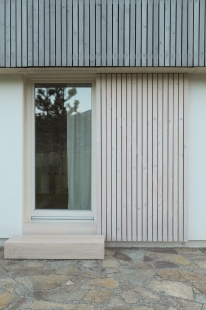
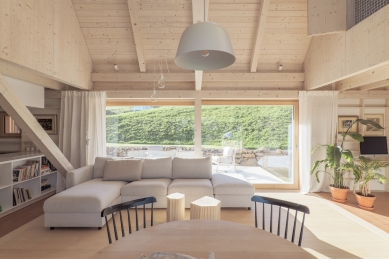
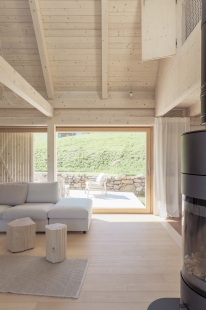
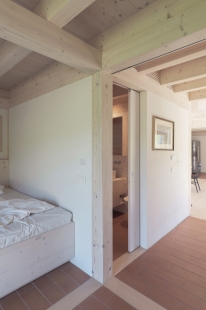
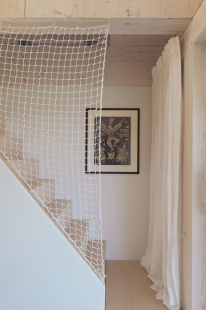
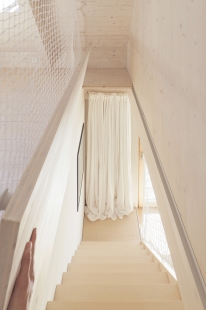
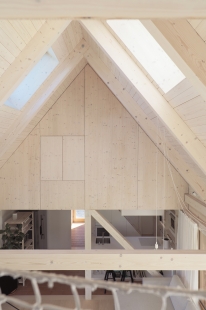
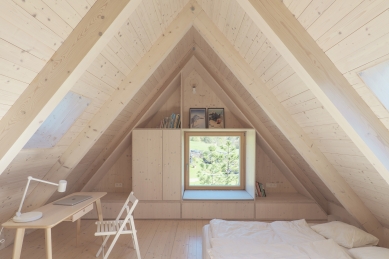
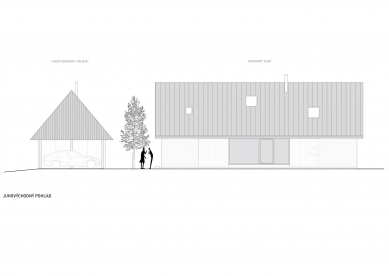
The architecture of the house corresponds to this. Its goal was to transform these traditional architectural principles into a new form, ensuring that, while maintaining a simple building, an airy and well-lit space was created that reflects the needs of contemporary living with an emphasis on craftsmanship details. All living spaces are therefore visually interconnected. The main living space in the central part of the layout is open to the attic and connected to the exterior through a sliding glazed façade. The attic spaces above the kitchen and bedroom zone, on the other hand, are utilized as guest rooms. The construction of the wooden skeleton is acknowledged in the interior and serves as an important artistic element. It is complemented in color by the traditional clay floor in the peripheral sections of the layout and simple white plaster of the dividing walls on the ground floor. On the outside of the house, the white plaster transitions to a structured coarse-grained finish. The gable walls of the house, on the other hand, are clad in gray wooden slats, which, along with the metal roof, emphasize the simple geometry of the building.
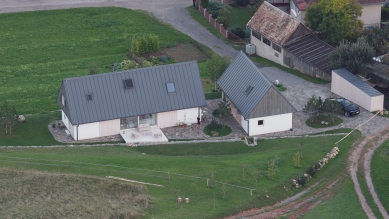
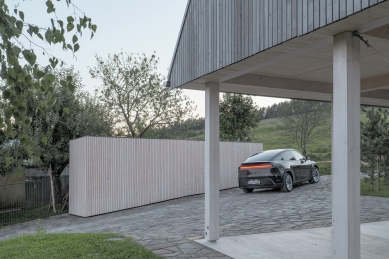
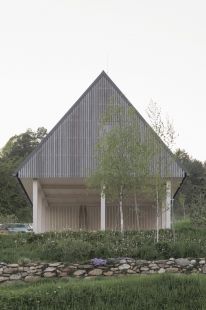
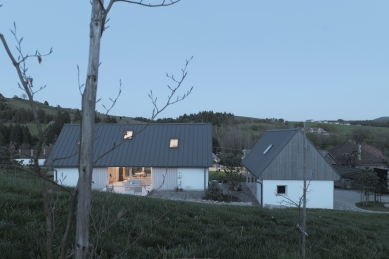
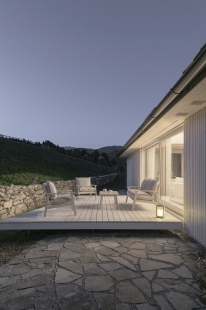
The same architectural and artistic principle is applied in the construction of the parking shelter. It is situated perpendicular to the main building, creating an entrance space from an urban planning perspective and simultaneously visually enclosing the outdoor living hardened areas on the western side of the plot. This composition also anticipates possible expansion of the development with smaller temporary living structures based on the same architectural and construction principles. The aim of the design was thus to create a spatially rational, timeless, and authentically local architecture that aspires to cultivate its immediate surroundings.
The architectural and construction principle of the two main buildings is based on a wooden skeleton structure, arranged in a uniform modular system of 2.5x2.5 m. This solution was chosen for several reasons. In the case of the family house itself, its internal space allows it to be divided into three equal sections depending on their function. Just as in the original rural wooden houses, one entered into the central hall / vestibule, which was followed by a room on one side and a pantry on the other, in this case, the sections of the house are similarly defined as a central living area, a bedroom with a bathroom, and a utility part in the form of a kitchen, pantry, and entrance hall. The same construction system in the form of two modules was also used in the smaller structure of the parking shelter with a workshop. However, another equally important factor was the possibility of self-building such a structure. Referring to traditional folk construction in this case is not merely a formal gesture in the form of the material range used or the architectural mass, but also a return to manual labor, the communal way of rural life, and the technical skills of the owners. After designing and preparing the individual parts of the basic construction system, almost all the work was carried out over the following six years by individual family members, relatives, and friends. This approach also allowed the authors, in addition to significantly reducing financial costs, to test and adapt the individually tailored details during the construction process.
The architecture of the house corresponds to this. Its goal was to transform these traditional architectural principles into a new form, ensuring that, while maintaining a simple building, an airy and well-lit space was created that reflects the needs of contemporary living with an emphasis on craftsmanship details. All living spaces are therefore visually interconnected. The main living space in the central part of the layout is open to the attic and connected to the exterior through a sliding glazed façade. The attic spaces above the kitchen and bedroom zone, on the other hand, are utilized as guest rooms. The construction of the wooden skeleton is acknowledged in the interior and serves as an important artistic element. It is complemented in color by the traditional clay floor in the peripheral sections of the layout and simple white plaster of the dividing walls on the ground floor. On the outside of the house, the white plaster transitions to a structured coarse-grained finish. The gable walls of the house, on the other hand, are clad in gray wooden slats, which, along with the metal roof, emphasize the simple geometry of the building.
The same architectural and artistic principle is applied in the construction of the parking shelter. It is situated perpendicular to the main building, creating an entrance space from an urban planning perspective and simultaneously visually enclosing the outdoor living hardened areas on the western side of the plot. This composition also anticipates possible expansion of the development with smaller temporary living structures based on the same architectural and construction principles. The aim of the design was thus to create a spatially rational, timeless, and authentically local architecture that aspires to cultivate its immediate surroundings.
What architects
The English translation is powered by AI tool. Switch to Czech to view the original text source.













0 comments
add comment