
Transportation Terminal Jihlava City
I. stage

In the urban and historical context, the decision to relocate the central transportation terminal appears to be a logical step. The Jihlava město railway station was built in 1887 and has always been considered the main city transport hub. A clear Legionářů avenue leads from here to the historic center, so the terminal will be comfortably connected to the city's urban structure. It is thus not just about a new location, but a long-tested direction and destination.
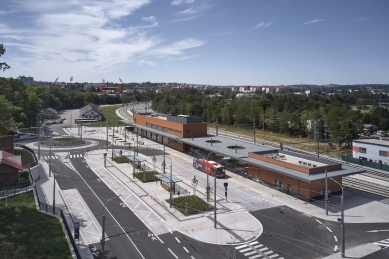
We have tried to create a clear and natural space that will take the form of a public area, thus visually suppressing transportation functions. In its western part, the city plans, according to the original study, to build a bus terminal in the second phase, while in the eastern part a terminal for public transport and a parking lot for cars has already been realized. An important element is also the fountain in front of the train station building, designed as a low circular area that allows for contact with the water surface.
The goal of the construction was to transform the original railway station with an oversized railway yard in unsatisfactory technical condition into a modern station. As part of the construction, the configuration of the railway yard was changed, a new underpass was built, and the original dispatch building was replaced with a new structure. The railway yard has been modified so that the station, conveniently located near the center, becomes the main passenger transport station in Jihlava, with a view towards the connection from the high-speed line Prague–Brno.
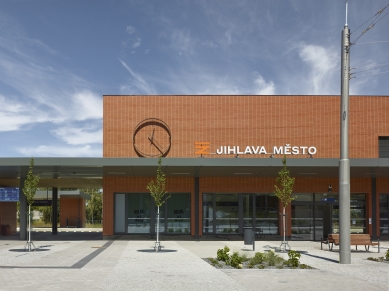
The dispatch building is designed as a two-story structure, with facilities for passengers on the ground floor and spaces for station employees on the upper floor. Architecturally, it consists of two simple cubes clad in brick with a black granite base. In the two-story part is the train hall, shops, and facilities, while the second cube houses technical operations. Both buildings are connected by a common cantilevered cornice and a roof punctured by two circular openings. In the future, this roof will seamlessly connect to the roof of the bus station, following the curve of the passing road. This will lead to the integration of rail, bus, and local trolleybus transport into a single hub.
We have tried to create a clear and natural space that will take the form of a public area, thus visually suppressing transportation functions. In its western part, the city plans, according to the original study, to build a bus terminal in the second phase, while in the eastern part a terminal for public transport and a parking lot for cars has already been realized. An important element is also the fountain in front of the train station building, designed as a low circular area that allows for contact with the water surface.
The goal of the construction was to transform the original railway station with an oversized railway yard in unsatisfactory technical condition into a modern station. As part of the construction, the configuration of the railway yard was changed, a new underpass was built, and the original dispatch building was replaced with a new structure. The railway yard has been modified so that the station, conveniently located near the center, becomes the main passenger transport station in Jihlava, with a view towards the connection from the high-speed line Prague–Brno.
The dispatch building is designed as a two-story structure, with facilities for passengers on the ground floor and spaces for station employees on the upper floor. Architecturally, it consists of two simple cubes clad in brick with a black granite base. In the two-story part is the train hall, shops, and facilities, while the second cube houses technical operations. Both buildings are connected by a common cantilevered cornice and a roof punctured by two circular openings. In the future, this roof will seamlessly connect to the roof of the bus station, following the curve of the passing road. This will lead to the integration of rail, bus, and local trolleybus transport into a single hub.
The English translation is powered by AI tool. Switch to Czech to view the original text source.





0 comments
add comment