
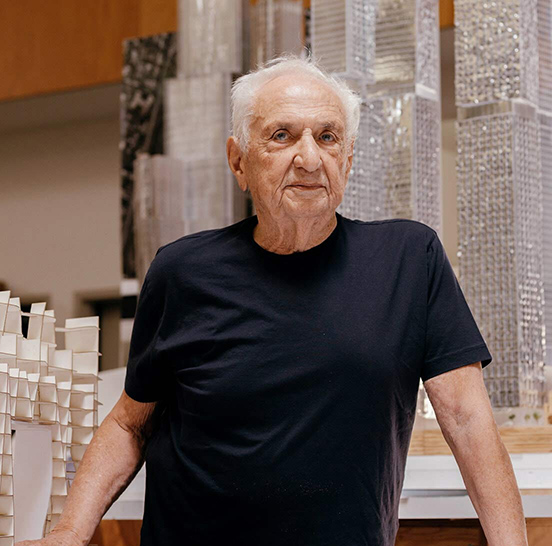
Frank Gehry was the creator of flowing buildings, his signature is also seen in the Dancing House
 |
"I try to design buildings as a response to human feelings," he explained in one of the interviews about world architecture. He mentioned sources of inspiration as varied as Indian sculptures of the god Shiva or the stuffed carp his grandmother prepared for dinner. Among his most famous works is the Walt Disney Concert Hall in Los Angeles, which towers in the city center like a gigantic iron flower, exposing bare metal beams, screws, and pipes, stone stairs, and light wood. Since its opening in October 2003, it has become a symbol of the city, although its appearance has been likened by several critics to a cone filled with fries. However, the residents of Los Angeles have fallen in love with the building, and artists and audiences appreciate its acoustics.
The famous Guggenheim Museum in Bilbao, Spain, from 1997, resembles a spaceship. The limestone, glass, and metal structure covered with panels of titanium sheets defies all traditional forms. The apparent external chaos of curves, arches, waves, and spirals transitions into complete order inside. Gehry's house in Seattle, named Experience Music, looks like a strangely shaped gelatin cake.
And from a distance, the building of the Fondation Louis Vuitton in Paris, which houses a collection of contemporary art, resembles a cluster of sailboats. The 2014 structure consists of more than 3,500 glass panels, and within the building, there are 11 exhibition halls. In recent years, Gehry has designed new modern headquarters for Facebook in Menlo Park, California, a seven-story headquarters for the same company in London's West End, and the colorful Biomuseum in Panama.
The Prague Dancing House, co-authored by Czech architect of Croatian descent Vlado Milunić, is inspired by the facades of the surrounding buildings, mostly Art Nouveau and often featuring towers. The 1996 building, popular among visitors to Prague, was today described by the American newspaper The New York Times as two towers "joined in a wild, ballet-like embrace." The building is nicknamed Ginger and Fred after the American acting and dancing duo of Ginger Rogers and Fred Astaire.
Frank Gehry was born on February 28, 1929, in Toronto, Canada, as Ephraim Owen Goldberg in a poor second-generation Polish Jewish family (his grandfather left Łódź in 1908). As a young man, he reportedly explored the insides of broken toasters and clocks at his grandfather's hardware store in Toronto, building fairy-tale cities from spare parts.
His father's businesses were failing, so they moved to Los Angeles. Gehry, who changed his name in 1956, installed dining nooks in houses during the day and studied architecture at the University of Southern California in the evenings. He graduated in 1951 and then studied urban planning at Harvard University from 1956 to 1957.
In 1962, he established his own firm in Los Angeles, initially working on shopping center projects and similar commercial contracts. In the late 1970s, he first remodeled his simple house in Santa Monica. He used wire fencing, corrugated metal fences, and bare wooden beams. The neighbors found the house ugly and hated the building - one of them would let their dog relieve itself on it. "It wasn't a provocation; I just didn't have much money for the remodel," Gehry insisted. "Then it occurred to me that it's aesthetically interesting. So why not turn low costs into an advantage?"
A former passionate hockey player and admirer of Jaromír Jágr, he also worked in paper design, naming cardboard chairs things like Krosček, Vysoká hůl, and Power Play. After hitting the market, his furniture became a hit, and design students still learn about it today. He concluded the cardboard idea epidemic in the 1980s with the legendary chair Little Beaver.
Gehry, who also tried his hand at being a set designer, designed jewelry and various trophies, was twice married and had four children. Gehry held Canadian and American citizenship and lived in Santa Monica, California, where he died yesterday after a brief respiratory illness.
 |
The English translation is powered by AI tool. Switch to Czech to view the original text source.
0 comments
add comment