
INTRO, a house full of salt and a cozy space in the color of duck eggs. The March issue returns to the theme of plastic again

Publisher
Tisková zpráva
29.03.2022 18:15
Tisková zpráva
29.03.2022 18:15
When Michal Škoda, an artist and the chief curator of the Gallery of Contemporary Art and Architecture in České Budějovice, learned that he would be doing an interview for the INTRA issue dedicated to plastic, he admitted that synthetic material is the last thing that would interest him, not only in architecture. However, he also pointed out that he is aware that “plastic can be used innovatively and beautifully to a certain extent,” and he cited Zen-Houses and the Kindergarten in Vratislavice nad Nisou by Petr Stolín and Alena Mičeková as examples: “They represent some kind of exception where I don’t mind plastic, or rather laminate, at all.”
This duo of architects wrote the foreword to the latest issue of INTRA, emphasizing that plastic can never replace natural materials, yet it becomes irreplaceable itself. “Some architects and artists enjoy working with it very much, and often thanks to it, they create truly unique projects that they would never have made from another material.”
 |
Plastic and Sustainability
As evidence of this, there are the “transport crate houses” by German sculptors Wolfgang Winter and Berthold Hörbelt, who transform something as mundane and simple as plastic transport crates into art that can sometimes have a nearly sacred effect. Their work also represents an ecological approach to sculpture in that it does not deprive our planet of another natural resource – stone. Although it may seem that plastic and sustainability do not go together, the opposite is often true. There is already so much plastic in the world that it is completely desirable, even necessary, for it to be further processed. This approach is also embraced by the artist Veronika Richterová, who utilizes materials such as PET bottles in her work. You can read about her commendable activities on pages 114–115.
An article titled "3D XL" discusses plastic recycling – especially 3D printing – and is authored by Kateřina Nováková, founder and director of the PETMAT institute and Plastenco company, and practicing architect Ondřej Cigáník.


What you will find in the new INTRA and where you can order it?
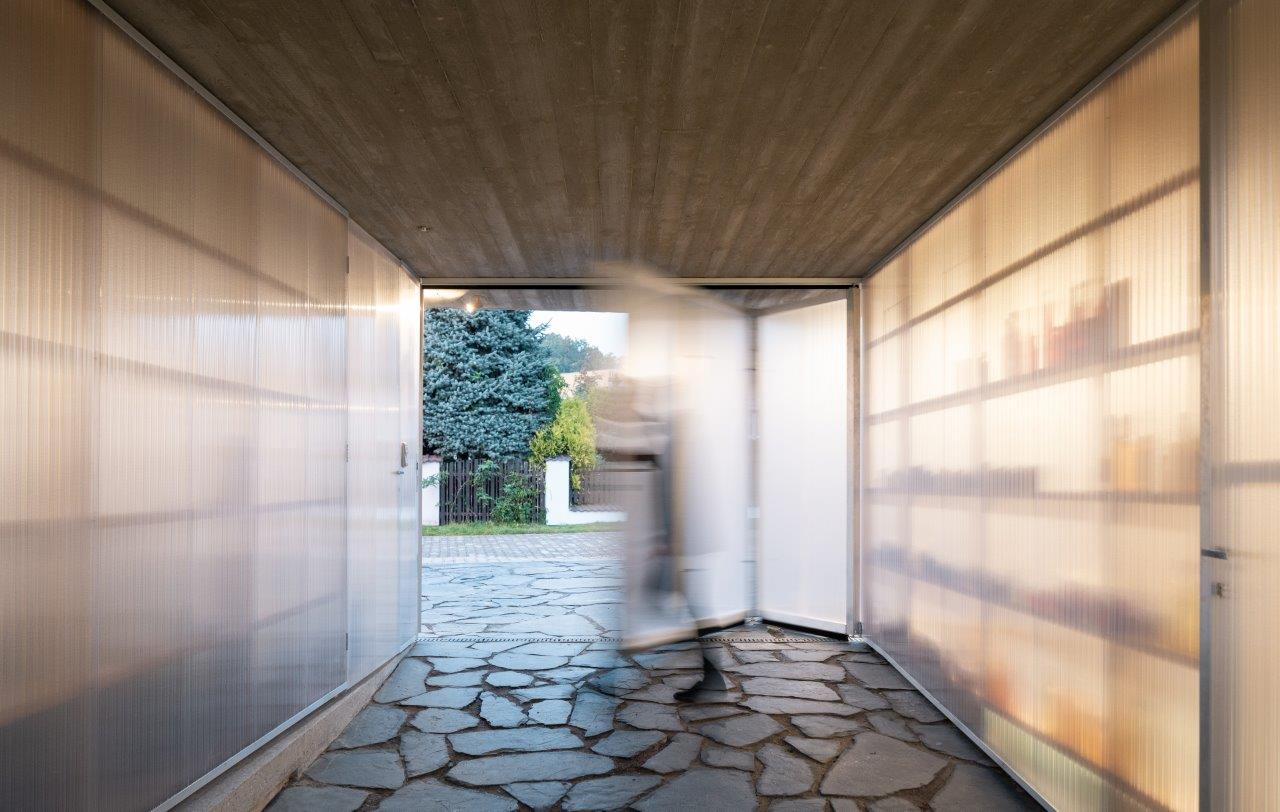
INTRO 17, which is already available for purchase on the e-shop, besides “large” projects like the Beloit College power plant (Studio Gang), also addresses smaller yet equally interesting dimensions. One such project is the mobile shelter Madlenka, reminiscent of a duck egg, designed by Martin Kožnar. Among the world’s unique projects featured in the magazine, we can mention, for example, the salt storage in the Belgian Ardennes by Goffart Polomé Architectes, the Prim roof in Mexico by Productora architects, the reconstruction and roofing of the Łazarski market in Poznań, Poland (Autorska Pracownia Architektoniczna – Jacek Bułat), or the Australian studio Hawkesbury (Leopold Banchini Architects). There are of course also domestic implementations such as the Atrium house in Lanškroun (Martin Neruda Architektura) or the renovation of a family house in Prague 5 – Hlubočepy by Atelier RUA, as well as ongoing columns, information about new products, materials, and technologies, and much more.
I am interested in the new issue


The English translation is powered by AI tool. Switch to Czech to view the original text source.
0 comments
add comment