
The expansion of the Panama Canal took nine years and doubled its capacity
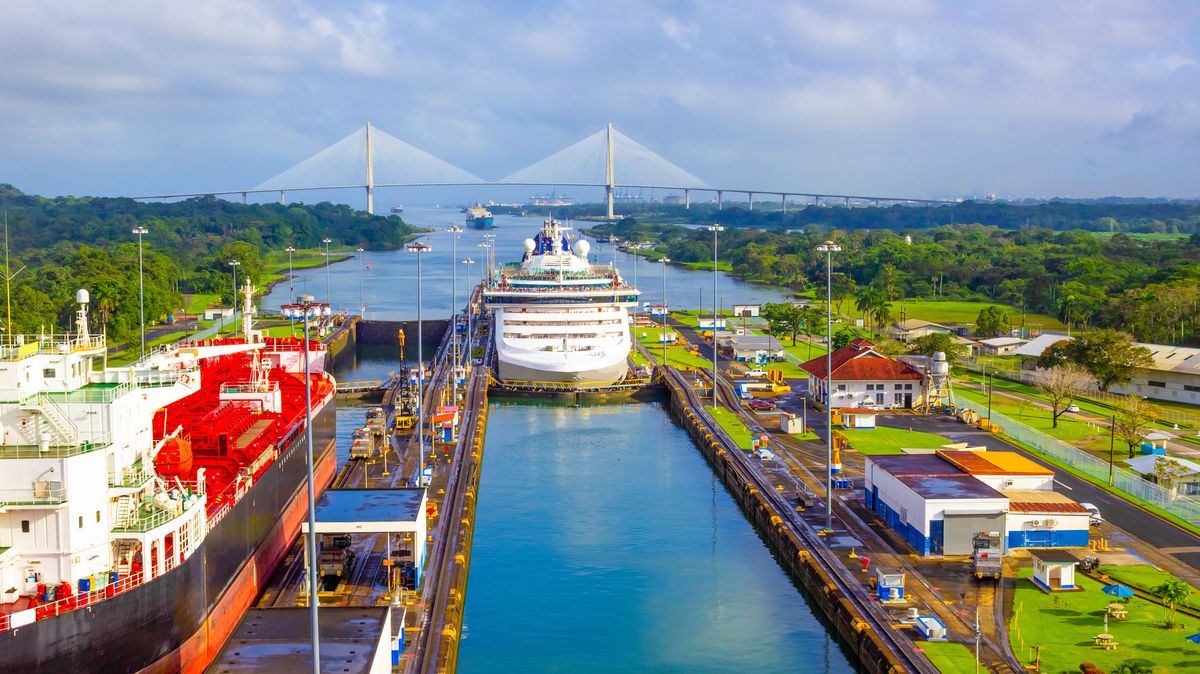 |
Panama/Praha – Ten years ago, on June 26, 2016, the famous Panama Canal was expanded in an effort to allow ships with up to three times the capacity to pass through compared to before. The expansion took nine years to build and cost over 5.25 billion dollars (about 131 billion CZK).
The first to attempt to bring the idea of connecting the Pacific and Atlantic Oceans to life was the French entrepreneur Ferdinand de Lesseps, who gained fame for constructing the Suez Canal, which opened in 1869. However, the idea of digging a canal through the narrowest point on the isthmus between North and South America had appeared earlier; for example, it was considered by the Spanish King Charles V in the 16th century. Given the state of technology at that time, however, such a construction remained a dream for a long time.
Lesseps, who embarked on the construction in 1880 at the age of 75, was unable to bring the project to a successful conclusion. The project, which envisioned connecting the oceans at sea level, faced difficulties from the start. Builders had to contend primarily with the challenges of nature; besides landslides and heavy rains, workers were mainly threatened by tropical diseases. During the nine years of construction of the canal, about 20,000 people died, and by 1889, when the French project failed, the canal was only one-third completed.
At the beginning of the 20th century, the concept was taken up by the United States, which was by then a regional power. They solidified their position by militarily supporting the declaration of independence of Panama – which had previously been a Colombian province – and in November 1903, the USA signed a favorable agreement with the Panamanian government for the construction of the canal. For a one-time payment of ten million dollars and an annual rent of 250,000 dollars, they obtained "in perpetuity" a six-mile strip on either side of the future canal.
American engineers took over the abandoned construction in spring 1904, and the fifteen-year interruption of the project was very apparent. Most of the equipment was unusable, and furthermore, the new plan did not consider a direct connection between the oceans but rather involved building a trio of locks and an artificial lake 26 meters above sea level. On the other hand, the Americans utilized French experiences with unpredictable Panamanian nature, and to succeed, they approached the construction as a military operation, with army officers leading the company. The Americans deployed 56,300 workers for the construction, who came to Panama from many countries around the world. Despite all efforts for a healthy environment and safety, the American phase of construction also claimed many lives, as 5,600 people died during this period due to accidents or illnesses.
The construction of the canal from 1904 to 1914 cost the Americans 375 million dollars (in today’s prices, this would be tens of billions of dollars). The first ship – an old floating crane – passed through the system of three locks and lakes in January 1914, and seven months later, the canal was ceremonially opened. However, just a year later, it was blocked by a large landslide, and regular traffic could only resume in 1920. Since then, the Panama Canal has reliably served global maritime transport.
The canal has always been particularly significant for the USA, but over the years, opposition in Panama grew against American control over the most important part of its economy. In 1977, the USA agreed to hand it over to Panama. In 2000, the Panamanian government took over the canal from the USA, which collects about one billion dollars annually (20.9 billion CZK) from fees for its use.
The modernization associated with the expansion of the canal in 2016 doubled its capacity. While before the expansion, the canal could accommodate ships with a maximum capacity of 79,000 tons, now it can handle up to 170,000 tons. The chambers of the new locks are 427 meters long, 55 meters wide, and 18 meters deep, allowing the passage of the largest vessels – so-called post-Panamax ships, which can carry up to 14,000 containers. The project, which involved 30,000 people, used 4.4 million cubic meters of concrete and took nine years to construct.
The ceremonial opening of the expanded canal on June 26, 2016, was attended by seventy world politicians, monarchs, and presidents, including American President Barack Obama and Chinese President Xi Jinping. The expansion of the Panama Canal, among other things, reduced the cost of transporting Asian goods to the eastern USA and provided China with better access to Latin American oil and other goods. Large ships no longer need to circumnavigate South America around Cape Horn. The first ship to transit the expanded canal – from the Caribbean to the Pacific Ocean – was a vessel from the Chinese company Cosco Shipping, measuring 48.2 meters in width and 300 meters in length.
The English translation is powered by AI tool. Switch to Czech to view the original text source.
0 comments
add comment
Related articles
0
30.04.2015 | The expansion of the Panama Canal is said to be completed in April 2016
0
11.12.2014 | Thousands of people protested against the construction of a canal in Nicaragua
0
21.11.2014 | The construction of the new canal in Nicaragua is set to begin on December 22
0
21.02.2014 | Work on the expansion of the Panama Canal is reportedly resuming
0
04.01.2007 | The decision on the new seven wonders of the world will be made in half a year