
The archives from the estate of architect Wiesner have arrived at the Brno villa Stiassni
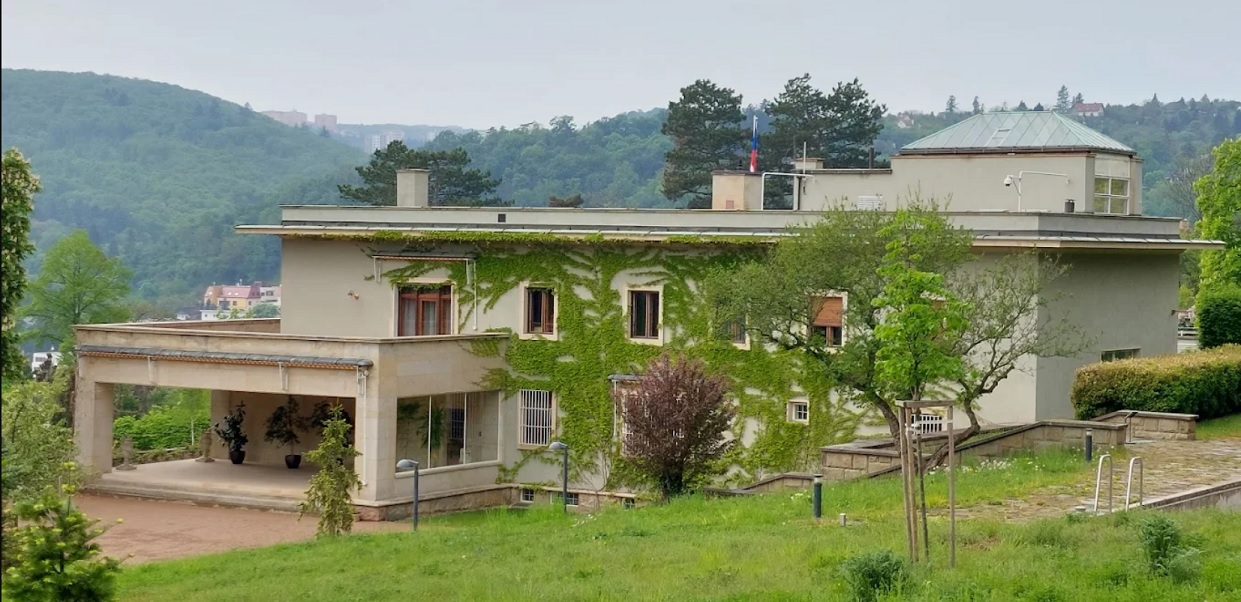 |
Brno – The National Heritage Institute (NPÚ) today took over the dissertation work of the significant Czechoslovak architect Ernst Wiesner, his photographs, and his wife's diary in Brno. The documents reminding of the life of this important Brno architect will be on display at the Stiassni villa, which Wiesner designed. Until now, they were with Brit Timothy Wilkinson, whose family was acquainted with the Wiesners, said the curator of the Stiassni villa, Kateřina Konečná, to reporters during the handover.
Wiesner was born in Brno; he fled from the city at the beginning of the Nazi occupation. He spent the rest of his life in England, including Liverpool, where he died and was buried. Recently, a restored tombstone with fragments from buildings he designed in Brno was unveiled in Liverpool.
"The former owner of the archives, Timothy Wilkinson, reached out directly. He contacted the Consul General in Manchester and asked if he could facilitate their transfer to the Czech Republic. We, together with the consul and colleagues, evaluated the villa as a suitable place to house these archives and where there is additional opportunity to present them to the public," Konečná said.
Among the archives is, for example, the architect's dissertation. "Which was a big surprise for us because we all associate him here with modern interwar architecture, but the dissertation concerns baroque architecture," Konečná stated. Among the photographs are images of the architect himself and his family. One photo of Wiesner captures him sitting at a table with an ice cream sundae in front of him. "That is definitely a photo that must end up in our café," the curator said.
"I can definitely say that this will be a significant contribution to enriching our knowledge about Wiesner's life in exile. Because, although it's terrible in a way, we actually know almost nothing about his life in exile," added regional councilor Michal Doležel (TOP 09), who has long been interested in the history of Brno in the first half of the last century.
Wiesner is the author of, among other things, the heritage-protected building of the Brno crematorium or the current seats of the regional public prosecutor's office and Czech Radio Brno in the city center. In addition to commercial buildings, he also designed villas, apartment buildings, and industrial complexes. Some properties from Wiesner's studio were also built in northern Moravia, Poland, and Slovakia.
The English translation is powered by AI tool. Switch to Czech to view the original text source.
0 comments
add comment
Related articles
0
05.08.2021 | Brno will come alive again on Saturday after last year's pandemic break thanks to the museum night
0
05.10.2020 | <Muzejní_noc_v_Brně_kvůli_pandemii_nebude_ani_v_náhradním_termínu> Museum Night in Brno will not take place even at the rescheduled date due to the pandemic.</Muzejní_noc_v_Brně_kvůli_pandemii_nebude_ani_v_náhradním_termínu>
0
06.07.2017 | Volunteers from the United Kingdom will come to help at the Stiassni villa
0
03.07.2015 | Vila Stiassni opens its restored garden
0
19.05.2012 | The Brno exhibition halls will open for the eighth time during the museum night
0
12.05.2011 | During the Brno Museum Night, the Stiassni Villa will also open