
The Ostrava Black Cube will be ready for extreme weather as well
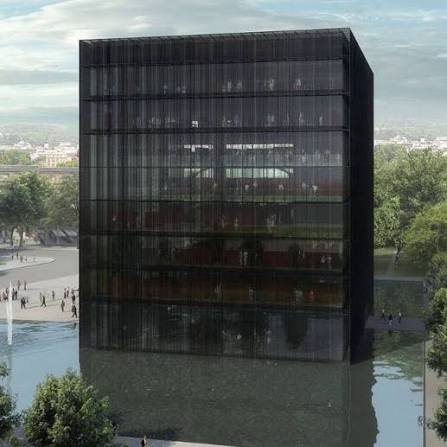 |
The nine-story building with two underground floors is one of the largest investments of the Moravian-Silesian Region and is financed with the help of the Just Transition program. It will house the Moravian-Silesian Research Library. The construction is expected to cost 2.6 billion crowns. The technologies are designed to ensure that there is enough natural light in the building, while also providing comfort for reading, working, or resting.
"The black color of the facade is the first thing that catches attention on the Black Cube. Although dark surfaces naturally attract the sun, it won't be hot inside the building. It hides a sophisticated system for maintaining a pleasant temperature," Geršlová said.
The facade of the building will feature so-called "porous screens" around the entire perimeter, which are special metal structures that act as sun shades. They will not only block heat but also prevent harsh light from shining into people's eyes or creating glare on computer monitors. In addition to the external shading screen, there will be three glass panels separated by air gaps forming another barrier. Thus, in summer, they should keep the heat out, and in winter, they should keep the warmth in.
"Moreover, the glass is not the same all around the perimeter. Each side of the building faces a different amount of sunlight throughout the day. Therefore, the northern facade received a different type of glazing than the southern one, which is exposed to a much greater thermal load," the spokesperson explained.
To ensure a pleasant climate, there will also be underground technologies – 68 wells up to 140 meters deep. A typical family house usually has one or maybe two such wells. The system works as a natural accumulator. In summer, it removes excess heat from the building and stores it in the ground. Conversely, it draws natural coolness from the ground to cool the air flowing into the building. In winter, the process is reversed. The system will take heat accumulated in the summer from the underground storage and use it for heating. A water feature in the vicinity of the building is also expected to help with a better climate.
Thanks to sensors, the building can also evaluate its environment in real-time and respond to external weather conditions and internal activities. For example, in the chilly morning hours, ventilation flaps will automatically open on the facade to draw in air and ventilate the building. A system is also being developed that will use cameras and artificial intelligence to track where the most people are at any given moment. Based on this data, the computer will automatically adjust the temperature, ventilation, or lighting.
"All measures and smart technologies serve the purpose of ensuring that visitors feel comfortable with us. The Black Cube is supposed to be a place where there is always enough fresh air and where you won’t be bothered by heat, cold, or harsh sunlight. In short, it is a space where you can focus calmly on what you come for, whether you want to create, seek new information, work on your project without interruption, or just relax with a good book," said the director of the Black Cube, Andrej Harmečko. The construction of the Black Cube is expected to be completed next year.
The English translation is powered by AI tool. Switch to Czech to view the original text source.
0 comments
add comment
Related articles
0
29.04.2025 | In Ostrava, the construction of the Center for Digitalization and Science Black Cube has started for 2.6 billion CZK
0
05.03.2025 | The Moravian-Silesian Region will sign a contract for the construction of the Black Cube in March
0
22.06.2022 | Ostrava will support the construction of the Black Cube, the headquarters of the scientific library, with 150 million
0
15.08.2020 | The development of librarianship will require 17.8 billion CZK by 2027
0
20.01.2020 | A company will be sought for the construction of a library in Ostrava
11
29.01.2019 | The Moravian-Silesian Region will update the project of the Black Cube
0
17.07.2017 | Countries want money from the state for a new gallery and library
0
31.01.2017 | The extension of the library in Budějovice will be designed by the studio Kuba and Pilař
0
19.10.2016 | The new Moravian-Silesian coalition wants to revive the Black Cube project
1
24.02.2016 | The scientific library in the Lower Vítkovice area would be more expensive than the Black Cube
1
24.11.2010 | Ostrava continues with the planned transformation of Černá louka
3
15.09.2010 | The government will not give Ostrava 500 million for a scientific library
0
30.08.2010 | The new scientific library in Ostrava is at risk, the state does not want to contribute
17
09.09.2009 | Will Ostrava have a Black Cube?
0
09.07.2009 | Czech Chamber of Architects supported the "Black Cube" in Ostrava
0
17.06.2009 | The representatives decided to abandon the original library project in Ostrava
2
16.06.2009 | In Ostrava, a petition was created for the construction of the original scientific library