
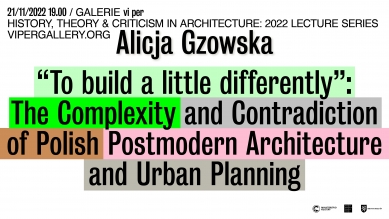
Alicja Gzowska: Budować nieco inaczej
The Complexity and Contradiction of Polish Postmodern Architecture and Urban Planning
Gallery VI cordially invites you to a lecture by Polish art historian Alicja Gzowska.
If, according to Robert Venturi, complexity and contradiction are characteristic features of postmodernism, then Polish architecture from 1970 to 2000 may be one of its finest examples. This is particularly evident in the period before the political transformation of 1989. At that time, postmodern tendencies in Poland could not manifest themselves in the "logic of late capitalism," as defined by Fredric Jameson. Was it then the logic of "late socialism"? Can we even talk about postmodernism in a country where modernization never truly occurred?
One of the key challenges in examining postmodernism outside the countries of the global North is to properly acknowledge and understand specific architectural traditions that contribute to its complexity and differentiate it from its Western counterparts. In this lecture, we will explore some of these specifics, such as the lack of a common understanding of the term "postmodernism" or the significance of the legacy of socialist realism. Understanding these phenomena helps to explain, for instance, why Poland never experienced a true movement of "returning to the city" or why various groups with often differing political interests, such as architects, the Catholic Church, and the state, have seized and appropriated postmodern aesthetics. Finally, the lecture will address the surprising "long duration" of postmodern forms in designs for the state institution of social insurance.
Alicja Gzowska is an art historian and curator at the Xawery Dunikowski Sculpture Museum, a department of the National Museum in Warsaw. She also collaborates with the Polish National Institute of Architecture and Urbanism. Her main research interest is post-war Polish architecture and culture. She is the co-author of several books on Polish postmodern architecture: Postmodernizm polski. Architektura i urbanistyka. Rozmowy z architektami (2013) and Postmodernism is almost all right: Polish architecture after socialist globalization (2012). Out of interest in thin-shell concrete structures and railway architecture, she wrote the book Szesnaście żelbetowych kwiatów. Nowy dworzec kolejowy w Katowicach (2012), a monograph on the recently demolished train station in the Polish city of Katowice. As a research worker, she has collaborated on international projects, including the South of East West project (www.south-of-eastwest.net), which focuses on the transfer of architecture, urbanism, and building technologies from European socialist countries to Africa, Asia, and the Middle East during the Cold War. From 2016 to 2017, she led a research grant from NCN: Piotr Zaremba (1910–1993): Oeuvre and impact of an urbanist and scholar in the age of globalized competence.
If, according to Robert Venturi, complexity and contradiction are characteristic features of postmodernism, then Polish architecture from 1970 to 2000 may be one of its finest examples. This is particularly evident in the period before the political transformation of 1989. At that time, postmodern tendencies in Poland could not manifest themselves in the "logic of late capitalism," as defined by Fredric Jameson. Was it then the logic of "late socialism"? Can we even talk about postmodernism in a country where modernization never truly occurred?
One of the key challenges in examining postmodernism outside the countries of the global North is to properly acknowledge and understand specific architectural traditions that contribute to its complexity and differentiate it from its Western counterparts. In this lecture, we will explore some of these specifics, such as the lack of a common understanding of the term "postmodernism" or the significance of the legacy of socialist realism. Understanding these phenomena helps to explain, for instance, why Poland never experienced a true movement of "returning to the city" or why various groups with often differing political interests, such as architects, the Catholic Church, and the state, have seized and appropriated postmodern aesthetics. Finally, the lecture will address the surprising "long duration" of postmodern forms in designs for the state institution of social insurance.
Alicja Gzowska is an art historian and curator at the Xawery Dunikowski Sculpture Museum, a department of the National Museum in Warsaw. She also collaborates with the Polish National Institute of Architecture and Urbanism. Her main research interest is post-war Polish architecture and culture. She is the co-author of several books on Polish postmodern architecture: Postmodernizm polski. Architektura i urbanistyka. Rozmowy z architektami (2013) and Postmodernism is almost all right: Polish architecture after socialist globalization (2012). Out of interest in thin-shell concrete structures and railway architecture, she wrote the book Szesnaście żelbetowych kwiatów. Nowy dworzec kolejowy w Katowicach (2012), a monograph on the recently demolished train station in the Polish city of Katowice. As a research worker, she has collaborated on international projects, including the South of East West project (www.south-of-eastwest.net), which focuses on the transfer of architecture, urbanism, and building technologies from European socialist countries to Africa, Asia, and the Middle East during the Cold War. From 2016 to 2017, she led a research grant from NCN: Piotr Zaremba (1910–1993): Oeuvre and impact of an urbanist and scholar in the age of globalized competence.
The English translation is powered by AI tool. Switch to Czech to view the original text source.
0 comments
add comment