
In July, reconstruction of the IPR headquarters, known as Prager's Blocks, will begin at the Emauz complex
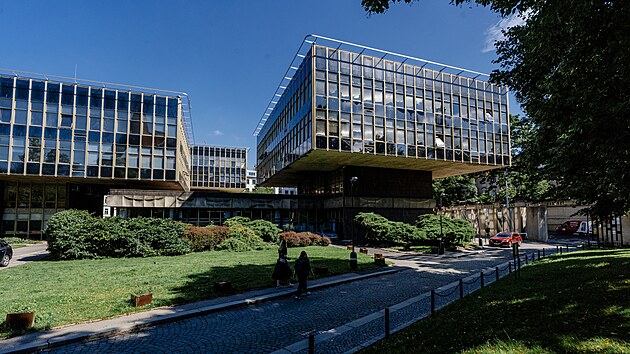 |
Prague – In July, the reconstruction of three architecturally valuable buildings designed by architect Karel Prager from the late 60s and early 70s will begin in the grounds of Prague's Emauz. Thanks to the reconstruction, costing 1.39 billion crowns including VAT, Prager's cubes will return closer to their original form. The work will last for three years. During the reconstruction, the Institute of Planning and Development (IPR) will relocate to Holešovice, while the Centre for Architecture and Urban Planning (CAMP) will move to Karlín. CAMP will bid farewell to the buildings with a one-day festival on June 25, as reported to journalists today by Štěpán Bärtl from CAMP.
The buildings are in poor technical condition and do not meet current requirements for energy efficiency, fire safety, or hygiene standards. The complex has not undergone significant repairs since its completion in 1975. In the late 80s and early 90s, only black glass was added to the façade, which, according to Jiří Jaroš from CAMP, masked the degradation of the original material. As a result, the buildings lost their original plasticity and characteristic appearance.
Although the buildings are not protected as historical monuments, the reconstruction will be approached with maximum respect, according to Jaroš. The goal is to preserve the original color scheme, window profiles, and overall appearance from the 70s.
The complex consists of three multi-story buildings with a shared atrium. The upper floors of the buildings are suspended on steel structures, which causes the buildings to vibrate, for example, when a tram passes by on the neighboring street. According to Jaroš, the complex was conceived as an architectural experiment. Prager was inspired by Western trends, but often encountered a lack of technology, materials, or funding.
Work will proceed according to an audit by the Czech Technical University (ČVUT), which assessed the possibilities for the reuse of steel, concrete, bricks, and glass. Dismantling will therefore be conducted carefully to allow for as much material as possible to be reused. According to IPR, this is the first circular reconstruction project carried out by a public authority. The institute is collaborating with the company Cyrkl.
The goal of circular reconstruction is to minimize waste and find new uses for as much material as possible. Each construction element or piece of equipment that does not need to be replaced with a new product represents a savings in raw materials, energy, and emissions, stated Martina Škvorová from Cyrkl.
During the reconstruction, IPR will be located in the ArtGen building in Holešovice. Any equipment that is not used will be offered to other institutions, non-profit organizations, and the public. CAMP will open in the autumn in the former ship repair yard on Pobřežní Street in Karlín. If all goes according to plan, both IPR and CAMP will return to Prager's cubes in 2029, according to Bärtlt.
After the reconstruction, IPR employees will be located in all three buildings; currently, one of the buildings is nearly empty, according to Jaroš. CAMP will gain a larger space for visitors. Additional operations could emerge in the bases, such as a children's group or a restaurant with a garden on the terrace between the buildings.
"We will come closest to Prager's intention by making the terraces accessible, which are currently uninhabitable, in poor condition, and have never fulfilled their original purpose of becoming a restaurant garden," said Jaroš, adding that the building also has dining elevators. In the future, a staircase to the terrace could also be created.
Prague has received a grant of 320 million crowns from the Modernization Fund for the repairs of the buildings. The reconstruction will be carried out by the companies PORR and Metrostav DIZ, with whom a contract was signed last summer. IPR is responsible for urban planning in the city.
The English translation is powered by AI tool. Switch to Czech to view the original text source.

0 comments
add comment
Related articles
0
08.02.2023 | The repair of the headquarters of Prague planners has been delayed by objections, it could start next year
0
04.04.2022 | Repair of the IPR headquarters in Emauzy will cost 1.16 billion CZK
0
20.05.2020 | <IPR> announces a competition for the design of the surroundings of its headquarters</IPR>
0
09.07.2019 | Buildings by Karel Prager in Vyšehrad will be repaired by IPR by the end of 2022
0
30.04.2019 | IPR will cut the grills between the statues towards Vyšehradská Street
0
03.01.2019 | IPR will repair its headquarters, the reason is the very poor condition of the buildings
0
20.09.2017 | In Prague, a space is opening up for the presentation of construction projects
0
06.04.2017 | The Prague IPR will open the Architecture Center in the Emauz area in September