
The Veletržní Palace became a temple of art 30 years ago
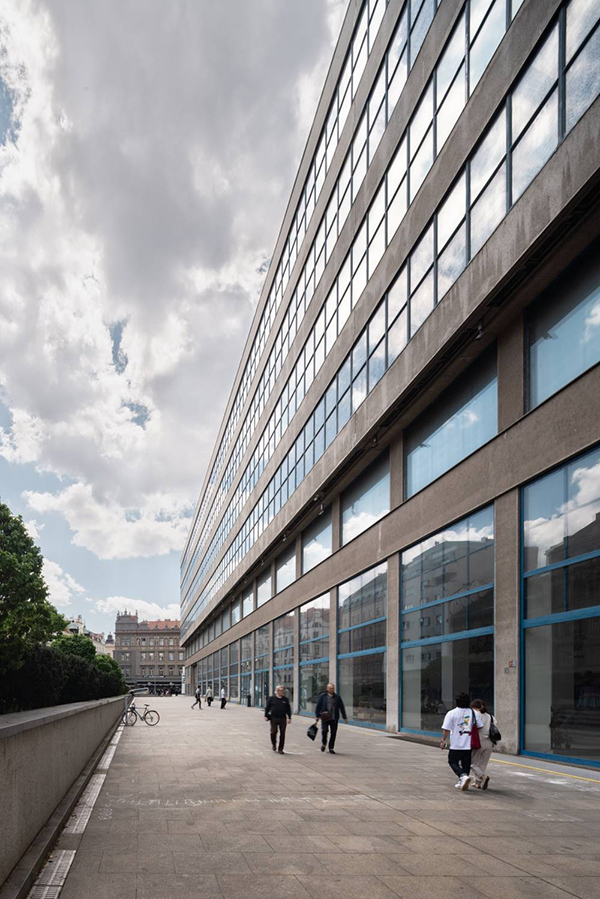 |
The Trade Fair Palace was built according to the designs of Josef Fuchs and Oldřich Tyl for the Prague Trade Fair Company between 1925 and 1928. At the time, it amazed with its expansiveness and concept as well as its rational approach. The palace, with eight above-ground and two underground floors, offered exhibition halls and a cinema, while the highest floor featured a café and restaurant with a view of Prague. The building's design was even praised by the functionalism guru, architect Le Corbusier, during his visit to Prague in 1928.
Since the late 1940s, the importance of the palace as a venue for fairs began to decline. The building was gradually occupied by officials and merchants from foreign trade enterprises. Unfortunately executed adaptations – partition walls between offices were built only from particleboard and plywood – contributed to a devastating fire that nearly destroyed the building in August 1974. The damage caused by one of the most destructive fires in Prague’s modern history was estimated in the hundreds of millions of then-crowns.
The burned and severely damaged building was surrounded by a metal fence, and for a long time, there were discussions about what to do with the palace. Finally, in 1978, it was acquired by the NG, and repairs began only nine years later. Jiří Kotalík, director of the NG from 1967 to 1990, played a significant role in transforming the Trade Fair Palace into a representative venue for modern art. However, the operation of the building is very costly, and for many years plans have been in preparation for the necessary reconstruction of this landmark of Holešovice, which also serves as a depository for the gallery.
In 2023, however, Culture Minister Martin Baxa stated that it no longer makes sense to invest larger sums into the Trade Fair Palace because its reconstruction will occur only after the construction of a new depository for the National Gallery in Jinonice, which is expected to cost over two billion crowns.
The English translation is powered by AI tool. Switch to Czech to view the original text source.
0 comments
add comment
Related articles
0
yesterday | The gallery wants to have the first feasibility study for the repair of the Trade Fair Palace in September
0
11.12.2015 | The Trade Fair Palace will continue to serve art, the National Gallery is also considering a new building
0
17.01.2014 | The NG exhibitions will commemorate the 40th anniversary of the fire at the Trade Fair Palace