
AP: Passengers in Italy can try the cable ferry designed by Leonardo da Vinci
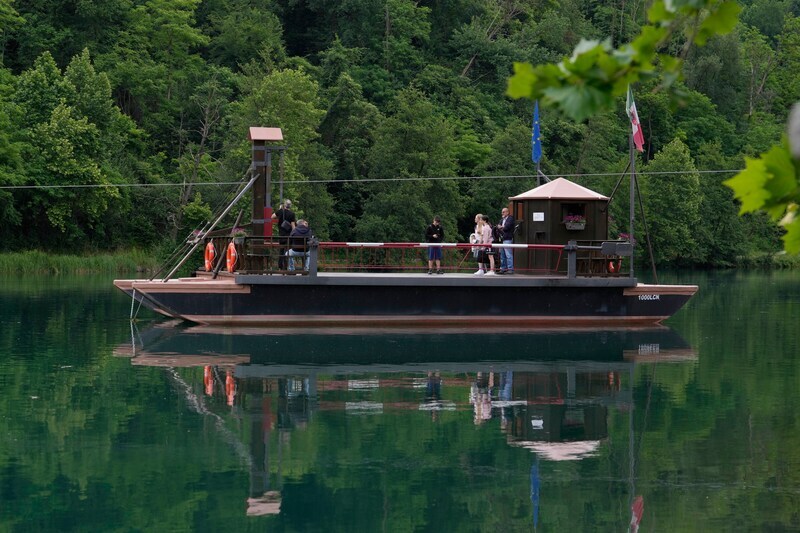 |
Rome – The ferry glides gently along the guiding cable from one bank of the northern Italian Adda River to the other, propelled by the current. Passengers on board can enjoy not only five minutes of tranquility on an alternative route during a time when the closure of a nearby bridge has caused traffic jams, but also a touch of history. The mechanism of this ferry was immortalized by the Renaissance genius Leonardo da Vinci in a drawing that is now part of the royal collection at Windsor Castle near London, reported the AP agency.
It is the last preserved example of the so-called reaction ferry on the Adda River, which stretches from the Alps to the Po River in Lombardy, of which it is a left tributary.
"It is a means of transportation that has existed here for 500 years and has always connected both banks of the Adda River," said Massimo Zoia, one of the volunteer ferrymen who operates the vessel. "And now it has returned to its original purpose: to connect two populations living on different banks of the river," added the ferryman.
Although this mechanism has been dubbed "Leonardo's ferry," it remains unclear whether this type of ferry was actually designed by Leonardo himself. However, it is certain that he sketched it in 1513 as part of his famous studies of waterways, among which was the Milanese canal system.
Leonardo was one of the greatest polymaths in history, filling his notebooks with designs from a wide range of fields. These included flying machines, which would not come to exist until centuries later.
The operating principle of the ferry is as simple as it is brilliant and entirely environmentally friendly. "The river carries us downstream. The boat is anchored to a cable connecting both banks, and due to the distribution of forces based on the parallelogram mechanism we learn about in high school, the force is divided – one part becomes resistance and the other is used for lateral movement," explained Zoia.
"With the help of the rudder, we angle the ferry to catch the current that pushes the vessel and propels us forward," added the experienced ferryman.
The ferry is operated by the town of Imbersago and sails to Villa d'Adda on the other side of the river. In 2023, it almost ceased to exist when its operator gave up the concession. However, Imbersago's mayor Fabio Vergani was determined to save the ferry, so he personally obtained a ferry license and, together with a local tourism association, assembled a team of volunteers.
Since 2024, they primarily transport weekend visitors from one bank of the Adda River to the other.
This spring, however, they also added weekday transportation for commuters. They were prompted to do so by the closure of a nearby bridge, which is undergoing maintenance – and with the help of the ferry, they are alleviating traffic jams at least a little.
The ferry now operates from 7:00 AM to 7:00 PM, with a two-hour lunch break. Passengers pay 1.50 euros (about 36 crowns) if walking, two euros with a bike, 2.50 euros with a motorcycle, and 3.50 euros if they need to transport a car.
Gianpaolo Graffagnino lives in Villa d’Adda and works on the other bank of the river. He started commuting by bike and uses the ferry as a shortcut. "Currently, it is not only the fastest way to get around but also the most pleasant, because one gets to enjoy a few minutes of peace," he said.
Mauro Carnati drove onto the ferry with his Maserati to take his daughter to school on the other side and avoided a long detour caused by the bridge closure. "It's true that it costs a bit of money and you can't do it every day, but the romance and added value of the Adda River and the ferry are really amazing. It gives me a better start to the day," he shared.
The English translation is powered by AI tool. Switch to Czech to view the original text source.
0 comments
add comment