
The Cheb Bridge in Karlovy Vary has three reconstruction options that the city is considering
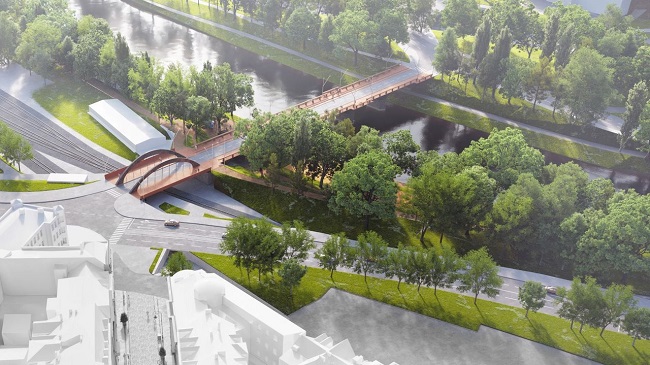 |
Karlovy Vary - The historical Cheb Bridge in Karlovy Vary could be reconstructed in three variants - in its existing width, in a slightly expanded width, or comfortably with sidewalks and bike lanes. A special type of concrete, known as UHPC (Ultra high performance concrete), could be used for the bridge structure, which consists of three bridge constructions. Although it is significantly more expensive, experts promise a considerably higher strength with a lower volume of material and minimal maintenance. Today, the councilors of Karlovy Vary discussed the possibilities of the final form of the reconstruction at an extraordinary meeting.
One of the most significant investments in the city in recent years is estimated to cost between 300 to 620 million crowns. The city's leadership is prepared to go into debt for financing. However, they want to know if the money spent will not bring additional costs for expensive maintenance or repairs in the future.
The bridge was originally built as a stone structure in the 1880s, and a wider concrete slab was placed on top of its structure 100 years later, which has gradually degraded and is now in a state of disrepair. Its repair or replacement is now necessary. The city must now decide whether the bridge will remain at its current width of 12 meters (variant III), which would essentially only prevent the closure of the bridge, or if it will be expanded to 13.3 meters, creating a more comfortable sidewalk and simultaneously widening the road so that emergency vehicles can also pass through (variant II). The most ambitious variant (variant I) plans for an expansion to 15 meters, where the bridge could not only accommodate the road for cars but also include a bike path and sidewalks. In the future, the bridge could even become a new pedestrian zone.
According to Karel Adamec, director of the Office of Architecture of the City of Karlovy Vary (KAM), variant I would be most prepared for future changes in the traffic and construction situation in the city center. Variant II could be a compromise that improves the bridge's functionality and saves costs. Variant III, on the other hand, loses for the city the opportunity for a change for better utilization of one of the main traffic arteries of Karlovy Vary.
The Mayor of Karlovy Vary, Andrea Pfeffer Ferklová (ANO), was interested, for example, in whether the use of significantly more expensive UHPC concrete would be beneficial in terms of future maintenance costs. UHPC concrete has thus far only been used in the Czech Republic for the construction of footbridges or for the reconstruction of the Barrandov Bridge. According to Petr Tej from the Bridge Structures studio, which also works at the Klokner Institute of Czech Technical University, this type of concrete has been used abroad since the 1980s, and the assumptions that it has extreme strength and minimal maintenance requirements are being confirmed.
Today's council meeting was only informative and did not aim to decide on a specific variant of the reconstruction preparations. According to Mayor Pfeffer Ferklová, the most damaged sidewalks are currently on the sides of the bridge, while the roadway itself, which connects two parts of the city across the Ohře River, is still in a condition where it is possible to agree on the most suitable variant.
The English translation is powered by AI tool. Switch to Czech to view the original text source.
0 comments
add comment