
In front of the congress center at Vyšehrad, the construction of a hall costing 1.35 billion CZK will begin
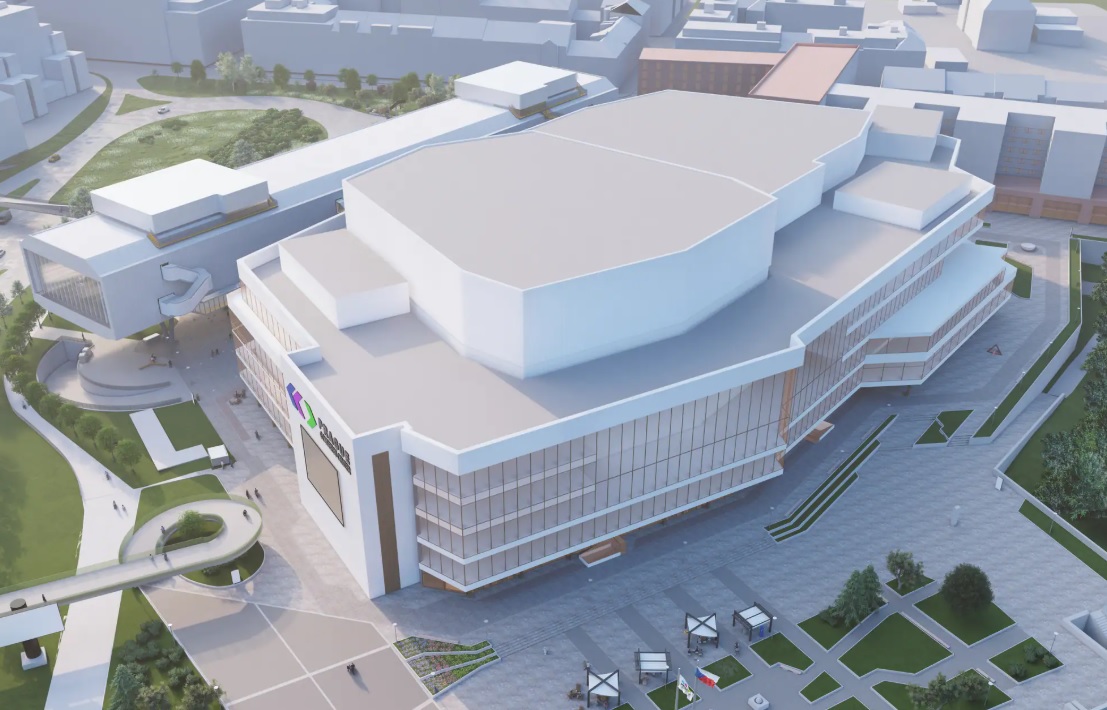 |
Prague – Construction of a new hall will begin in July in front of the Prague Congress Centre (KCP) towards Pankrácké náměstí. It will serve for exhibitions, conferences, congresses, and social events, accommodating 1500 people. The building is expected to be completed in September 2028. This was announced to journalists today before the groundbreaking ceremony by KCP Director Lenka Žlebková and Prague Councilor Zdeněk Kovářík (ODS). According to them, the construction costs will amount to 1.35 billion crowns, of which 1.2 billion will be paid by KCP from its own funds. The rest will be covered by the city. Since last year, Prague has been the sole shareholder of KCP.
According to Žlebková, the construction of the hall is crucial because it will allow hosting the largest congresses that KCP has had to decline due to insufficient capacity. "The interest in new capacities is not hypothetical. KCP is already recording demand for approximately 15 globally significant congresses, especially in the field of medicine, whose occurrence is directly conditioned on the completion of the hall," she stated. She mentioned that these congresses will bring not only finances to the city and entrepreneurs but will also provide opportunities for students. They will be able to meet top experts and scientists without having to travel abroad.
According to Žlebková, Prague has very few spaces that can host social events like gala evenings for more than a thousand participants. She noted that the only options are the exhibition grounds in Letňany and the O2 arena. For example, the Žofín Palace can accommodate about 800 people.
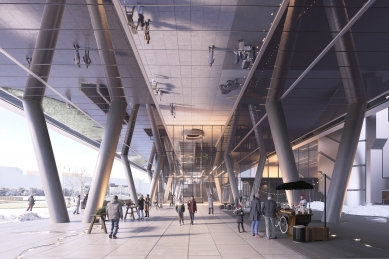
The hall will be connected to the existing building of the congress center. It will have the shape of a rectangle placed transversely in front of the congress center. A significant portion of the hall will be elevated on columns, creating an open space underneath. The interior spaces will be divisible into up to five separate parts. The design of the hall was created by the Spanish firm OCA Architects in collaboration with the Czech studio CMC Architects. The construction will be carried out by the company GEMO.
Architect David Richard Chisholm from CMC Architects stated that designing the building was a challenge due to the garages located under the future hall, with the metro, main road, and residential buildings nearby. According to him, there will only be a glass lobby on the ground floor, while the main spaces will be on the first and second floors.
After the construction begins, direct pedestrian access from the square to the Holiday Inn hotel will not be possible. For the necessary period, entrances 9, 10, and 11 to the congress center will be closed. During the construction of the hall, KCP will also repair the underground garages. According to Peter Baulovič from the company Gemo, the piles for the new hall will be established through the garages, supporting the entire structure. "This is a method that will be used for the second or third time in the Czech Republic," noted Baulovič.
Until 2025, the state held a majority stake in KCP, while Prague owned 45.65 percent. In exchange for its stake, the state received from the city the Faust House on Karlovo náměstí, land in the Na Homolce hospital, a parking lot in front of the Ministry of Foreign Affairs, and 2.21 billion crowns that the state had previously invested in the center in connection with the International Monetary Fund meeting in 2000.
The KCP joint-stock company was established on July 1, 1995. Last year, it reached a turnover of 717 million crowns and a profit of 138.9 million crowns. The center hosted 185 events for 210,000 people.
The congress center offers 70 halls and lounges for events, from small conferences to large congresses. It also includes the Vyšehrad Business Centre and the four-star Holiday Inn Prague Congress Centre with a capacity of 254 rooms. Its construction took place between 1976 and 1981, and the building was renovated at the turn of the millennium. It is a neo-functional building designed by architects Jaroslav Mayel and Antonín Vaněk.
The English translation is powered by AI tool. Switch to Czech to view the original text source.

0 comments
add comment