
The personality of Milan Knížák left hardly anyone indifferent
 |
Knížák's artistic activities were broad, encompassing visual art, music, architecture, design, fashion, poetry, and photography. The artistic world knew him for his happenings, but he became more widely known only after the Velvet Revolution. As the head of the art academy and the National Gallery, he frequently sparked controversy, but his successes cannot be denied. For example, thanks to government support, Knížák quickly rectified the gallery's budget deficit, which also successfully handled the aftermath of the devastating floods in 2002 that affected the exhibitions in Zbraslav and the Old Town.
Under his leadership, the National Gallery also offered the public additional spaces - from the newly conceptualized Veletržní Palace to the cubist exhibition at the House of the Black Mother and Kinský Palace. However, part of the professional community criticized Knížák for focusing on permanent exhibitions and providing little support for significant exhibition projects. He rejected such criticisms, asserting that "the National Gallery is not a Kunsthalle (exhibition hall)" and its primary task is to collect and study art, thus performing the sometimes-criticized museum activities.
Milan Knížák drew attention as the head of the NG for his authoritative management style, which did not suit everyone. For example, he decisively parted ways with several professionals who worked under him, such as the former head of the modern art collection, Katarína Rusnáková, or the former director of the old art collections, Jiří Fajt. Knížák also had disagreements with some curators; in 2000, he even entered into a heated dispute with artist David Černý during the award ceremony of the Jindřich Chalupecký Prize held at the Veletržní Palace.
His conflict with Fajt, who led the NG from 2014 to 2019, became a kind of evergreen. Fajt was one of Knížák's major critics, and their disputes ended up in court. In 2015, Knížák wrote an open letter to then-Minister of Culture Daniel Herman, urging him to remove Fajt from the head of the gallery. He claimed that Fajt did not understand the operations of an art museum, was dismissing long-term employees, and was indebting the gallery. The Constitutional Court rejected Knížák's complaint against a ruling that previously ordered him to apologize for claiming that Fajt had ruined the NG in the past.
Instead, Knížák earned praise for his tenure as rector of the AVU. He was elected by acclamation in 1990 and remained in office until January 1997. He brought new impulses to the academy and opened it to the world. For a quarter of a century, he also led the Studio of Intermedia Creation, which he founded. His students included Krištof Kintera, Jakub Špaňhel, Milena Dopitová, and Milan Mikuláštík. However, in 2015, Knížák failed in a competition for the position of leading the studio, which sparked a storm of discontent among his students.
The artist was known as a supporter of the ODS during Václav Klaus's era and unsuccessfully ran for the Senate for the party in 1998. Conversely, he had conflicts with Miloš Zeman, who later succeeded Klaus at the Castle. For example, in 1996, when then-ČSSD Chairman Zeman was elected head of the Chamber of Deputies, he sent him a sharp letter. "Your ways, your unmistakable desire for power, terrify me. I perceive this situation as a personal injustice," it stated, among other things.
According to Knížák, Václav Havel "was well suited for the Velvet Revolution because he acted as a contrast to the Bolshevik potentates". However, Knížák suggested that Havel "enjoyed being president, traveling the world, and posing as important". He was critical of the previous government led by Petr Fiala (ODS) and also of the ANO movement. "A bright future does not await us. This year's elections do not offer a solution. There is no one to vote for," he wrote on his website before the elections won by the movement led by Andrej Babiš. He also expressed criticism of the current president, Petr Pavel.
Knížák was born on April 19, 1940, in Plzeň. He studied at the Higher Pedagogical School, the Academy of Fine Arts, and the Faculty of Mathematics and Physics at Charles University, but he did not complete his studies. It was only from 1997 to 1998 that he completed his doctoral studies at the AVU. At the turn of the 60s and 70s, Milan Knížák was known as the founder of the Aktual Club and the same-named beat group, which is considered one of the most significant underground bands of the communist regime.
From 1968 to 1969, he lectured at two universities in the USA. He was also a supporter of the international movement of Fluxus artists, whose events he participated in, especially during his stay in the USA, and which was based on the principles of Dadaism, where the artist's opinion or stance was more important than a traditional exhibition. Thus, popular means included actions, happenings, installations, performances, objects, music, sound, scent, visual representations, or just experiences. Until 1970, Knížák held various temporary jobs and then worked as a freelance artist.
In the 1980s, he lectured abroad again, in Hamburg and Salzburg. During normalization, he was harassed by the police, detained several times, and repeatedly ended up in prison as a "state enemy". Even years later, Milan Knížák sought redress; this year, the Constitutional Court upheld his complaint and returned the case of Knížák's judicial rehabilitation to the general courts. This specifically concerns his detention for allegedly attempting to harm the interests of Czechoslovakia abroad, for which he was held from October 1974 to February 1975.
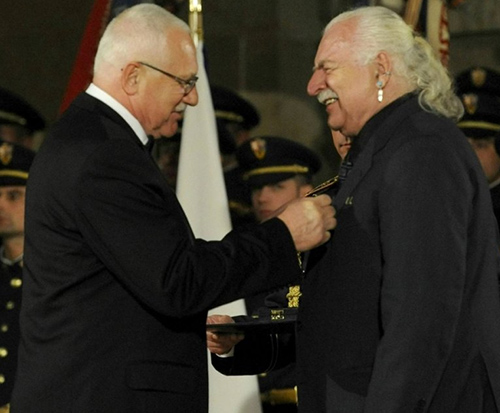
Knížák exhibited in the Czech Republic, Europe, the USA, Japan, Canada, and Australia. His work is represented in the Museum of Modern Art in New York, the British Tate Gallery, the French Centre Pompidou, and other institutions. He is the author of poems and has published dozens of books, catalogs, and music recordings. As a collector of puppets, he authored the Encyclopedia of Visual Artists in Puppet Theatre in the Czech Lands and Slovakia. He received numerous awards for his work, including being awarded the Medal of Merit by Miloš Zeman in 2010.
The English translation is powered by AI tool. Switch to Czech to view the original text source.
0 comments
add comment
Related articles
0
yesterday | At the age of 86, the artist and former director of the National Gallery, Milan Knížák, has died
0
14.06.2024 | Over 90 artists in a public call demand changes at AVU and the National Gallery
0
26.01.2015 | Knížák's students do not want his departure from the position of studio head
0
19.06.2013 | The accreditation committee approved the art university with Knížák at the helm
0
31.08.2011 | I have great concerns about the fate of NG, stated its outgoing chief Knížák.
0
20.10.2010 | The National Gallery responded to Havel's criticism of Knížák
2
04.07.2009 | Knížák did not fulfill initial hopes after ten years at the helm of the NG
6
23.04.2008 | Knížák comes up with the idea of converting the KC into a library
12
06.03.2007 | The preservationists are hesitant with Kaplický, Knížák would like to see the building elsewhere