
<h1>Uneven Terrain as Part of the Playground Design</h1>

The case of public space in Prague- Modřany

Publisher
Tisková zpráva
24.08.2026 19:00
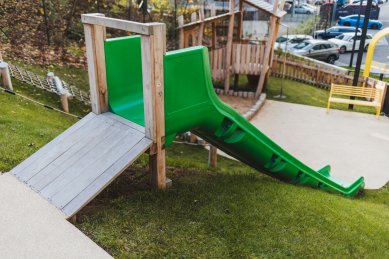
Every public playground is created under specific conditions. The decisive factors are not only the selection of play elements, but also the management of the terrain, the organization of the space, the choice of materials, and the demands for long-term operation. In the residential development on Československého exilu street in Prague-Modřany, the design is based on a naturally sloped site, which has become part of the resulting solution.
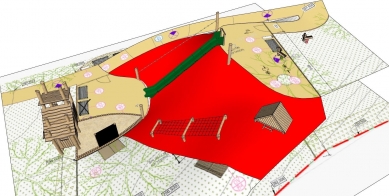
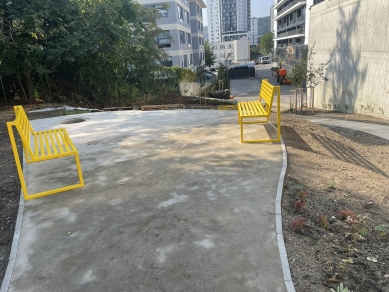
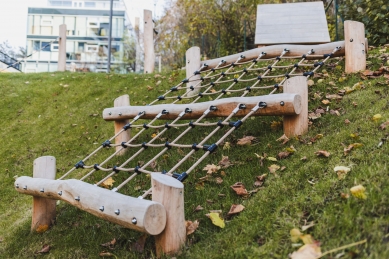
Instead of a flat comparison of the terrain, a system of several height levels was created. The quieter parts of the playground are located in the upper area of the plot, while the slope creates space for rope climbs, slides, and other movement activities. The terrain here serves not only as a backdrop but also determines the way of movement and the interrelationships of the various play zones.

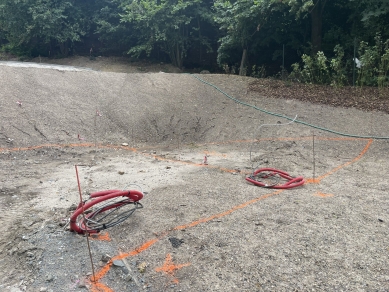
Working with the natural configuration of the land also limits the extent of earthworks. It preserves a larger proportion of greenery and allows the site’s characteristics to be utilized rather than suppressed. Topography thus becomes one of the main design tools.

The realization was prepared by the company Hřiště hrou, which provides the design, manufacturing, assembly, and subsequent service of children's playgrounds for public spaces. For this realization, acacia play elements from the ROBINO program were used. Robinia is among the most durable European woods used in outdoor environments, especially where long life and low maintenance requirements are demanded in public implementations.

Individual play elements are not designed as standalone attractions. The sloped slide connects to the rope climbs, stairs, and grassy slope, creating a continuous movement path. Children can use the same space in various ways without the need to increase the number of devices.

The design incorporates the requirements of standards ČSN EN 1176 and ČSN EN 1177. These determine safety distances, critical fall heights, and the choice of impact surfaces. Poured rubber is used only in the most heavily trafficked areas, while other parts remain grassed.

Equal attention is required for subsequent operation as for the design. Regular visual inspections, operational checks, and main annual inspections according to ČSN EN 1176–7 are part of the management of every public playground and affect its long-term functionality.

The project in Prague-Modřany demonstrates an approach where the design does not stem from a catalog layout of play elements, but from the characteristics of the specific site. Working with the terrain, materials, and safety requirements creates a cohesive whole.

About Hřiště hrou

The company Hřiště hrou specializes in the design, manufacture, and implementation of children's playgrounds and play landscapes for public spaces. In addition to typical elements, it also prepares individual solutions responding to the character of the site and the investor's requirements. The delivery includes manufacturing, assembly, inspection, and subsequent service. It has long been working with acacia wood (robinia), primarily used in public implementations.

In addition to typical elements, it also prepares individual solutions responding to the character of the site and the investor's requirements, examples of which can be found in the Hřiště hrou realization gallery.
The English translation is powered by AI tool. Switch to Czech to view the original text source.
0 comments
add comment