
<p>The expert group agreed on the possibility of repairing and preserving the bridge at Výton.</p>
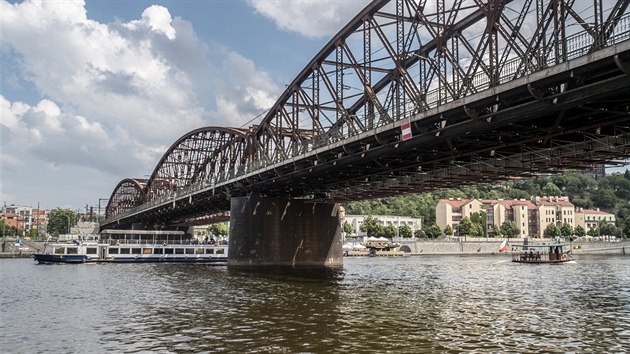 |
Prague – Experts from the international advisory group agreed by a vote of 8:1 that the railway bridge at Prague's Výtoň can be repaired while preserving its heritage value. With appropriate reconstruction and subsequent regular maintenance, it can serve for at least another 100 years. This was reported today by the National Heritage Institute (NPÚ) in a press release. The Railway Administration (SŽ) had previously planned to replace the bridge, but following a wave of criticism, former Minister of Transport Martin Kupka (ODS) ultimately decided on reconstruction last year.
The experts in the group, established by the director of the institute Naďa Goryczková, assessed the lifespan of the structure, the scope of interventions, operational safety, and the possibilities for preserving historical value. The conclusions will be used by the NPÚ to prepare the conditions for the bridge's restoration. The results will serve the SŽ as a basis for planning the reconstruction.
Based on diagnostics and foreign experiences, experts recommended temporarily disassembling and relocating the bridge to the shore during reconstruction, where the individual parts can be inspected in detail and cleaned of corrosion.
In the restoration, the most severely damaged parts should be replaced, while other parts should be assessed individually. The original technological principle of the structure, including riveted joints, should be preserved. The group recommended maintaining the existing profile of the bridge, and any increase in capacity should be ensured by constructing a separate new structure for a third track in the immediate vicinity of the bridge.
According to steel construction expert Andreas Taras from the Swiss Federal Institute of Technology (ETH) in Zurich, monitoring the volumes and composition of railway traffic on the bridge is also crucial for its lifespan, in addition to maintenance.
"Foreign specialists have demonstrated that there are practically proven solutions suitable for the restoration of the bridge. The conclusions of the group thus represent an important step in the preparation for the restoration of this monument, while also confirming the correctness of UNESCO's request for the restoration of the bridge at its current location," stated the Czech National Committee of the International Council on Monuments and Sites (ČNK ICOMOS) in a press release. The committee recommends that the SŽ consult the work with the UNESCO World Heritage Centre.
In addition to Taras, the group included Swiss civil engineer Karl Baumann, architect Tomáš Efler, Belgian civil engineer Bernard Espio, heritage expert and ICOMOS member Šárka Jiroušková, steel construction expert from Czech Technical University Pavel Ryjáček, and NPÚ experts Miloš Matěj, Alena Borovcová, and David Měska.
Local governments, civic associations, heritage organizations, and the UNESCO committee had previously opposed the intention to replace the original heritage-protected steel structure with a new one. A study assessing the impact on cultural heritage, commissioned by the Ministry of Transport, also recommended the reconstruction. In response, the then-minister decided to change the plan for the new bridge, which was based on a previous architectural competition.
According to current plans, builders will dismantle the bridge and reconstruct it on the shore, where it will be temporarily replaced by a single-track structure on the pillars during the repairs. According to a schedule released last year, the temporary structure should replace the existing one at the turn of 2027 and 2028. Construction of the new bridge with a third track and a stop on the Výtoň side of the Vltava River is expected to begin at the end of 2029, with completion anticipated by the end of 2032. At the end of this year, SŽ plans to announce a new international architectural competition for the project.
The railway bridge at Výtoň was opened on August 15, 1872, and was originally a single-track bridge. It was replaced by a double-track bridge at the turn of the 19th and 20th centuries. With its historic riveted structure, it represents a significant technical cultural monument in Prague's heritage reserve, according to experts. Due to its poor condition, train traffic on the bridge has been significantly restricted for several years, and SŽ deemed it necessary to replace it due to severe corrosion.
The English translation is powered by AI tool. Switch to Czech to view the original text source.
0 comments
add comment
Related articles
0
18.02.2026 | NPÚ will prepare a set of demands for the repair of the bridge at Výton
0
18.09.2025 | Kasl: The announcement of a new competition for the Výtoň Bridge decreases trust in competitions
0
17.09.2025 | ČKAIT: The decision on the reconstruction of the Výtoň Bridge is incorrect
2
16.09.2025 | Most na Výtoni is set to undergo repairs, the authors of the proposal for its replacement are disappointed
0
11.09.2025 | Kupka should, according to the group of senators, allow the reconstruction of the bridge under Vyšehrad
0
15.07.2025 | The decision on the railway bridge under Vyšehrad will be made before the elections, said Kupka
3
19.12.2023 | <Praha offered assistance in searching for a possible new location for the railway bridge.
0
14.12.2023 | Central Bohemian Region and transporters request a new railway bridge at Prague's Výtoň
0
13.12.2023 | Specialists will prepare a study of the bridge at Prague's Výtoň for free and hand it over to Kupka
1
30.11.2023 | Repairing the bridge at Výton was supported by 20 percent of respondents in the survey for SŽ
0
14.11.2023 | Representatives of Prague rejected the association's claim that the bridge at Výtoň only needs two tracks
0
10.11.2023 | SŽ rejected the association's study about the bridge at Výton, claiming that a third track is necessary
3
08.11.2023 | The capacity of the bridge at Výtoň can be increased according to the study of the association even without a third track
8
31.10.2023 | Railway Administration: According to EU experts, it is more advantageous to replace the bridge at Vyton with a new one
0
09.08.2023 | The association filed a criminal complaint due to neglected maintenance of the bridge at Výton
0
20.06.2023 | Praha 2 supported the reconstruction of the railway bridge at Výton
0
21.04.2023 | Experts on bridge construction are behind the new design of the bridge under Vyšehrad
0
23.03.2023 | Prague wants to preserve the railway bridge at Výtoň and add a third track to it
5
13.03.2023 | Prague councilors will discuss the bridge at Výtoň; experts have recommended a replacement
0
20.02.2023 | The only possible option is to repair the Vyšehrad Bridge
7
10.01.2023 | A petition to preserve the railway bridge has been created in Prague, and the town hall wants it too.
11
20.03.2008 | Praha 2 does not want a new bridge at Výtoně, fearing an increase in traffic