
Zlín Film Studios were established for the promotion of the Baťa empire
 |
Prague – The Zlín Film Studios owe their existence to a combination of several favorable circumstances. The most important was undoubtedly the existence of Baťa's industrial empire, which was behind the establishment of the film studio. Without the enthusiasm and interest of talented creators who headed to Moravia, particularly from Prague studios, the studios, opened on July 1, 1936, originally as a place for filming promotional films for the Baťa company, would likely never have achieved such fame.
The well-known mass producer of footwear, and not only that, had experience with film promotion since the 1920s, but the filming was mainly ensured by traditional Prague manufacturers such as AB studios. A new impulse came in the mid-1930s, when, after the tragic death of Tomáš Baťa, his half-brother Jan Antonín took the helm of the company. It is said that the decision to build their own studios came shortly after a visit to American studios, especially when offers for advertising production from established manufacturers seemed too expensive to him.
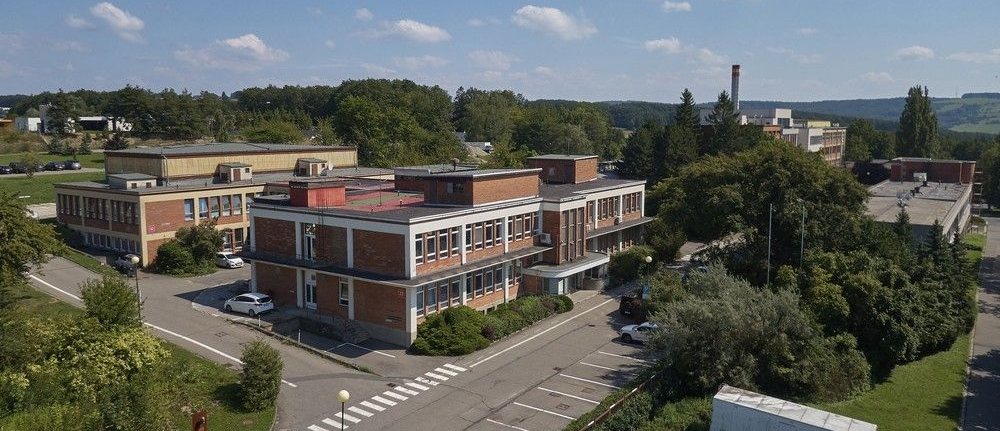
In 1935, new studios began to rise near Zlín between the forest cemetery and the then village of Kudlov, designed by architect Vladimír Karfík, supplemented by houses with apartments for filmmakers. There were several reasons for choosing the location – a remote and quiet, yet easily accessible place, which had, among other things, a water source suitable for film developing and also offered a clear horizon. Filmmakers appreciate a free view of the landscape; this already played a role a few years earlier in the choice of Barrandov as the site for the Prague film studio.
However, the budding Baťa Film Studios were connected to Prague by more than one thing – for example, a number of experts came to Zlín from there. Initially, screenwriter and director Elmar Klos was accepted, who brought experienced producer Ladislav Kolda and avant-garde filmmaker Alexander Hackenschmied from Prague. Although the Baťa studios served the benefit of the company and the owners did not perceive them as a charitable endeavor, they were indeed brimming with avant-garde creators before and even during World War II.
The films created in Kudlov, however, did not serve the egos of their creators, but promoted products of the parent company. And they did so successfully. The first advertisement created was for galoshes titled "Autumn Caprices," in 1937 the studio gained international recognition when the advertising story "The Road Sings" by K. M. Walló and Elmar Klos received a medal at the Paris World Exposition. Besides films with melodic songs and a cheerful atmosphere, more educational films depicting factories or the city of Zlín were also shot in the studios.
According to contemporary materials, the Kudlov studios functioned economically similarly to any other part of the Baťa empire. The filmmakers operated as a separate limited liability company, maintained their own accounting, and accepted orders from external customers. Everything was simply subordinated to ensure that neither the buildings nor the expensive equipment idled without cause. However, the filmmakers did have one exception; they did not have to strictly adhere to the usual weekly inventories elsewhere at Baťa.
In the middle of the occupation, the Zlín studios were taken over by the German company Descheg, but before that, many other creators from Prague found refuge here. Among them was Hermína Týrlová, the founder of Czech animated film, who filmed the first Czech puppet film "Ferda Mravenec" here even during the war. With the end of the war and the nationalization of Czechoslovak cinema and Baťa's empire, uncertainty reigned in the Zlín studios, especially when most creators returned to Prague.
Ultimately, film production was preserved in Zlín, albeit under the banner of Short Film and with the condition that the studios sustain themselves through commissioned work. The creators also continued their previous experience with films for schools (the first film about the mulberry borer was made as early as 1940). Over time, the characteristic feature of the Zlín – and from 1949 Gottwaldov – studio became mainly the creation of youth films, including both animated and combined films by Hermína Týrlová or Karel Zeman, as well as live-action films or animated evening tales.
In Zlín, a film festival for children and youth has also been held since 1961, which is the oldest and largest film showcase of its kind in the world. This year, the 66th edition was held at the turn of May and June.
The English translation is powered by AI tool. Switch to Czech to view the original text source.
0 comments
add comment