
The Royal Palace in Brussels attracts visitors with its restored halls and decoration made from beetle exoskeletons
Brussels – After four years of renovations, the Royal Palace in Brussels reopened to the public this summer. It is not the royal residence; King Philippe of Belgium and his family live at the castle in Laeken on the outskirts of the city. Nevertheless, the Royal Palace in the heart of the Belgian capital serves as his official workplace, where he receives foreign visitors and where state ceremonies take place. Traditionally, the palace is open to the public only for a few weeks in the summer, this year from July 3 to August 16. Following this, preparations will begin for a state visit from the Danish royal family.
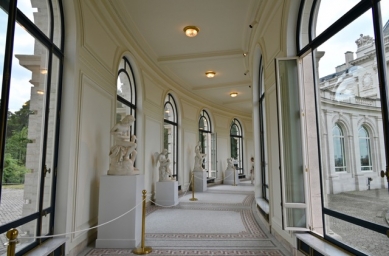
Due to extensive renovations, the palace remained closed for four years, and scaffolding covered its façade for many months. Workers restored the façade, replaced approximately 700 windows, repaired stone elements, mosaic floors, and interior lighting.
The Brussels Royal Palace appears perhaps less striking from the outside than the famous Buckingham Palace, but its main façade is actually half again as long, according to a Belgian guide. However, with a total area of 33,000 square meters, it is less than half the size. Construction took place gradually from the 18th century, and it only took on its current form during the reign of Leopold II at the turn of the 19th and 20th centuries.
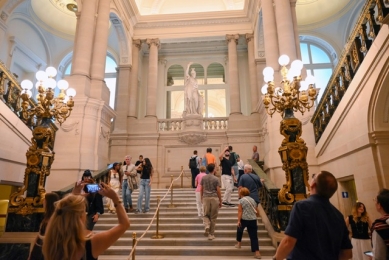
Upon entering the palace, visitors are greeted by giant portraits of both King Philippe and Queen Mathilde. The main staircase and entrance vestibule were designed by court architect Alphonse Balat, who was the teacher of Victor Horta, the most significant Belgian architect and one of the fathers of Art Nouveau. The monumental staircase feels more like an entrance to an opera than an office.
Unlike most historical castles, visitors pass through representative halls that still serve their original purpose. It is here that the Belgian king receives foreign presidents, prime ministers, or new ambassadors. Thus, they are not just museum exhibits. At the end of one of the halls are panels with photographs of some guests that the king has welcomed in the past two years, including a photo with Czech President Petr Pavel.
The most representative room in the palace is the Throne Room, which was created during the reign of Leopold II at the end of the 19th century and is decorated with red curtains and gilded ornaments. Attention during the tour is also drawn to dozens of monumental chandeliers. Nearly every hall is adorned with them.
Among the most interesting interiors that can now be explored is the Mirror Room, which often forms long queues. Everyone wants to photograph the installation by Belgian artist Jan Fabre. At first glance, it is a blue-green sparkling mosaic reminiscent of the sky; in reality, it is a work made from about 1.5 million shells of tropical beetles.
Fabre has explained in many interviews that no beetles were killed for the artwork. The shells primarily came from Thailand, but also from Indonesia and Malaysia, where these beetles are part of the diet. After consuming the bodies, the hard shells remain as waste, which is used, for example, in the production of jewelry and decorations. Fabre obtained them through universities, traders, and local markets, he described in an interview with Sculpture magazine.
It took the Belgian artist approximately three years to collect the necessary amount of shells. The actual installation in the Brussels palace then took about four months. For the ceiling, Fabre worked with 29 assistants, who glued the individual shells by hand next to each other according to a pre-prepared design.
Visitors can see not only the restored representative halls but also several new temporary exhibitions. One of them tells the story of the first Belgian queen, Louise Marie of Orléans.
Admission is 10 euros; children under thirteen years old enter for free. At the end of the tour, visitors pass through a part of the garden that is usually not accessible to the public, and in a small shop, it is possible to buy souvenirs featuring the royal family, photos, postcards, and books about Belgium and its history.
Sixty-six-year-old Philippe is the seventh king since the establishment of Belgium in 1830. He has ruled the country since July 21, 2013, when his father Albert II abdicated for health reasons after 20 years on the throne. With Queen Mathilde, who is 13 years younger, he has daughters Elisabeth and Eléonore and sons Gabriel and Emmanuel.
Due to extensive renovations, the palace remained closed for four years, and scaffolding covered its façade for many months. Workers restored the façade, replaced approximately 700 windows, repaired stone elements, mosaic floors, and interior lighting.
The Brussels Royal Palace appears perhaps less striking from the outside than the famous Buckingham Palace, but its main façade is actually half again as long, according to a Belgian guide. However, with a total area of 33,000 square meters, it is less than half the size. Construction took place gradually from the 18th century, and it only took on its current form during the reign of Leopold II at the turn of the 19th and 20th centuries.
Upon entering the palace, visitors are greeted by giant portraits of both King Philippe and Queen Mathilde. The main staircase and entrance vestibule were designed by court architect Alphonse Balat, who was the teacher of Victor Horta, the most significant Belgian architect and one of the fathers of Art Nouveau. The monumental staircase feels more like an entrance to an opera than an office.
Unlike most historical castles, visitors pass through representative halls that still serve their original purpose. It is here that the Belgian king receives foreign presidents, prime ministers, or new ambassadors. Thus, they are not just museum exhibits. At the end of one of the halls are panels with photographs of some guests that the king has welcomed in the past two years, including a photo with Czech President Petr Pavel.
The most representative room in the palace is the Throne Room, which was created during the reign of Leopold II at the end of the 19th century and is decorated with red curtains and gilded ornaments. Attention during the tour is also drawn to dozens of monumental chandeliers. Nearly every hall is adorned with them.
Among the most interesting interiors that can now be explored is the Mirror Room, which often forms long queues. Everyone wants to photograph the installation by Belgian artist Jan Fabre. At first glance, it is a blue-green sparkling mosaic reminiscent of the sky; in reality, it is a work made from about 1.5 million shells of tropical beetles.
Fabre has explained in many interviews that no beetles were killed for the artwork. The shells primarily came from Thailand, but also from Indonesia and Malaysia, where these beetles are part of the diet. After consuming the bodies, the hard shells remain as waste, which is used, for example, in the production of jewelry and decorations. Fabre obtained them through universities, traders, and local markets, he described in an interview with Sculpture magazine.
It took the Belgian artist approximately three years to collect the necessary amount of shells. The actual installation in the Brussels palace then took about four months. For the ceiling, Fabre worked with 29 assistants, who glued the individual shells by hand next to each other according to a pre-prepared design.
Visitors can see not only the restored representative halls but also several new temporary exhibitions. One of them tells the story of the first Belgian queen, Louise Marie of Orléans.
Admission is 10 euros; children under thirteen years old enter for free. At the end of the tour, visitors pass through a part of the garden that is usually not accessible to the public, and in a small shop, it is possible to buy souvenirs featuring the royal family, photos, postcards, and books about Belgium and its history.
Sixty-six-year-old Philippe is the seventh king since the establishment of Belgium in 1830. He has ruled the country since July 21, 2013, when his father Albert II abdicated for health reasons after 20 years on the throne. With Queen Mathilde, who is 13 years younger, he has daughters Elisabeth and Eléonore and sons Gabriel and Emmanuel.
The English translation is powered by AI tool. Switch to Czech to view the original text source.



0 comments
add comment