
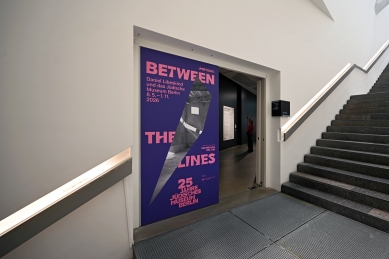
Daniel Libeskind: Between the Lines - 25 Years of the Jewish Museum in Berlin
7.5. - 31.10.2026
After the fall of the Berlin Wall, the capital of reunified Germany became one of the largest construction sites and also a popular destination for student excursions. Just a few months before the end of the communist regime, two architecturally groundbreaking events took place in West Berlin. The first was the victory of the then relatively unknown American architect Steven Holl in the competition for the expansion of the Amerika-Gedenkbibliothek, which ultimately did not come to fruition due to turbulent political changes. The second was a highly contested competition for a new Jewish Museum, where the Polish-born architect Daniel Libeskind, who had no realizations at the time but had great potential to create a building that would leave a strong impact on every visitor, emerged victorious.
After studying accordion in Israel, Libeskind traveled to New York in 1965 to study architecture under John Hejduk at the Cooper Union. Before graduating, he worked briefly in the studio of Richard Meier, and in the same year that the publication Five Architects (Wittenborn, 1972) was released, he managed to briefly familiarize himself with the activities of Eisenman's IAUS (Institute for Architecture and Urban Studies). Thus, at the turn of the 60s and 70s, Libeskind could personally meet most of the famous New York Five. In addition to his own design studio, Libeskind taught and later headed the Institute of Architecture at the Cranbrook Academy of Art in Bloomfield Hills from 1978 to 1985. The outputs from Libeskind's studio, which included a set of detailed drawings “Micromegas“ (1979) and mobile wooden models “Three Architectural Lessons“ (1985), evoked unrest and partially resembled the work of his teacher from Cooper Union.
During the summer (June 23 - August 30) of 1988, Daniel Libeskind participated in the exhibition Deconstructivist architecture at New York's MoMA, where he was selected by curators Philip Johnson and Mark Wigley, who introduced the emerging avant-garde to the world, including Zaha Hadid, Frank Gehry, Rem Koolhaas, and Bernard Tschumi. Libeskind, who at that time was operating a private institute called Architecture Intermundium in Milan, presented his winning project City Edge (Urban Edge) for Berlin from 1987, in which he designed a prominent linear object floating on slanted columns above the terrain, looking over the Berlin Wall. The drawings referenced previous detailed images “micromegas“, while the model anticipated the future winning design of the Jewish Museum.
In June 1989, when the jury chairman J.P. Kleihues announced the results of the international competition for the new Jewish Museum in Berlin, Libeskind was 43 years old and was still waiting for his first realization. However, he had to wait another twelve years for completion. In the meantime, he managed to win and realize another “museum without exit” in Osnabrück dedicated to painter Felix Nussbaum, who was murdered in the Auschwitz concentration camp.
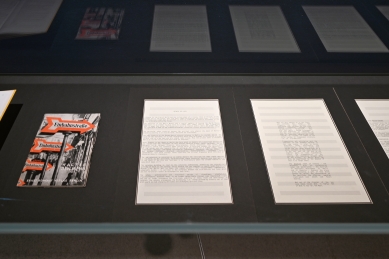
Libeskind's Berlin project titled “Between the Lines“ written on sheet music referred in form to the indescribable feelings that the building was intended to convey, and any interested parties should understand them from the hints between the lines. While Frank Gehry, a peer from the deconstructivist exhibition in New York, never bothered with theoretical interpretations of his buildings, for Libeskind's early work, the concept was a cornerstone.
I would like to add a brief memory of my own study years when Jiří Oplatek came to our diploma studio at the VUT in December 2002, and instead of discussing his successful practice in Basel, Switzerland, he decided to dedicate the entire lecture to describing Libeskind's freshly completed museum. Jiří Oplatek did not stay with mere descriptions of the urban contexts and sharp forms of the proposed building, but revealed the musical inspiration that Libeskind drawn from Schönberg's unfinished opera Moses and Aaron (1923-37). The atonal music composed with twelve tones represented a similarly revolutionary endeavor in its time. Besides the story that the opera conveyed (the truth cannot be communicated in words, and there is only one name of God, which must not be spoken or depicted), Libeskind was fascinated by the sheet music itself, which he attempted to translate into his floor plan design, where Aaron's song represented the line of the torn Star of David, and Moses's spoken words with their pauses represented empty spaces that visitors could glimpse through narrow slits but could never physically enter. After Oplatek's introduction to Libeskind's thought processes, we then began to economize the word concept in our studio, knowing that compared to Libeskind's carefully constructed narrative, each of our architectural attempts would significantly falter.
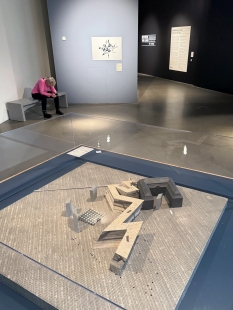
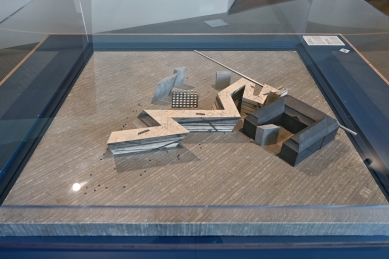
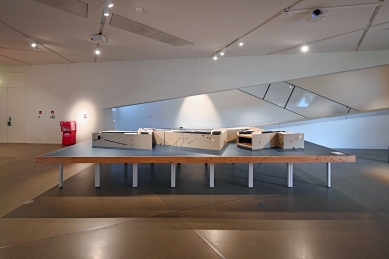
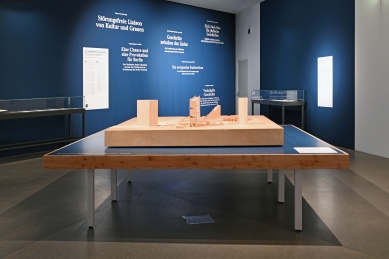
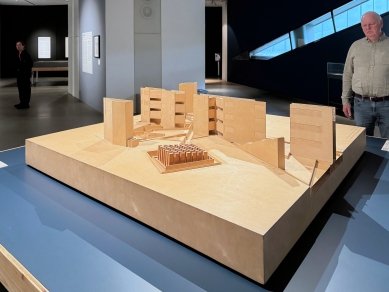
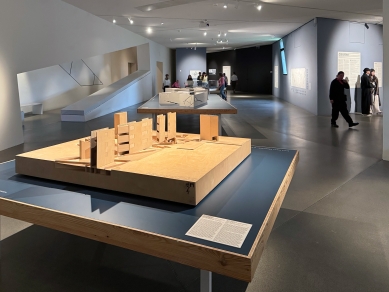
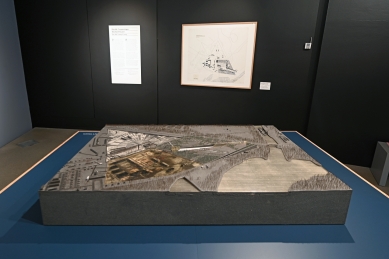
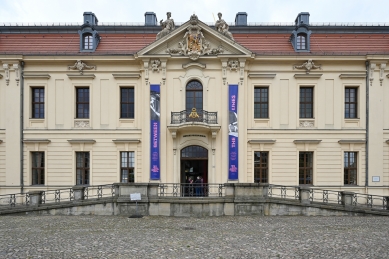
Libeskind added a new southern wing to the Baroque Kollegienhaus (Philipp Gerlach, 1735), where he not only placed exhibits but also depicted the fate of Jewish inhabitants before, during, and after World War II through his building. The axis of the new building is slightly rotated at 12º relative to the original building, referencing the twelve equalized tones in Schönberg's compositions. The museum sparked public interest during its construction even without a deeper understanding of the theoretical background. The impressive form of the cast-in-place concrete shell, which featured openings resembling wounds, was a restrained version of the original competition design with expressively tilted exterior walls (this model is part of the current exhibition in the ground floor hall of Eric F. Ross).
The Japanese magazine Kenchiku Bunka dedicated an entire monographic issue in December 1995 to the unfinished torso of the museum. After the building was completed in 1999, the museum became accessible to the public, allowing them to experience the strong impressions from the empty spaces. The official opening of the museum with exhibitions took place two years later in September 2021. Those who had the opportunity to visit the museum during construction or immediately after its completion without exhibits were not as impressed by the final form. In the memoir by Miroslav Masák So It Was, Libeskind's first work did not appear. The world of speculative deconstructivism was distant to him, but nonetheless, Professor Masák took the opportunity to visit the museum (a social housing project by SIAL was realized just a few dozen meters from the Jewish Museum as part of IBA'87) even before the cladding with titanium sheeting, and he had to acknowledge that the unfinished object contained a stronger message than the completed building filled with objects. An empty museum would, however, be difficult to justify to the public. Even so, visitors had to become accustomed to a completely innovative spatial scheme and an unadorned raw aesthetic.
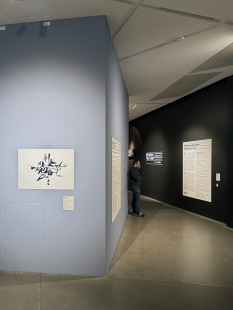
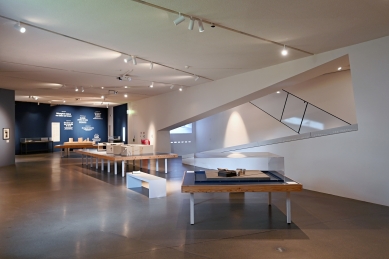
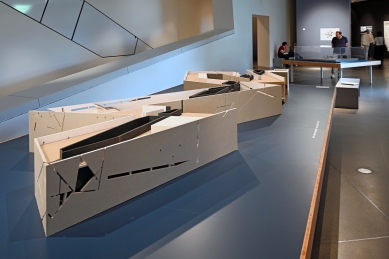
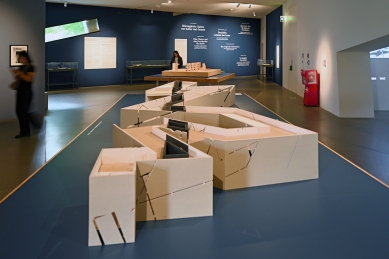
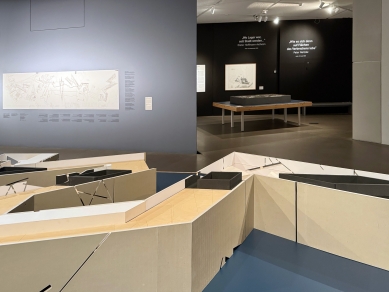
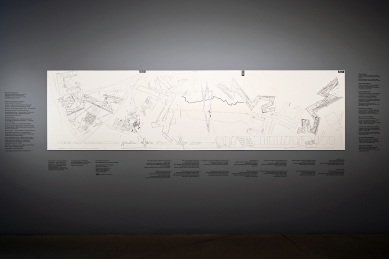
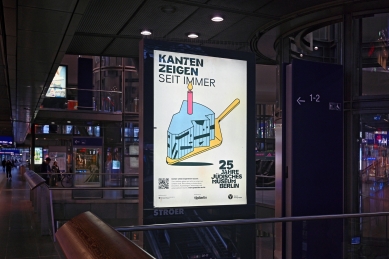
The exhibition Between the Lines not only commemorates a quarter century since the opening of the Jewish Museum in Berlin's Kreuzberg but also celebrates the eightieth anniversary of the building's author. In the Eric F. Ross Gallery, in addition to the model of the winning design, you can also browse through a catalog featuring dozens of other competition proposals. Other exhibits include volume models that reveal and help better understand the author's intention of three paths and the interrupted empty axis. You can also see photos from the competition proceedings, chaired by J.P. Kleihues, the original accompanying report written on sheet music, and also an early sketch where Libeskind not only addressed the assigned parcel but also connected his design with the story of the entire city and the personalities who lived in it (in the sketch, he directly mentions architect Mies van der Rohe and Romanian poet Paul Celan). The exhibition is supplemented by the winning project MoUrning (Grief) from 1992, addressing the area of Nazi barracks next to the Sachsenhausen concentration camp memorial (Hans Günter Merz, 2005) in Oranienburg on the northern outskirts of Berlin, where Libeskind questioned the original assignment and instead of classic development created a series of notches where sorrow and hope coexist - so that future generations will never forget. In the side corridor of the Eric F. Ross Gallery, you can recall a time-lapse film documenting the construction of the museum.
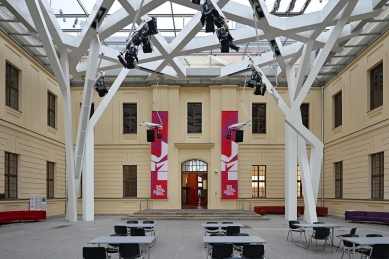
In 2003, Libeskind moved his studio to New York, where he planned to focus on the redevelopment of the WTC site, but over the years he repeatedly returned to the Berlin Jewish Museum project, where he gradually designed a new entrance (2005), roofing for the courtyard (2007), and an academy (2012).
In the past three decades, Libeskind has realized dozens of buildings around the world (one is soon to be built in Prague as well), but his first work should be mandatory for visits even for those who are not particularly fond of deconstructivist aesthetics.
The exhibition Between the Lines is free to view until the end of October.
More information >
After studying accordion in Israel, Libeskind traveled to New York in 1965 to study architecture under John Hejduk at the Cooper Union. Before graduating, he worked briefly in the studio of Richard Meier, and in the same year that the publication Five Architects (Wittenborn, 1972) was released, he managed to briefly familiarize himself with the activities of Eisenman's IAUS (Institute for Architecture and Urban Studies). Thus, at the turn of the 60s and 70s, Libeskind could personally meet most of the famous New York Five. In addition to his own design studio, Libeskind taught and later headed the Institute of Architecture at the Cranbrook Academy of Art in Bloomfield Hills from 1978 to 1985. The outputs from Libeskind's studio, which included a set of detailed drawings “Micromegas“ (1979) and mobile wooden models “Three Architectural Lessons“ (1985), evoked unrest and partially resembled the work of his teacher from Cooper Union.
During the summer (June 23 - August 30) of 1988, Daniel Libeskind participated in the exhibition Deconstructivist architecture at New York's MoMA, where he was selected by curators Philip Johnson and Mark Wigley, who introduced the emerging avant-garde to the world, including Zaha Hadid, Frank Gehry, Rem Koolhaas, and Bernard Tschumi. Libeskind, who at that time was operating a private institute called Architecture Intermundium in Milan, presented his winning project City Edge (Urban Edge) for Berlin from 1987, in which he designed a prominent linear object floating on slanted columns above the terrain, looking over the Berlin Wall. The drawings referenced previous detailed images “micromegas“, while the model anticipated the future winning design of the Jewish Museum.
In June 1989, when the jury chairman J.P. Kleihues announced the results of the international competition for the new Jewish Museum in Berlin, Libeskind was 43 years old and was still waiting for his first realization. However, he had to wait another twelve years for completion. In the meantime, he managed to win and realize another “museum without exit” in Osnabrück dedicated to painter Felix Nussbaum, who was murdered in the Auschwitz concentration camp.
Libeskind's Berlin project titled “Between the Lines“ written on sheet music referred in form to the indescribable feelings that the building was intended to convey, and any interested parties should understand them from the hints between the lines. While Frank Gehry, a peer from the deconstructivist exhibition in New York, never bothered with theoretical interpretations of his buildings, for Libeskind's early work, the concept was a cornerstone.
I would like to add a brief memory of my own study years when Jiří Oplatek came to our diploma studio at the VUT in December 2002, and instead of discussing his successful practice in Basel, Switzerland, he decided to dedicate the entire lecture to describing Libeskind's freshly completed museum. Jiří Oplatek did not stay with mere descriptions of the urban contexts and sharp forms of the proposed building, but revealed the musical inspiration that Libeskind drawn from Schönberg's unfinished opera Moses and Aaron (1923-37). The atonal music composed with twelve tones represented a similarly revolutionary endeavor in its time. Besides the story that the opera conveyed (the truth cannot be communicated in words, and there is only one name of God, which must not be spoken or depicted), Libeskind was fascinated by the sheet music itself, which he attempted to translate into his floor plan design, where Aaron's song represented the line of the torn Star of David, and Moses's spoken words with their pauses represented empty spaces that visitors could glimpse through narrow slits but could never physically enter. After Oplatek's introduction to Libeskind's thought processes, we then began to economize the word concept in our studio, knowing that compared to Libeskind's carefully constructed narrative, each of our architectural attempts would significantly falter.
Libeskind added a new southern wing to the Baroque Kollegienhaus (Philipp Gerlach, 1735), where he not only placed exhibits but also depicted the fate of Jewish inhabitants before, during, and after World War II through his building. The axis of the new building is slightly rotated at 12º relative to the original building, referencing the twelve equalized tones in Schönberg's compositions. The museum sparked public interest during its construction even without a deeper understanding of the theoretical background. The impressive form of the cast-in-place concrete shell, which featured openings resembling wounds, was a restrained version of the original competition design with expressively tilted exterior walls (this model is part of the current exhibition in the ground floor hall of Eric F. Ross).
The Japanese magazine Kenchiku Bunka dedicated an entire monographic issue in December 1995 to the unfinished torso of the museum. After the building was completed in 1999, the museum became accessible to the public, allowing them to experience the strong impressions from the empty spaces. The official opening of the museum with exhibitions took place two years later in September 2021. Those who had the opportunity to visit the museum during construction or immediately after its completion without exhibits were not as impressed by the final form. In the memoir by Miroslav Masák So It Was, Libeskind's first work did not appear. The world of speculative deconstructivism was distant to him, but nonetheless, Professor Masák took the opportunity to visit the museum (a social housing project by SIAL was realized just a few dozen meters from the Jewish Museum as part of IBA'87) even before the cladding with titanium sheeting, and he had to acknowledge that the unfinished object contained a stronger message than the completed building filled with objects. An empty museum would, however, be difficult to justify to the public. Even so, visitors had to become accustomed to a completely innovative spatial scheme and an unadorned raw aesthetic.
The exhibition Between the Lines not only commemorates a quarter century since the opening of the Jewish Museum in Berlin's Kreuzberg but also celebrates the eightieth anniversary of the building's author. In the Eric F. Ross Gallery, in addition to the model of the winning design, you can also browse through a catalog featuring dozens of other competition proposals. Other exhibits include volume models that reveal and help better understand the author's intention of three paths and the interrupted empty axis. You can also see photos from the competition proceedings, chaired by J.P. Kleihues, the original accompanying report written on sheet music, and also an early sketch where Libeskind not only addressed the assigned parcel but also connected his design with the story of the entire city and the personalities who lived in it (in the sketch, he directly mentions architect Mies van der Rohe and Romanian poet Paul Celan). The exhibition is supplemented by the winning project MoUrning (Grief) from 1992, addressing the area of Nazi barracks next to the Sachsenhausen concentration camp memorial (Hans Günter Merz, 2005) in Oranienburg on the northern outskirts of Berlin, where Libeskind questioned the original assignment and instead of classic development created a series of notches where sorrow and hope coexist - so that future generations will never forget. In the side corridor of the Eric F. Ross Gallery, you can recall a time-lapse film documenting the construction of the museum.
In 2003, Libeskind moved his studio to New York, where he planned to focus on the redevelopment of the WTC site, but over the years he repeatedly returned to the Berlin Jewish Museum project, where he gradually designed a new entrance (2005), roofing for the courtyard (2007), and an academy (2012).
In the past three decades, Libeskind has realized dozens of buildings around the world (one is soon to be built in Prague as well), but his first work should be mandatory for visits even for those who are not particularly fond of deconstructivist aesthetics.
The exhibition Between the Lines is free to view until the end of October.
More information >
The English translation is powered by AI tool. Switch to Czech to view the original text source.
0 comments
add comment
Related articles
0
11.05.2026 | Daniel Libeskind will celebrate his eightieth birthday
0
08.11.2010 | Invitation to the lecture by Martin Link "Daniel Libeskind's Villa and the Jewish Museum in Berlin"
0
01.11.2010 | Architecture is a language. Daniel Libeskind in Ostrava.
0
29.08.2010 | Exhibition "Daniel Libeskind: Architecture is a Language"