
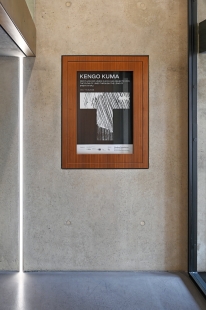
Kengo Kuma: The Magic of the Gaze by Erieta Attali - exhibition at Tchoban Foundation
13.6 - 13.9.2026
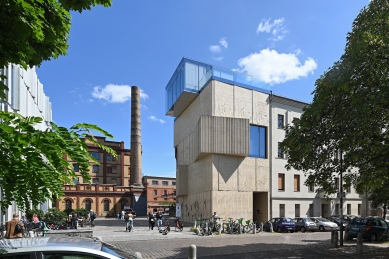
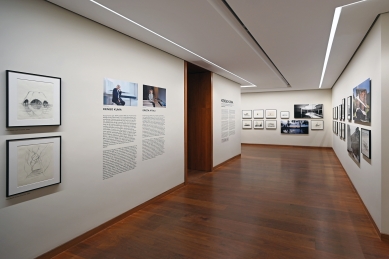
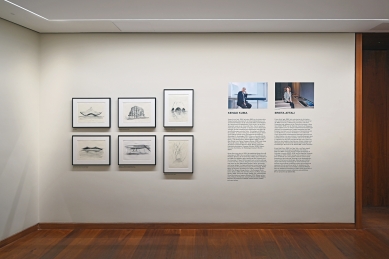
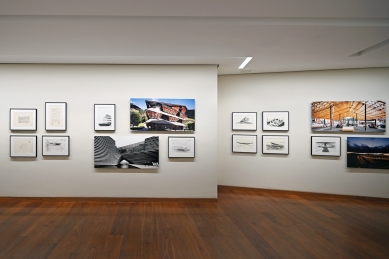
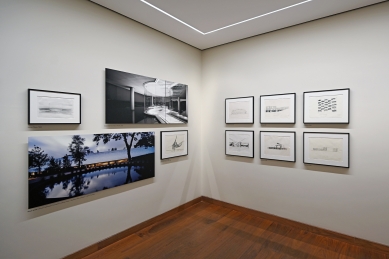
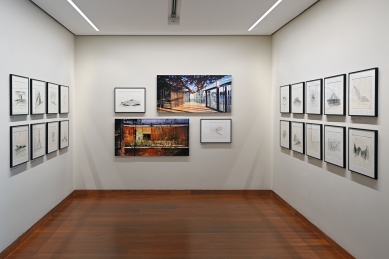
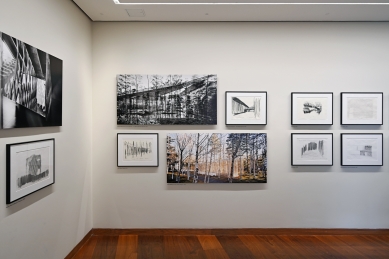
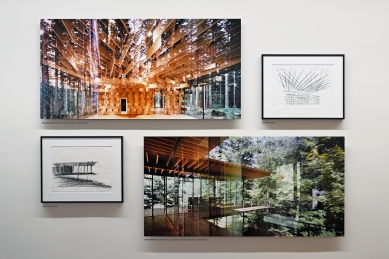
As the name of the institution suggests, the Berlin Museum of Architectural Drawing focuses primarily on showcasing sketches, drawings, and paintings that precede design work, navigating through authorities, negotiating with contractors, and overseeing construction. It is rare to see plans, models, or photographs at the Tchoban Foundation, which we commonly associate with architectural exhibitions. This time, alongside 86 drawings by Japanese architect Kengo Kuma, the exhibition also features 18 large-format images by Erieta Attali on both floors. Kuma's office has been collaborating with this Israel-born photographer, who alternates between Paris and New York, for over two decades. Attali became acquainted with Kuma's work in 2001 during her studies at Columbia University in New York. A year later, she had the opportunity to photograph the Water/Glass villa in the Japanese city of Atami. This glass structure set on a reflective water surface is a contemporary interpretation of the imperial Katsura Palace through new materials. Kuma's design also sensitively responds to the neighboring Hyuga villa from the 1930s by German architect Bruno Taut. Since then, Erieta Attali has captured dozens of Kuma's realizations through her camera lens.
Nadeja Bartels, the director of the Tchoban Foundation, finds a historical parallel in her introductory text to the exhibition with Le Corbusier and the Hungarian-born photographer Lucien Hervé, who began their collaboration in 1949 and continued to document not only the finished buildings but also the course of realization and daily life until the architect's death in 1965. Another international example of collaboration between an architect and a staff photographer is Finnish-American architect Eero Saarinen, who in 1955 appointed Hungarian photographer Balthazar Korab to document the entire design process, including taking photos of models and buildings during construction. Unfortunately, this bond was tragically cut short by Saarinen's premature death six years later. Among contemporary examples, the work of Portuguese photographer Fernanda Guerry stands out, having open access to the studio of Álvaro Siza and accompanying this legend on his travels. In Central European conditions, it is essential to mention the work of the married couple, Austrian photographer Margherita Spiluttini and her husband Adolf Krischanitz. In the Czech context, Pavel Štecha documented the events surrounding the Liberec SIAL in great detail. From the present day, one could mention the long-standing collaboration of photographer Ester Havlová with the studio of Roman Koucký or photographer Jan Malý with Josef Pleskot.
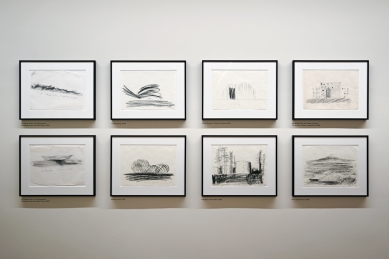
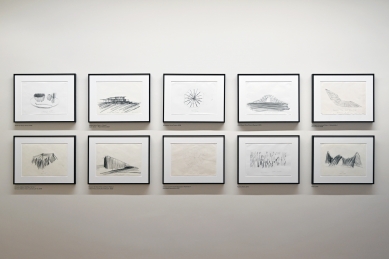
Barry Bergdoll, who is a curator and a professor of art history at Columbia University in New York, attempted an analysis of Kuma's drawings, seeking the foundational atmosphere of future buildings shaped by years of experience and intuition. Even the most tangible construction arises from light lines drawn on paper. It acquires weight only later through the relocation of materials on the construction site. Even the drawing can reflect the materials used. Initially, drawing with a stick on the ground took place directly on the construction site. With the establishment of art schools, drawing increasingly moved away from construction sites. Subsequently, the spatial object was more abstracted into floor plans, sections, views, and details. A distant communication between the drawing board and the construction site became established. However, sketching resists these conventions. It allows for free exploration. Through sketches, we enter the architect's private world, where he creates personal notes, records thoughts, and often draws even without precise assignments or a specific construction program. A piece of charcoal that Kengo Kuma likes to use when drawing, in a certain sense, frees him from static burdens. A sketch may often be legible only to its creator. In many cases, however, the architect's lines can anticipate the future experiences of viewers or visitors. Sketches can be much more immediate and convincing than classic plans. They convey architecture even to those not trained in decoding construction documentation.
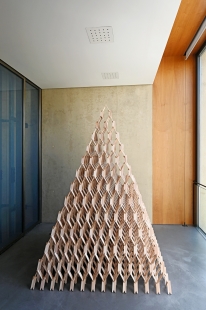
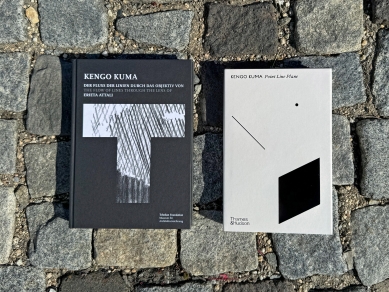
Kuma himself notes that “he wants to create an ambiguous state in which materials change into particles. He does not want to break the essence of architecture itself, but rather transform this dispersion into a certain kind of atmosphere.” In 2020, Kuma published a book Point, Line, Plane (translated into English four years later), where he replaced drawing with a textual accompaniment to his buildings that connects his own work with historical examples and inspirations from the natural world. At the same time, he criticizes what he calls “the object-volume obsession of the history of modern architecture”, from which he seeks to liberate both himself and the users of his buildings. His drawings are part of the project “liberating architecture from form and letting it spread into a world of flickering light.”
While the previous spring exhibition showcased detailed perspectives from the Vienna studio of Otto Wagner, the creation of which took several weeks and involved dozens of talented employees alongside Wagner, the current exhibition presents sketches directly from the pen (brush, charcoal) of Kengo Kuma. Quickly created drawings capture the main idea of the entire design in just a few lines. The resulting charcoal sketches resemble calligraphy. A parallel could be drawn with the drawing expression of Japanese minimalist Tadao Ando. However, there is one essential difference. Ando alternates colors in his sketches, but they still depict the same material, namely exposed concrete. Kuma, on the other hand, uses thick charcoal lines to capture various materials as needed, as well as the atmosphere of the surrounding environment (meadows, forests, rivers). Unlike Ando, Kuma does not favor any specific material. Within his laboratory at Tokyo University, he enjoys experimenting with various materials that have historically been used with structures but have also been developed relatively recently, and one would not automatically associate them with construction.
In the sketches from the early 1990s, one can see detailed pencil drawings and alternating colors of watercolors. However, 35 years ago, Kuma suffered a serious hand injury, and he has not regained full sensation in his fingers (to this day, he cannot button his shirt). Therefore, he now draws more with his wrist and his whole arm. Besides the final lines, he also perceives the rhythm and movement of the body during the sketching process, which resonates not only with the drawing but also with the resulting architecture. This handicap paradoxically allowed Kuma to liberate himself more and not to drown in details. From Kuma's simple drawings emanate relaxation and energy. Kuma himself admits that sketching holds significance for him on two levels. The first is the mutual interaction of the drawing tool with the surface being described. He prefers black charcoal. Sometimes he chooses Japanese handmade paper with a rough texture. At other times, he opts for smooth tracing paper, which is evident not only in the sketch but also translates into the resulting architecture. The dialogue with materials forms the essence of Kuma's architectural practice. By sketching in today’s increasingly virtual time, he maintains direct contact with the material world.
You can view the joint exhibition of Kuma's sketches and Erieta Attali's photographs at the Tchoban Foundation throughout the summer until mid-September.
More information >
Nadeja Bartels, the director of the Tchoban Foundation, finds a historical parallel in her introductory text to the exhibition with Le Corbusier and the Hungarian-born photographer Lucien Hervé, who began their collaboration in 1949 and continued to document not only the finished buildings but also the course of realization and daily life until the architect's death in 1965. Another international example of collaboration between an architect and a staff photographer is Finnish-American architect Eero Saarinen, who in 1955 appointed Hungarian photographer Balthazar Korab to document the entire design process, including taking photos of models and buildings during construction. Unfortunately, this bond was tragically cut short by Saarinen's premature death six years later. Among contemporary examples, the work of Portuguese photographer Fernanda Guerry stands out, having open access to the studio of Álvaro Siza and accompanying this legend on his travels. In Central European conditions, it is essential to mention the work of the married couple, Austrian photographer Margherita Spiluttini and her husband Adolf Krischanitz. In the Czech context, Pavel Štecha documented the events surrounding the Liberec SIAL in great detail. From the present day, one could mention the long-standing collaboration of photographer Ester Havlová with the studio of Roman Koucký or photographer Jan Malý with Josef Pleskot.
Barry Bergdoll, who is a curator and a professor of art history at Columbia University in New York, attempted an analysis of Kuma's drawings, seeking the foundational atmosphere of future buildings shaped by years of experience and intuition. Even the most tangible construction arises from light lines drawn on paper. It acquires weight only later through the relocation of materials on the construction site. Even the drawing can reflect the materials used. Initially, drawing with a stick on the ground took place directly on the construction site. With the establishment of art schools, drawing increasingly moved away from construction sites. Subsequently, the spatial object was more abstracted into floor plans, sections, views, and details. A distant communication between the drawing board and the construction site became established. However, sketching resists these conventions. It allows for free exploration. Through sketches, we enter the architect's private world, where he creates personal notes, records thoughts, and often draws even without precise assignments or a specific construction program. A piece of charcoal that Kengo Kuma likes to use when drawing, in a certain sense, frees him from static burdens. A sketch may often be legible only to its creator. In many cases, however, the architect's lines can anticipate the future experiences of viewers or visitors. Sketches can be much more immediate and convincing than classic plans. They convey architecture even to those not trained in decoding construction documentation.
Kuma himself notes that “he wants to create an ambiguous state in which materials change into particles. He does not want to break the essence of architecture itself, but rather transform this dispersion into a certain kind of atmosphere.” In 2020, Kuma published a book Point, Line, Plane (translated into English four years later), where he replaced drawing with a textual accompaniment to his buildings that connects his own work with historical examples and inspirations from the natural world. At the same time, he criticizes what he calls “the object-volume obsession of the history of modern architecture”, from which he seeks to liberate both himself and the users of his buildings. His drawings are part of the project “liberating architecture from form and letting it spread into a world of flickering light.”
While the previous spring exhibition showcased detailed perspectives from the Vienna studio of Otto Wagner, the creation of which took several weeks and involved dozens of talented employees alongside Wagner, the current exhibition presents sketches directly from the pen (brush, charcoal) of Kengo Kuma. Quickly created drawings capture the main idea of the entire design in just a few lines. The resulting charcoal sketches resemble calligraphy. A parallel could be drawn with the drawing expression of Japanese minimalist Tadao Ando. However, there is one essential difference. Ando alternates colors in his sketches, but they still depict the same material, namely exposed concrete. Kuma, on the other hand, uses thick charcoal lines to capture various materials as needed, as well as the atmosphere of the surrounding environment (meadows, forests, rivers). Unlike Ando, Kuma does not favor any specific material. Within his laboratory at Tokyo University, he enjoys experimenting with various materials that have historically been used with structures but have also been developed relatively recently, and one would not automatically associate them with construction.
In the sketches from the early 1990s, one can see detailed pencil drawings and alternating colors of watercolors. However, 35 years ago, Kuma suffered a serious hand injury, and he has not regained full sensation in his fingers (to this day, he cannot button his shirt). Therefore, he now draws more with his wrist and his whole arm. Besides the final lines, he also perceives the rhythm and movement of the body during the sketching process, which resonates not only with the drawing but also with the resulting architecture. This handicap paradoxically allowed Kuma to liberate himself more and not to drown in details. From Kuma's simple drawings emanate relaxation and energy. Kuma himself admits that sketching holds significance for him on two levels. The first is the mutual interaction of the drawing tool with the surface being described. He prefers black charcoal. Sometimes he chooses Japanese handmade paper with a rough texture. At other times, he opts for smooth tracing paper, which is evident not only in the sketch but also translates into the resulting architecture. The dialogue with materials forms the essence of Kuma's architectural practice. By sketching in today’s increasingly virtual time, he maintains direct contact with the material world.
You can view the joint exhibition of Kuma's sketches and Erieta Attali's photographs at the Tchoban Foundation throughout the summer until mid-September.
More information >
The English translation is powered by AI tool. Switch to Czech to view the original text source.
0 comments
add comment
Related articles
0
04.05.2026 | Otto Wagner: Architect of Modern Life - Exhibition at Tchoban Foundation
0
02.03.2026 | Kumova sound-imaginary creation - exhibition at Casa da Arquitectura
0
25.04.2025 | To the exhibition of Steven Holl at the Tchoban Foundation in Berlin
0
02.01.2017 | Kengo Kuma / Woven - exhibition at GAB
0
12.10.2016 | Interview with Kengo Kumou
0
26.10.2015 | <Muzeum architektonických výkresů projektuje i na fasádě> translates to <The Museum of Architectural Drawings is also projected on the facade>