Antoni Gaudí – mystical architect of Spanish Art Nouveau
 |
Gaudí's note for his Casa Batlló project could serve as the motto of today's futuristic architecture: "Corners will disappear and matter will abundantly appear in its astral forms, the sun will penetrate from all four sides, and it will be like a vision of paradise." He was also ahead of his time with his ecological approach. He used broken tiles, children's toys, old needles, clay, and fired bricks from industrial furnaces. His unmistakable style was influenced by Neo-Gothic, Art Nouveau, oriental art, but most of all by himself.
He soon became one of the most significant architects in Barcelona. Prominent citizens and entrepreneurs entrusted this young man with a strong character and a pronounced relationship with nature with important projects. "He was a genius,” says Xavier Villanueva enthusiastically, the chief architect of Casa Batlló, which nearly two million visitors visited in 2024 according to AFP: "He knew how to touch people in their deepest essence."
His Barcelona houses act as oases amid many functional buildings. The roof of Casa Batlló resembles the back of a prehistoric lizard; the columns take the form of bones; the facade with wavy balconies plays with all colors and is covered with small broken tiles. Another of his houses, Casa Milá, with its wavy facade also colors reminiscent of sand dunes. This huge corner block, in which it would be difficult to find a straight wall, earned the nickname La Pedrera (the quarry) from critics.
Gaudí's life was full of contrasts. In his youth, he openly criticized the Church; as a mature forty-year-old, he held long fasts that seriously threatened his health. He dedicated the last 16 years of his life to building his unfinished masterpiece, the Sagrada Família. During that time, he also stopped caring about his appearance, so when a tram hit him in early June 1926, he was initially mistaken for a beggar. He died a few days later at the age of 73, and thousands of people accompanied him on his final journey to the crypt of his beloved cathedral.
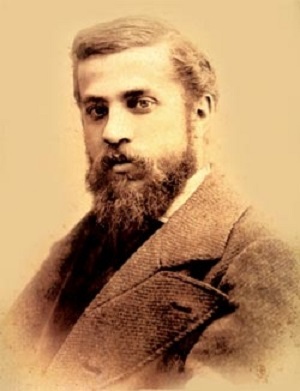
The architect, known for his moodiness, remained single throughout his life, despised admirers and, according to his biographers, even refused to be photographed – which is ironic given that today millions of people visit his works, and they have become a symbol of mass tourism in Barcelona. Almost five million people visited his master temple last year, which is nearly half the entire population of the Czech Republic.
The atypical blond with blue eyes for a Spaniard was born on June 25, 1852, into a deeply religious family. In childhood, he was often ill. Following a lung infection, he developed rheumatoid arthritis, which sometimes made it hard for him to walk. The reputation of a loner accompanied him for most of his life. While studying architecture in Barcelona, he still attended society events, but later avoided them, living in complete devotion to his artistic work, with his only distraction being his daily trip to church to pray.
He created something very personal and captivating. He was unafraid to break the architectural rules of his day. He rarely stuck to plans; he preferred three-dimensional models that he altered during construction according to continually new visions. For inspiration, he went into nature, which was for him a "great book," in which he spent hours observing since childhood when he could not play with other children due to his weak health.
He received his first independent commission in 1878 from industrialist Manuel Vicens. In building his residence, Casa Vicens, he broke away from known styles and was inspired by Islamic architecture, combining brick row construction with colorful tiles. A similar, but even more fairy-tale-like creation is Gaudí's summer villa in Comillas near Santander, which earned the nickname El Capricho (Whim).
A fateful encounter for Gaudí was with patron Eusebi Güell. For him, he built a palace in the heart of Barcelona, using a parabolic arch in its two enormous iron grid gates. As with many other buildings, he also designed the luxurious interiors, including furniture. The grand project of a garden city, started in 1900, was interrupted by World War I, so today visitors to Güell Park can admire only rows of slanted columns, two villas (one of which houses a Gaudí museum), and from the terrace with a wavy bench covered in mosaics, they can observe Barcelona.
Gaudí, also known as God's architect, accepted celibacy in his mature age. His faith and unconventional approach to nature awakened in him a deeply spiritual dimension. Many of his contemporaries and biographers described his visionary nature and perception of space as mystical. The Roman Catholic Church declared him venerable last April, which is the first step towards his beatification and then sainthood.
The English translation is powered by AI tool. Switch to Czech to view the original text source.
0 comments
add comment